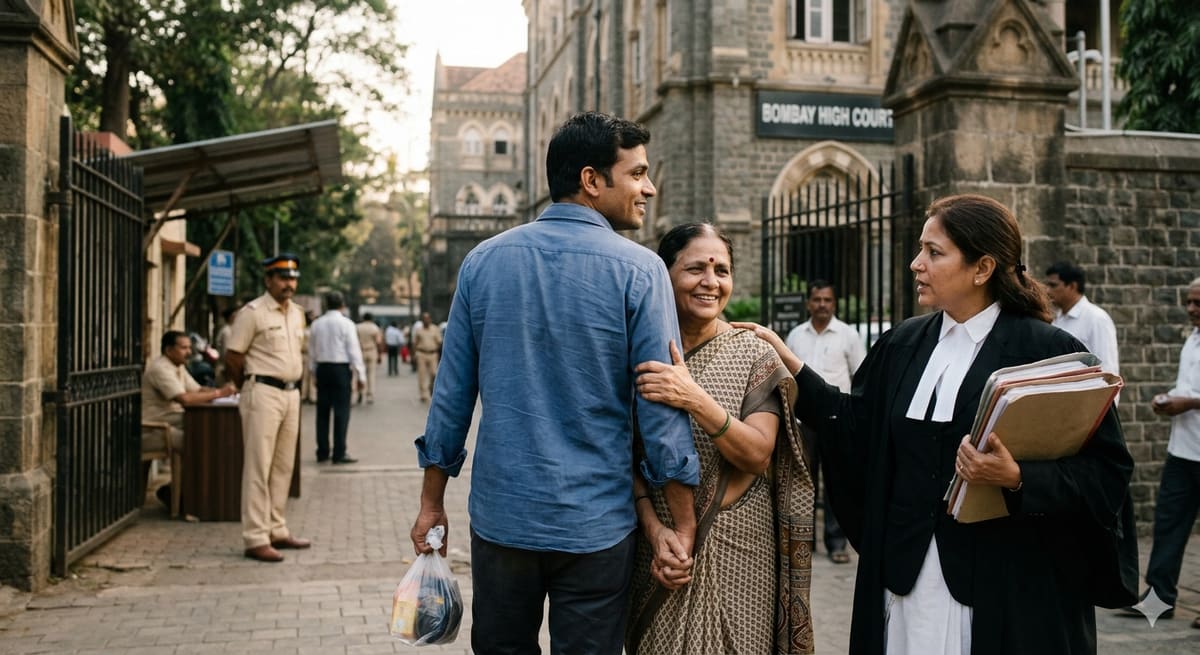
The Bombay High Court has granted bail to four accused in a serious case involving grievous injuries, holding that once the charge-sheet is filed and recoveries are complete, continued custody lacks justification. The judgment reinforces that bail is the norm and incarceration the exception, even in cases under the Bharatiya Nyaya Sanhita, 2023.
Background & Facts
The Dispute
The dispute arose from a violent clash between two rival political groups in Pimpalner village, District Beed, following an RTI request filed by the informant seeking information about the gram panchayat. The altercation resulted in the informant sustaining multiple fractures to the leg, hand, back, and head, allegedly inflicted using an iron rod and wooden stick.
Key Facts
The incident occurred on 26.03.2026 and led to registration of Crime No.83 of 2026 at Pimpalner Police Station
The accused persons are Sudhakar @ Sudam Baburao Padule, Kamalesh Sopan Borwade, Pradip Sandipan Sonawane, and Santosh Vitthalrao Patil (Gund)
The offences charged include Sections 109, 118(2), 126(2), 190, 191(2), 191(3), 324(4), 351(2), and 352 of the Bharatiya Nyaya Sanhita, 2023, read with Sections 4 and 25 of the Arms Act and Sections 3 and 7 of the Criminal Law Amendment Act
Medical certificates confirmed grievous injuries including fractures
Recoveries of weapons and other evidence were completed from the accused
The charge-sheet was filed before the bail application
All injured persons were discharged from hospital and no longer undergoing treatment
Procedural History
26.03.2026: Crime No.83 of 2026 registered at Pimpalner Police Station
01.04.2026: Accused taken into custody
Before 17.06.2026: Investigation completed and charge-sheet filed
17.06.2026: Bail application filed before Bombay High Court, Aurangabad Bench
The Parties' Positions
For the Applicants: Learned counsel argued that the investigation is complete, recoveries have been effected, and the custodial presence of the accused is no longer necessary. They emphasized that the accused have been in custody since 01.04.2026 and that there is no risk of evidence tampering or flight.
For the Respondent-State: The Additional Public Prosecutor contended that the allegations are serious, cross-cases have been registered, and weapons remain unrecovered from absconding co-accused. He warned that granting bail may lead to renewed violence and law and order issues.
Relief Sought
The Applicants sought release on bail with appropriate conditions, arguing that their continued detention was unjustified after completion of investigation and recovery of evidence.
The Legal Issue
The central question was whether continued custody of the accused is warranted under Section 439 of the Code of Criminal Procedure when the charge-sheet has been filed, recoveries are complete, and the accused have been in custody for over a month, despite the gravity of the alleged offences.
Arguments Presented
For the Appellant/Petitioner
Learned counsel relied on the principle that bail is the rule and jail the exception. He submitted that the investigation is closed, the charge-sheet filed, and all recoveries made from the accused. He emphasized that the accused have no history of absconding and that their detention beyond the completion of investigation serves no legitimate purpose under Section 167 CrPC. He further noted that the injured parties have been discharged and are no longer in medical danger.
For the Respondent/State
The Additional Public Prosecutor argued that the offences under the Bharatiya Nyaya Sanhita, 2023, are serious and involve grievous hurt with weapons. He contended that cross-cases exist, absconding accused remain at large, and some weapons have not yet been recovered. He warned that releasing the accused may embolden them to intimidate witnesses or reignite communal tensions in the village.
The Court's Analysis
The Court acknowledged the seriousness of the allegations and the nature of the injuries, which were confirmed as grievous under Section 320 of the Bharatiya Nyaya Sanhita, 2023. However, it emphasized that the stage of investigation and the status of custody are decisive factors in bail adjudication.
"The investigation is completed and charge-sheet has been filed. Recoveries have already been effected from the present Applicants. The injured persons have been discharged from the hospital and are no longer in danger."
The Court noted that the State did not demonstrate any specific threat of witness tampering or flight by the Applicants. The mere existence of cross-cases and absconding co-accused was held insufficient to deny bail to those already in custody and from whom evidence has been recovered. The Court distinguished between the risk posed by absconding accused and those who have been arrested, cooperated with investigation, and are now in custody.
It further observed that the duration of custody - over 45 days - without trial commencement, weighed in favor of release. The Court reiterated that Section 439 CrPC permits bail even in heinous cases if the conditions for custody are no longer met.
The Verdict
The bail application was allowed. The four Applicants - Sudhakar @ Sudam Baburao Padule, Kamalesh Sopan Borwade, Pradip Sandipan Sonawane, and Santosh Vitthalrao Patil (Gund) - are released on bail upon executing a personal bond of Rs.15,000 each with one solvent surety in the like amount. They must not enter Pimpalner village except for court proceedings, attend all trial dates, and refrain from tampering with evidence or intimidating witnesses. Any breach shall render bail liable for cancellation. The Court clarified that its observations are prima facie and shall not influence the Trial Court’s merits-based adjudication.
What This Means For Similar Cases
Custody Must Be Justified Beyond Charge-Sheet Filing
Practitioners must argue that once the charge-sheet is filed and recoveries are complete, continued custody under Section 167 CrPC loses statutory basis
The burden shifts to the prosecution to show specific, concrete risks - not general fears of law and order
Recovery Completes the Investigative Phase for Bail Purposes
If the accused have surrendered or been arrested and evidence recovered from them, the State cannot rely on unrecovered items from absconding co-accused to deny bail
This judgment clarifies that bail decisions must be individualized, not collective
Grievous Hurt Does Not Automatically Bar Bail
Even offences under Section 324(4) BNS involving fractures do not create a per se bar to bail
The Court’s focus remains on necessity of custody, not merely the nature of the offence
Conditional Bail as Standard Practice
Courts are increasingly imposing tailored conditions (e.g., territorial restrictions, witness protection) rather than outright denial
Practitioners should proactively propose reasonable conditions to facilitate bail