The Rajasthan High Court at Jodhpur has dismissed two connected writ petitions challenging the rescission of a railway infrastructure contract, holding that the court lacked territorial jurisdiction and that the dispute involved contested factual questions requiring resolution through the contractual arbitration mechanism. The judgment reinforces the principle that writ jurisdiction under Article 226 is not a substitute for arbitral adjudication where an efficacious alternative remedy exists and the controversy turns on disputed questions of fact.
Background & Facts
The Dispute
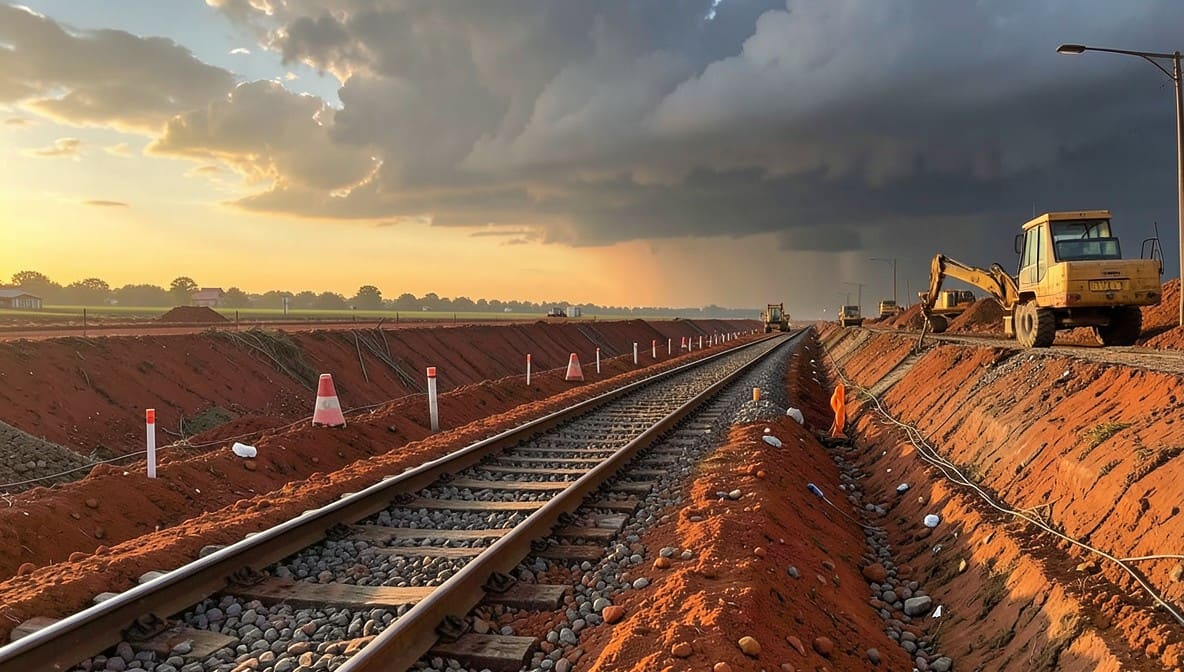
The petitioner, Vishnu Prakash R Punglia Ltd., a public limited company registered at Jodhpur, was awarded a contract by the North-Western Railway for construction works between Jaipur and Chaksu railway stations (Km 131.27 to Km 87.60) forming part of the Jaipur - Sawai Madhopur Doubling Project. The Letter of Acceptance (LoA) dated 10.10.2024 stipulated a 24-month contractual period, with the targeted Chaksu - Sheodaspura section to be completed within 15 months. The petitioner furnished bank guarantees totalling Rs. 17.86 crore and an indemnity bond of Rs. 3 crore. The formal contract agreement was executed on 25.03.2025.
Key Facts
- 10.10.2024: LoA issued by North-Western Railway, Jaipur
- 24.10.2024: Bank Guarantee No. 76260ILG014924 (Rs. 8,04,30,150) from Punjab National Bank, Jodhpur
- 10.07.2024: Bank Guarantee No. 1872IGB005938724 (Rs. 82,60,300) from Bank of Baroda, Jodhpur
- 05.06.2025: Additional Bank Guarantees for Rs. 5 crore and Rs. 3.85 crore from Bank of Baroda, Jodhpur
- 11.01.2025: Petitioner requested approved drawings and site identification
- 24.01.2025: Joint inspection identified 123 site hindrances (S&T structures, OHE, cables, encroachments)
- 10.02.2025: Petitioner sought removal of hindrances and issuance of drawings
- 13.03.2025: First progress meeting; petitioner submitted Bar Chart programme
- 01.03.2025: First slow-progress notice issued by Railway Administration
- 25.03.2025: Formal Contract Agreement executed
- 29.03.2025: Structural drawings for Chaksu Station Building handed over (nearly 6 months post-LoA)
- 29.04.2025: Notice alleging slow progress (earthwork at 27%, blanketing not commenced)
- 09.06.2025: Engineering Scale Plan (ESP) for Chaksu Station Yard approved (8+ months post-LoA)
- 28.08.2025: Tree-cutting permission granted by District Collector, Jaipur (10 months post-LoA)
- 03.09.2025: Progress meeting; petitioner furnished Target Date of Completion commitments
- 01.10.2025: ESP for Sheodaspura Station Yard approved (12 months post-LoA)
- 10.10.2025: General Arrangement Drawing of RUB-60A issued; some structural drawings pending
- 10.11.2025: Slow-progress notice; first 7-day notice under Clause 62 GCC issued
- 17.11.2025: Petitioner's comprehensive reply citing non-availability of drawings, delayed ESP approvals, site hindrances
- 09.12.2025: Second 7-day notice under Clause 62 GCC
- 02.01.2026: Third 7-day notice under Clause 62 GCC
- 06.01.2026: Petitioner's reply reiterating factual position
- 10.01.2026: 48-hour notice proposing termination under Clause 62 GCC
- 11.01.2026: Petitioner's detailed response requesting withdrawal
- 13.01.2026: Impugned rescission order issued; bank guarantees directed to be encashed
Procedural History
- 23.01.2026: S.B. Civil Writ Petition No. 983/2026 filed at Jodhpur Bench challenging rescission order and proposed encashment of bank guarantees
- Connected: S.B. Civil Writ Petition No. 8878/2026 filed challenging NIT dated 06.05.2026 for re-tendering
- 15.01.2026: Co-ordinate Bench granted interim protection (stay application)
- 21.07.2026: Arguments concluded; judgment reserved
- 17.08.2026: Judgment pronounced
The Parties' Positions
Petitioner: Contended that delays were attributable to respondents' failure to provide approved drawings, clear sites, NOCs, and approvals. Alleged arbitrary, mala fide rescission without considering repeated representations. Argued territorial jurisdiction at Jodhpur based on registered office and bank guarantee issuance. Claimed writ maintainable despite arbitration clause where State action is arbitrary.
Respondents: Contended principal cause of action arose at Jaipur (work site, contract execution, administrative control). Argued petitioner suppressed arbitration clause and alternative remedy. Asserted petitioner achieved only ~6% progress in 12+ months, no machinery deployed since June 2025. Maintained notices issued per contractual procedure after repeated opportunities. Emphasised public interest in timely railway infrastructure completion.
Relief Sought
- Quash rescission order dated 13.01.2026 as arbitrary, non-speaking, violative of Articles 14 and 19(1)(g)
- Declare rescission illegal, void, inoperative; restore contract and permit work continuation
- Restrain encashment of bank guarantees
- Quash all consequential actions including re-tendering at petitioner's risk and cost (~Rs. 30 crore alleged additional expenditure)
- Declare actions during pendency void ab initio
The Legal Issue
The central questions were: (1) Whether the Rajasthan High Court at Jodhpur has territorial jurisdiction under Article 226(2) where the petitioner's registered office and issuing banks are located at Jodhpur but the contract, work site, and administrative decisions are at Jaipur; (2) Whether a writ petition is maintainable under Article 226 to challenge contractual rescission where the contract contains an arbitration clause and the dispute involves seriously contested questions of fact regarding performance, delay attribution, and contractual compliance; (3) Whether the decision-making process discloses manifest arbitrariness or mala fides warranting displacement of the agreed dispute-resolution mechanism.
Arguments Presented
For the Petitioner
Senior Advocate Samar Bansal submitted that a material part of the cause of action arose at Jodhpur (registered office, bank guarantee issuance, consequences of encashment). Relied on Nawal Kishore Sharma v. Union of India (2014) 9 SCC 329, Kusum Ingots Alloys Ltd. v. Union of India (2004) 6 SCC 254, and Ambica Industries v. Commissioner of Central Excise (2007) 6 SCC 769 for maintainability of writ petitions against arbitrary State action despite contractual disputes. Cited ABL International Ltd. v. Export Credit Guarantee Corporation (2004) 3 SCC 553 and JCL Infra Private Limited v. Jaipur Development Authority (2026 SCC OnLine Raj 3549) for the proposition that disputed facts do not absolutely bar Article 226 jurisdiction. Argued that Clause 62 GCC contains "excepted matters" and the controversy falls within contractual exceptions. Relied on Harsha Construction v. Union of India (2014) 9 SCC 246 for termination falling under arbitration exceptions. Contended the decision-making process was predetermined and violated natural justice.
For the Respondents
ASG Bharat Vyas submitted that the principal cause of action arose at Jaipur: work site, contract award, LoA execution, contract agreement, administrative machinery, and rescission decision. Relied on Oil & Natural Gas Commission v. Utpal Kumar Basu (1994) 4 SCC 711 and State of Rajasthan v. M/s Sawika Properties (1985) 3 SCC 217 for territorial jurisdiction principles. Argued petitioner suppressed arbitration clause and efficacious alternative remedy under Arbitration and Conciliation Act, 1996 and Commercial Courts Act, 2015. Cited State of Bihar v. Jain Plastics and Chemicals Ltd. (2002) 1 SCC 216, National Highways Authority of India v. Ganga Enterprises (2003) 7 SCC 410, and Tata Motors Ltd. v. Brihan Mumbai Electric Supply (2023) 19 SCC 1 for the principle that contractual disputes with disputed facts should be relegated to alternative forums. Relied on M.P. Power Management Co. Ltd. v. Sky Power Southeast Solar India (2023) 2 SCC 703 and A. Ayyasamy v. A. Paramasivam (2016) 10 SCC 386 for competence-competence and arbitration primacy. Contended petitioner achieved only 6% progress, no machinery since June 2025, and was afforded repeated opportunities.
The Court's Analysis
The Court examined territorial jurisdiction under Article 226(2) through the lens of Oil & Natural Gas Commission v. Utpal Kumar Basu. It held that the expression "cause of action" means the bundle of material facts the petitioner must establish. The mere fact that the petitioner resides or carries on business within the territorial jurisdiction, or that some incidental consequence is felt there, does not ipso facto confer jurisdiction. The Court found:
"The present controversy does not arise from any independent act performed by the respondents at Jodhpur. The subject matter of the contract is the execution of railway infrastructure between Jaipur and Chaksu, the contractual work site is situated there, the contract was awarded by the North-Western Railway Headquarters at Jaipur, the LoA and Contract Agreement were executed at Jaipur, and the administrative machinery responsible for the project is situated at Jaipur."
The registered office at Jodhpur and bank guarantees issued by Jodhpur banks were deemed "consequential and incidental" - insufficient to displace the "overwhelming territorial nexus" with Jaipur. The banks were not even arrayed as parties.
On maintainability, the Court applied the principle from Joshi Technologies International Inc. v. Union of India (2015) 7 SCC 728: although no absolute constitutional prohibition exists against exercising writ jurisdiction in contractual matters, High Courts ordinarily exercise restraint where the contract contains a specific dispute-resolution mechanism (particularly arbitration) or where resolution involves serious disputed questions of fact requiring evidence. This was reinforced by M.P. Power Management Co. Ltd. v. Sky Power Southeast Solar India (2023) 2 SCC 703.
The Court identified six core disputed factual questions requiring holistic appreciation of contractual documents, Bar Chart, site records, progress reports, drawings, approvals, minutes, notices, and replies:
- Whether petitioner achieved contractually stipulated progress per Bar Chart under Clause 19(3) GCC
- Whether 7-day and 48-hour notices were validly issued per Clause 62 GCC
- Whether delay was attributable to petitioner or respondents (drawings, ESPs, hindrances, NOCs, site availability, departmental stoppages)
- Whether petitioner failed obligations given time was of the essence
- Whether respondents discharged reciprocal obligations to legitimately attribute delay
- Whether rescission was arbitrary, mala fide, predetermined, or vitiated by non-application of mind
The Court held these questions "cannot be answered merely by examining isolated communications" and require a forum equipped for fact-finding. Citing Tata Motors Ltd. v. Brihan Mumbai Electric Supply, the Court emphasised that writ courts should not interfere in contractual matters unless something "very gross or palpable" is pointed out, and must keep "larger public interest" in mind.
On arbitrariness, the Court applied the Wednesbury principle: judicial review targets the decision-making process, not merits. The record showed repeated communications, successive notices, petitioner's replies, and final action referencing Clause 62 GCC read with Clause 16(4)(f). The existence of competing factual versions "by itself, militates against a conclusion that the decision is demonstrably mala fide or Wednesbury unreasonable." The Court noted mala fides non praesumuntur - bad faith must be established by cogent material.
The Court distinguished the petitioner's cited precedents, noting they must be applied in their factual matrices. It relied on M/s Khodal Corporation v. West Central Railway (SB Civil Writ Petition No. 6148/2026) where a co-ordinate bench dismissed a similar railway contract writ petition on grounds of disputed facts, alternative remedy, and judicial restraint.
Public interest was deemed a legitimate consideration: the work concerns railway infrastructure of "substantial public importance" where delay causes "hardship to the public at large." The principle salus populi suprema lex supported balancing private contractual interest against public consequences of stalling infrastructure.
The Verdict
The Court dismissed both writ petitions. It held: (1) No territorial jurisdiction at Jodhpur - the material and integral cause of action arose at Jaipur; (2) The dispute is governed by GCC/SCC with an efficacious alternative remedy under the contractual/statutory arbitration mechanism; (3) Seriously disputed questions of fact require evidentiary adjudication inappropriate for summary writ proceedings; (4) No manifest arbitrariness or mala fides disclosed at the threshold to displace the agreed mechanism. The petitioner is directed to invoke the alternative efficacious remedy (arbitration) within 45 days from the date of pronouncement (17.08.2026). Status quo as on the date of reservation of judgment (21.07.2026) shall continue till expiry of the 45-day period qua both petitions. The Court expressly clarified no final opinion on merits of rival contractual claims (delay attribution, progress achievement, notice validity, reciprocal obligations, rescission justification) - the competent forum shall adjudicate independently, uninfluenced by prima facie observations. No costs awarded.
What This Means For Similar Cases
Territorial Jurisdiction Requires Material Cause of Action, Not Incidental Connections
- The situs of a petitioner's registered office and the location of banks issuing performance guarantees do not, by themselves, confer territorial jurisdiction under Article 226(2) where the contract, work site, administrative decisions, and contractual performance are centred elsewhere.
- Practitioners must identify the "bundle of material facts" constituting the cause of action and demonstrate their integral connection to the chosen High Court's territory. Incidental or consequential facts (bank guarantee issuance, registered office location) are insufficient.
- Oil & Natural Gas Commission v. Utpal Kumar Basu remains the governing test: facts relied upon must constitute an "integral and material part" of the cause of action.
Disputed Facts + Arbitration Clause = Strong Presumption Against Writ Jurisdiction
- Where a government contract contains an arbitration clause and the dispute involves seriously contested factual questions (progress measurement, delay attribution, notice compliance, reciprocal obligations), the High Court will ordinarily decline Article 226 jurisdiction.
- The competence-competence principle (Section 16, Arbitration Act, 1996) empowers the arbitral tribunal to rule on its own jurisdiction, including contractual validity and applicability of clauses like Clause 62 GCC.
- Writ courts will not convert constitutional jurisdiction into a substitute for civil trial or arbitral adjudication. The threshold for interference is "something very gross or palpable" (Tata Motors Ltd. v. BEST).
Public Interest in Infrastructure Projects Weighs Against Interim Judicial Stalls
- In railway and public infrastructure contracts, courts will balance the contractor's private interest against the "larger public consequences of stalling an infrastructure project."
- The financial burden on the public exchequer from re-tendering and delay is a "guiding factor" in exercising discretionary writ jurisdiction.
- Even where interim protection was previously granted, it does not create a vested right to merits adjudication if jurisdictional/maintainability objections ultimately prevail.
Practical Takeaways for Practitioners
- Forum selection: File writ petitions at the High Court where the contract was awarded, executed, and performed - not merely where the corporate petitioner is registered.
- Arbitration invocation: If challenging contractual termination, consider invoking arbitration first; writ petitions face high maintainability barriers when alternative remedies exist.
- Evidence preservation: Contemporaneous correspondence, progress reports, meeting minutes, and site records are critical - the arbitral tribunal will require holistic factual appreciation.
- 45-day window: This judgment's 45-day direction to invoke alternative remedy (with status quo protection) provides a template for courts dismissing writs on maintainability grounds while preserving the petitioner's substantive rights.
- No prejudice clause: The Court's explicit clarification that observations are confined to jurisdiction/maintainability and do not prejudice merits adjudication protects both parties in the subsequent arbitral forum.