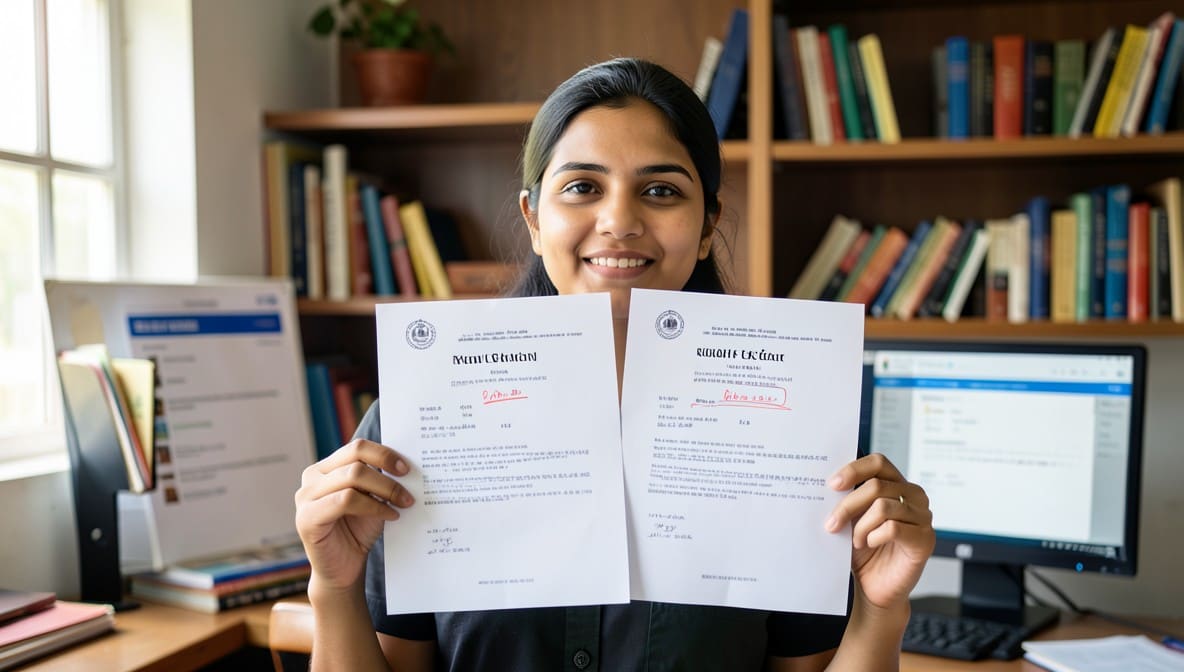
The Chhattisgarh High Court has clarified that the availability of a civil suit as an alternative remedy does not automatically bar judicial review under Article 226 when administrative authorities refuse to correct official educational records to maintain consistency with legally recognized changes in personal identity. This ruling reinforces the principle that constitutional remedies remain available where administrative decisions are arbitrary or result in manifest injustice.
Background & Facts
The Dispute
The appellant, Vanshika Shyamkunwar, a student who completed her Class 10th examination in 2022 and Class 12th in 2024 from the Chhattisgarh Board of Secondary Education, sought correction of her mother’s name in her Class 10th mark-sheet. Her mother, Pratibha Shyamkunwar, formally adopted Buddhism in 2023 and legally changed her name to Pratibha Bauddh, a change duly notified in the Gazette of India. This change was reflected in the appellant’s Class 12th, Class 8th, and Class 5th mark-sheets. However, the Board refused to amend the earlier Class 10th mark-sheet, creating a discrepancy in official documents.
Key Facts
- The appellant completed Class 10th in 2022 and Class 12th in 2024
- Her mother’s name change was officially notified in the Gazette of India in 2023
- The appellant’s Class 12th mark-sheet (issued in 2024) correctly reflects the name "Pratibha Bauddh"
- The Class 8th and Class 5th mark-sheets were corrected by respective schools in 2024 following a Board directive dated 24.06.2024
- The appellant submitted a formal application for correction on 18.07.2024, accompanied by the Gazette notification and updated mark-sheets
- No response was received initially; repeated RTI requests yielded no result
- The application was rejected by order dated 15.05.2025 by the Registrar, Chhattisgarh Board of Secondary Education
- The rejection cited Rule 12 of the Board’s regulations, which allegedly permits only one correction for clerical errors and prohibits substantive changes like name changes
Procedural History
- 15.05.2025: Registrar rejects application for name amendment in Class 10th mark-sheet
- 02.09.2025: Writ Petition (C) No. 4476 of 2025 dismissed in limine by Single Judge on ground of alternative remedy
- 07.04.2026: Intra-court appeal filed under Section 2 of the Chhattisgarh High Court (Appeal to Division Bench) Act, 2006
The Parties' Positions
Appellant’s Position: The refusal to amend the Class 10th mark-sheet is arbitrary, violates the principle of consistency in official records, and ignores the Board’s own circular dated 31.03.2022 which vests authority to decide such matters with the Secretary. The distinction between "correction" (for clerical errors) and "amendment" (for legally recognized changes) was misapplied.
Respondents’ Position: The Board’s policy, as per the joint meeting of the Executive and Finance Committee dated 07.12.2021 and order dated 22.12.2021, prohibits any second amendment after issuance of a mark-sheet. The appellant had already availed a correction opportunity. The matter involves a declaration of identity change, which is a civil dispute requiring a declaratory suit.
Relief Sought
The appellant sought quashing of the rejection order dated 15.05.2025, directions to amend her mother’s name in the Class 10th mark-sheet to "Pratibha Bauddh", and uniformity across all academic records.
The Legal Issue
Can the High Court exercise its writ jurisdiction under Article 226 to direct correction of an academic record to ensure consistency with a legally recognized name change, despite the availability of a civil suit as an alternative remedy?
Arguments Presented
For the Appellant
Counsel relied on M/s Radha Krishna Industries v. State of Himachal Pradesh (2021) 6 SCC 771 to argue that the rule of alternative remedy is discretionary, not jurisdictional. The issue involved no disputed facts but a clear administrative failure to follow governing circulars. The refusal to amend the mark-sheet created inconsistency in official documents, prejudicing the appellant’s future academic and employment prospects. The Board’s reliance on a "one-time correction" rule was misplaced, as the change was not a clerical error but a legally recognized identity change reflected in the Gazette and subsequent records.
For the Respondent/State
The State contended that the appellant’s request amounted to a claim for declaration of name change, which falls within the domain of civil courts. The Board’s regulations, as per the 2021 policy decision, strictly prohibit any amendment after issuance of a mark-sheet, except for typographical errors. The appellant had already benefited from a prior correction in other records, and permitting a second amendment would undermine the integrity of academic records.
The Court's Analysis
The Court observed that the learned Single Judge dismissed the writ petition solely on the ground of alternative remedy without examining whether such remedy was efficacious or whether the administrative action suffered from arbitrariness or non-application of mind. The Court emphasized that the rule of alternative remedy is not a bar to writ jurisdiction but a principle of judicial discretion.
"The High Court may exercise its writ jurisdiction notwithstanding the availability of an alternative remedy where the action impugned is arbitrary or where the remedy is not efficacious."
The Court noted that the appellant’s mother’s name change was not a disputed fact but a legally documented event, evidenced by the Gazette notification and consistent across all subsequent academic records. The Board’s refusal to amend the Class 10th mark-sheet was based on a misinterpretation of its own circulars, conflating "correction" with "amendment". The Board’s policy of permitting only one correction was intended for clerical errors, not for legally recognized changes in identity.
The Court further held that requiring the appellant to file a civil suit for a declaratory decree would be an unnecessary, time-consuming, and inefficient remedy in a case where the facts were undisputed and the relief sought was purely administrative. The inconsistency in records directly affected the appellant’s future opportunities, making the writ remedy not only appropriate but necessary.
The Verdict
The writ appeal was allowed. The order dated 02.09.2025 of the Single Judge dismissing the writ petition was set aside. The respondents are directed to consider and process the appellant’s application for amendment of her mother’s name in the Class 10th mark-sheet from "Pratibha Shyamkunwar" to "Pratibha Bauddh", in light of the Gazette notification and entries in her Class 12th, Class 8th, and Class 5th mark-sheets. The correction shall be completed within 60 days from the date of receipt of a certified copy of this order. No order as to costs.
What This Means For Similar Cases
Administrative Inconsistencies Trigger Writ Jurisdiction
- Practitioners may now invoke Article 226 to compel correction of official records when administrative bodies refuse to align documents with legally recognized changes (e.g., name change via Gazette, gender transition, religious conversion)
- The mere existence of a civil remedy does not oust writ jurisdiction if the issue is administrative in nature and the facts are undisputed
Correction vs. Amendment: A Critical Distinction
- Educational boards cannot invoke "one-time correction" rules to deny legally substantiated name changes
- "Correction" applies to typographical or clerical errors; "amendment" applies to changes in identity supported by statutory documentation
- Boards must distinguish between procedural rules and substantive rights
Uniformity in Records Is a Legitimate Public Interest
- Courts will prioritize consistency across official documents to prevent future prejudice to students
- Delayed or denied corrections can impact higher education admissions, employment, and passport applications
- Institutions must proactively update records when legally mandated changes occur