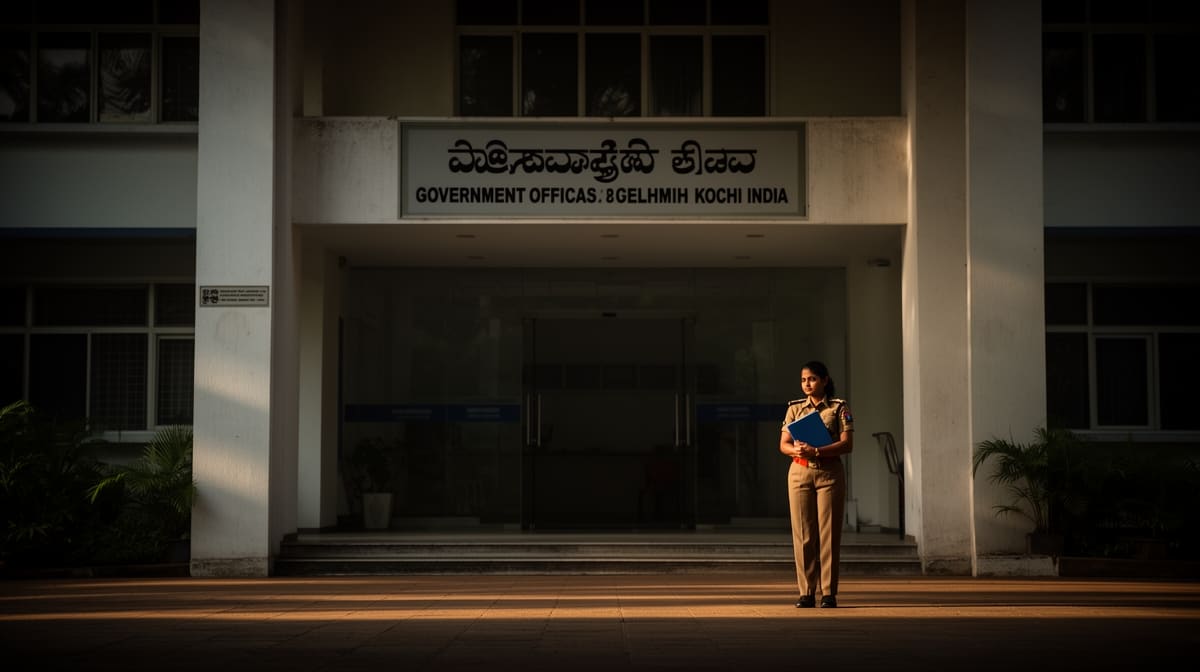
A teacher facing credible security threats due to her husband’s political activities was left in limbo for months despite verified threat assessments. The Central Administrative Tribunal’s order now mandates timely decision-making on humanitarian transfer requests, reinforcing the state’s duty to protect public servants under duress.
Background & Facts
The Dispute
Mudasar Parveen, a regularized Teacher Grade-II in the School Education Department, was posted in District Anantnag but was compelled to relocate to Srinagar due to credible security threats against her and her minor children. These threats arose from her husband’s active involvement in public and political life, which drew hostility from inimical elements in Anantnag. The Sub-Divisional Police Officer and the CID, J&K, confirmed the existence of a genuine security risk and advised her to vacate her residence in Anantnag.
Procedural History
- The applicant submitted multiple representations seeking inter-district transfer to Srinagar on security and humanitarian grounds.
- Her service particulars, integrity certificate, and No Objection Certificate were forwarded by the Chief Education Officer, Anantnag, to the Directorate of School Education, Kashmir.
- The Directorate, on 27.09.2025 and again on 26.11.2025, referred the matter to the Administrative Department for final orders.
- Despite verification by security agencies and procedural compliance, no decision was rendered for over six months.
Relief Sought
The applicant sought a direction to the respondents to grant her transfer to Srinagar. Ultimately, she narrowed her prayer to a directive compelling the competent authority to treat her application as a formal representation and decide it within a stipulated timeframe.
The Legal Issue
The central question was whether administrative authorities can indefinitely delay decisions on transfer requests grounded in verified security and humanitarian concerns, even when all procedural requirements have been fulfilled and recommendations have been made.
Arguments Presented
For the Petitioner
Learned counsel argued that prolonged inaction violated the applicant’s rights under Article 21 of the Constitution, which protects life and personal liberty, including the right to security. The verified threat inputs from CID and SDPO constituted compelling grounds for immediate action. Reliance was placed on State of U.P. v. Raj Narain to assert that administrative delay in matters of personal safety amounts to arbitrariness. The applicant had exhausted all internal remedies and complied with all procedural formalities.
For the Respondent
The Advocate General conceded that the matter had been referred to the Administrative Department but contended that the final decision rested solely with that department and was not within the purview of the School Education Department. He argued that the Tribunal lacked jurisdiction to direct a transfer, as it was an administrative function governed by service rules. However, he did not dispute the veracity of the security concerns or the procedural compliance.
The Court's Analysis
The Tribunal emphasized that administrative silence in the face of verified threats cannot be equated with neutrality. It observed that the applicant had not merely requested a transfer but had demonstrated a real and present danger to her life and the lives of her children. The Court held that the state’s obligation under Article 21 extends beyond reactive protection to proactive measures that mitigate foreseeable harm.
"The state cannot remain a passive spectator when its employee, acting in good faith, is placed in a zone of imminent danger due to circumstances beyond her control. The duty to protect life includes the duty to facilitate safe relocation."
The Court rejected the notion that procedural referral absolved the authorities of their responsibility to decide. It noted that the matter had been pending for months after all requisite documents were submitted, and that the delay itself constituted a violation of the principle of reasonable time in administrative adjudication. The Tribunal further held that the applicant’s limited prayer - seeking only a time-bound decision - was both reasonable and within the Tribunal’s jurisdiction under Section 19 of the Administrative Tribunals Act, 1985, which empowers it to issue directions to ensure compliance with law and fairness.
The Verdict
The applicant prevailed. The Court held that administrative inaction on verified security-based transfer requests violates constitutional obligations and directed the Union Territory of Jammu and Kashmir to decide the matter within two weeks. The decision must be reasoned, communicated promptly, and a copy filed with the Tribunal.
What This Means For Similar Cases
Administrative Delay Is Not a Valid Defense
- Practitioners must now treat prolonged inaction on humanitarian transfer requests as a justiciable grievance under Article 21.
- A mere referral to another department does not discharge the duty to decide; the responsible authority must act within a reasonable time.
- Verified threat assessments from security agencies constitute prima facie grounds for urgent administrative intervention.
Humanitarian Grounds Override Routine Transfer Rules
- Service rules governing transfers cannot be invoked to deny relief when life and safety are at stake.
- Courts and Tribunals will prioritize substantive justice over procedural formalities in cases involving credible threats to personal security.
- Applicants need not exhaust all internal appeals if the threat is immediate and verified; a representation with supporting documents suffices.
Procedural Compliance Triggers Time-Bound Obligations
- Once all documents are submitted and recommendations are made, the clock starts ticking on the authority’s duty to decide.
- A two-week deadline set by the Tribunal establishes a new benchmark for administrative urgency in security-related service matters.
- Failure to comply may invite contempt proceedings or writ petitions under Article 226 for violation of fundamental rights.