The Supreme Court has intervened under Article 32 to protect the fundamental rights of contractual employees wrongfully detained after a minor altercation at a toll plaza, condemning the violent retaliation by members of the Bar Association against an advocate who dared to defend them. This judgment reaffirms that the legal profession’s duty to uphold justice cannot be subverted by mob mentality, and that denial of legal representation and prolonged custody without bail violate the core guarantees of Article 21.
Background & Facts
The Dispute
The petitioners, Vishvjeet and others, are contractual employees of M/s Skylark Infra Engineering Pvt. Ltd., permanent residents of Madhya Pradesh, posted at the Gotona Bara Toll Plaza on the Lucknow-Sultanpur Highway in District Barabanki, Uttar Pradesh. On 14 January 2026, an advocate, Mr. Ratnesh Shukla, allegedly refused to pay toll charges, leading to a verbal dispute that escalated into a physical scuffle. The petitioners, as toll staff, were accused of assaulting the advocate.
Key Facts
- The incident occurred on 14.01.2026 at the Gotona Bara Toll Plaza, Barabanki, Uttar Pradesh
- An FIR No. 15/2026 was registered on the same day at P.S. Haidergarh under Sections 115(2), 352, 351(3), 109(1), 110, 311 and 3(5) of the Bharatiya Nyaya Sanhita, 2023
- The petitioners were arrested without communication of grounds of arrest
- They were produced before the A.C.J.M., Barabanki on 16.01.2026 and remanded to judicial custody
- No representation was available to them due to a collective boycott by the Bar Association
- Advocate Manoj Shukla filed a bail application on 05.02.2026, violating the Bar Association’s resolution
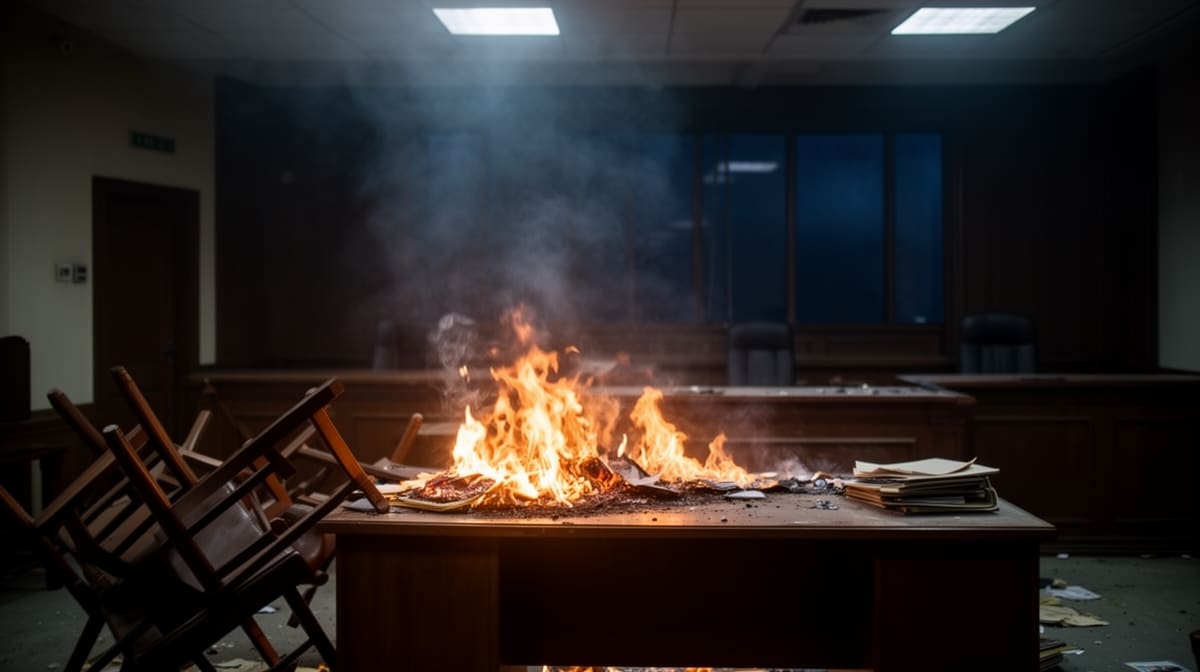
- On 05.02.2026, members of the Bar Association stormed Advocate Manoj Shukla’s office, set his furniture on fire, and burned his effigy
- The incident was reported in Dainik Bhaskar, Lucknow City Edition, dated 06.02.2026
- The District Bar Association President, Narendra Verma, was identified as leading the mob
- No advocate in Barabanki or nearby areas was willing to represent the petitioners after the arson
- As of 17.03.2026, the petitioners had been in custody for over two months
Procedural History
- 14.01.2026: Incident at Gotona Bara Toll Plaza; FIR No. 15/2026 registered
- 16.01.2026: Petitioners remanded to judicial custody by A.C.J.M., Barabanki
- 05.02.2026: Advocate Manoj Shukla files bail application
- 05.02.2026: Bar Association members attack Advocate Shukla’s office
- 06.02.2026: Dainik Bhaskar publishes report on arson and mob violence
- 17.03.2026: Writ Petition (Criminal) No. 109 of 2026 filed before the Supreme Court under Article 32
The Parties' Positions
The petitioners contended that their arrest was arbitrary, grounds were not communicated, and they were denied legal representation due to intimidation and violence by the Bar Association. They argued that their detention for over two months without bail was a gross violation of Article 21.
The State of Uttar Pradesh did not file a formal reply. Mr. Rohit K Singh appeared on behalf of the State but did not contest the factual assertions in the petition.
Relief Sought
The petitioners sought:
- Immediate release on bail
- Transfer of the criminal proceedings from Barabanki to a neutral forum
- Protection from further threats by members of the Bar Association
- Direction to the Bar Council of India to initiate disciplinary action
The Legal Issue
The central question was whether the denial of legal representation due to threats and violence by a Bar Association, coupled with prolonged custody without bail in a non-heinous case, violates Article 21 and justifies the exercise of Article 32 jurisdiction by the Supreme Court.
Arguments Presented
For the Petitioner
The petitioners argued that their detention for over two months without bail, despite the trivial nature of the alleged offence, was arbitrary and disproportionate. They cited Arnesh Kumar v. State of Bihar to emphasize that bail should be the norm, not the exception, in cases not involving grave violence or flight risk. They further contended that the Bar Association’s boycott and violent retaliation against Advocate Manoj Shukla constituted a systematic denial of access to justice, rendering the trial forum hostile and violating the right to a fair trial under Article 21.
For the Respondent
The State did not file a written reply. The appearance of Mr. Rohit K Singh did not contest the factual allegations, and no counter-narrative was presented to challenge the petitioners’ version of events.
The Court's Analysis
The Court observed that the incident at the toll plaza was a minor altercation arising from a dispute over toll payment, not a premeditated or brutal assault. A bare reading of the FIR revealed no allegations of grievous hurt, weapon use, or organized violence. The Court noted that the petitioners were merely performing their lawful duties.
"We can understand the sentiment of fraternity amongst the lawyers but that, by no means, can justify the acts of violence and lawlessness which ensued when a brave lawyer came forward to defend the accused. These deplorable acts of hooliganism deserve to be deprecated."
The Court emphasized that the legal profession’s duty is to uphold the rule of law, not to enforce collective punishment. The burning of Advocate Manoj Shukla’s office and the intimidation of other lawyers created a climate of fear that effectively denied the petitioners their constitutional right to counsel. The Court held that such conduct by members of the Bar Association is not merely unethical - it is criminal and undermines the very foundation of adversarial justice.
The Court further held that the prolonged detention of the petitioners for over two months without bail, in the absence of any compelling reason, was a clear violation of Article 21. The Court rejected the notion that the gravity of the alleged offence, even if taken at face value, warranted such extended custody.
The Verdict
The petitioners succeeded. The Supreme Court directed their immediate release on bail upon furnishing personal bonds to the satisfaction of the concerned Magistrate. The proceedings arising from FIR No. 15/2026 are transferred to the Tis Hazari Courts, New Delhi, for all further stages including remand, investigation report filing, and trial. The trial court in Delhi may impose additional bail conditions as necessary. The Director General of Police, Uttar Pradesh, is directed to ensure the petitioners’ safe escort upon release. The Bar Council of India is directed to initiate disciplinary proceedings against those involved in the arson and intimidation.
What This Means For Similar Cases
Legal Representation Cannot Be Boycotted
- Practitioners must immediately challenge any Bar Association resolution that denies representation to accused persons
- Such boycotts constitute a violation of Article 21 and may be challenged under Article 32
- Courts must treat intimidation of defence counsel as a serious threat to fair trial rights
Bail Denial in Minor Altercations Is Unlawful
- In cases involving minor scuffles, especially where no grievous injury or weapon is involved, bail must be granted as a matter of course
- Custody beyond 30 days without bail in such cases invites Article 21 scrutiny
- Courts must apply Arnesh Kumar rigorously: bail is the rule, jail the exception
Transfer of Proceedings Is a Viable Remedy for Hostile Forums
- When local institutions are compromised by collective bias or violence, transfer under Article 32 is a legitimate remedy
- Courts may transfer cases to neutral jurisdictions even without a formal application if the right to fair trial is demonstrably impaired
- The burden shifts to the State to prove that a fair trial can still be held locally
Disciplinary Action Against Bar Associations Is Mandatory
- The Bar Council of India must act suo motu against members who engage in violence or intimidation
- Failure to act may render the Bar Council liable for dereliction of statutory duty under the Advocates Act, 1961
- Law students and practitioners must report such conduct to the Bar Council without delay