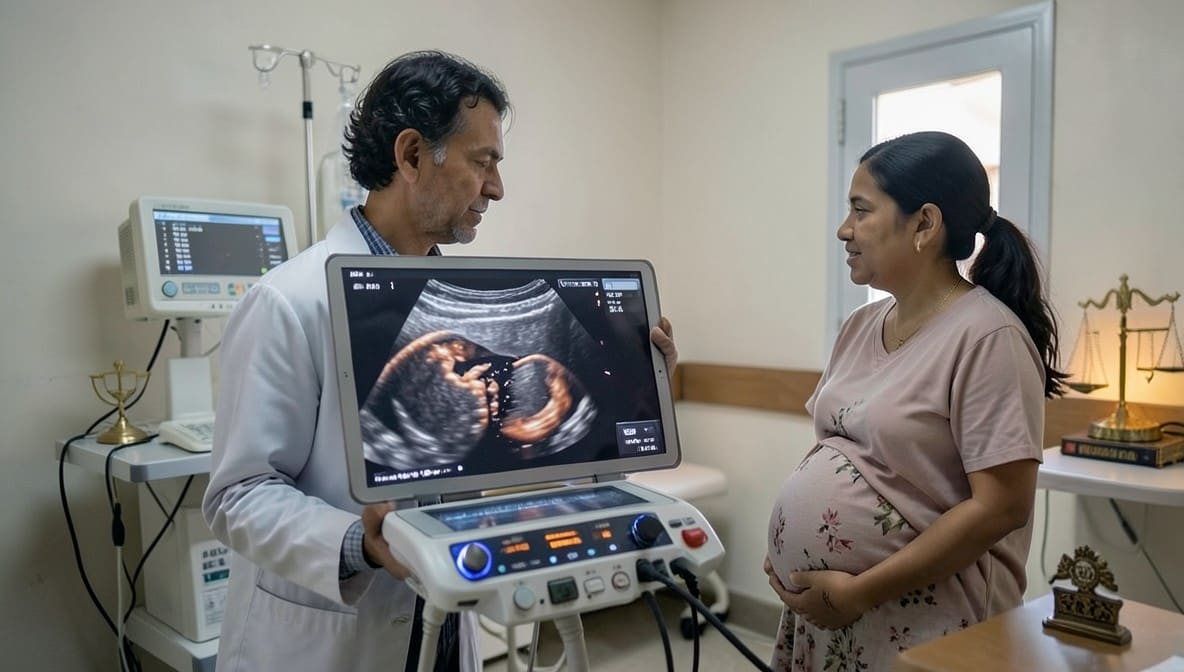
In a significant ruling on reproductive rights, the Kerala High Court held that Assisted Reproductive Technology (ART) services cannot be denied to couples merely because one spouse has crossed the prescribed age limit. The judgment reinforces the principle that arbitrary age-based restrictions violate the fundamental right to reproductive autonomy, aligning with the precedent set in Union of India v. Devayani S.
Background & Facts
The Dispute
The petitioners, Lijomol (aged 42) and Aniyankunju Pappan (aged 55), a married couple from Mavelikkara, Alappuzha, sought ART services from the 4th respondent hospital, Sabine Hospital and Research Centre Pvt. Ltd. The hospital allegedly denied them treatment on the ground that the husband had crossed the age limit prescribed under the Assisted Reproductive Technology (Regulation) Act, 2021 and associated rules. The petitioners challenged this denial, contending that it violated their fundamental right to reproductive autonomy and amounted to arbitrary discrimination.
Key Facts
- The petitioners are a married couple residing in Mavelikkara, Alappuzha
- The 1st petitioner (wife) is 42 years old, and the 2nd petitioner (husband) is 55 years old
- The couple sought ART services from the 4th respondent hospital
- The hospital allegedly denied treatment citing the husband’s age exceeding the prescribed limit
- The petitioners filed Exhibit P3, a treatment summary dated 26.06.2026, issued by the 4th respondent hospital
- The petitioners relied on Exhibits P1 and P2, their Aadhaar cards, to establish identity and marital status
Procedural History
- 10.07.2026: The present writ petition (WP(C) No. 22105 of 2026) was filed before the Kerala High Court
- The petitioners sought directions to the respondents to permit ART services without age-based discrimination
- The matter was heard on admission, and the court disposed of the petition on the same day
Relief Sought
The petitioners sought:
- A declaration that the denial of ART services based solely on the husband’s age is arbitrary and violates fundamental rights
- Directions to the respondents to permit the petitioners to avail ART services without discrimination
- Any other relief deemed just and proper by the court
The Legal Issue
The central question before the court was whether ART services could be denied to a couple solely on the ground that one spouse has crossed the prescribed age limit under the Assisted Reproductive Technology (Regulation) Act, 2021 and its rules.
Arguments Presented
For the Petitioners
The petitioners relied on the precedent Union of India v. Devayani S. [2025 KHC Online 2473], wherein a Division Bench of the Kerala High Court held that ART services cannot be denied merely because one spouse has crossed the prescribed age limit. The petitioners argued that the age-based restriction was arbitrary and violated their right to reproductive autonomy under Article 21 of the Constitution of India.
For the Respondents
The learned Central Government Counsel and the learned Government Pleader did not contest the applicability of the precedent cited by the petitioners. No substantive counter-arguments were presented during the admission hearing.
The Court's Analysis
The court observed that the issue had already been settled by the Division Bench in Union of India v. Devayani S., wherein it was held that ART services cannot be denied solely based on the age of one spouse. The court noted:
"The benefit of ART services cannot be denied solely for the reason that one among the spouses has crossed the prescribed age limit."
The court emphasized that arbitrary restrictions on ART services would infringe upon the fundamental right to reproductive autonomy, which is protected under Article 21 of the Constitution. The judgment underscored that while regulatory frameworks are necessary to govern ART services, they must not impose unreasonable or discriminatory restrictions that violate constitutional rights.
The Verdict
The writ petition was disposed of in favor of the petitioners. The court held that the petitioners are entitled to the benefit of the principles laid down in Union of India v. Devayani S., thereby permitting them to avail ART services without being denied solely on the ground of the husband’s age. The court did not impose any specific compliance timelines but directed that the petitioners’ rights under the precedent be upheld.
What This Means For Similar Cases
Age-Based Restrictions on ART Services Are Arbitrary
- The judgment reinforces that age-based restrictions on ART services must be reasonable and non-discriminatory
- Courts will scrutinize arbitrary denials of ART services under Article 21 of the Constitution
- Practitioners should argue that reproductive autonomy cannot be curtailed without justifiable grounds
Precedent as a Tool for Reproductive Rights
- The reliance on Union of India v. Devayani S. demonstrates the importance of binding precedents in protecting reproductive rights
- Lower forums and hospitals must align their policies with judicial pronouncements to avoid legal challenges
- Couples denied ART services on arbitrary grounds can seek redress under Article 226 of the Constitution
Regulatory Frameworks Must Balance Rights and Restrictions
- While the Assisted Reproductive Technology (Regulation) Act, 2021 provides a regulatory framework, it must not impose unconstitutional restrictions
- The judgment highlights the need for judicial review of administrative decisions that infringe on fundamental rights
- Policymakers must ensure that ART regulations are proportionate and non-discriminatory