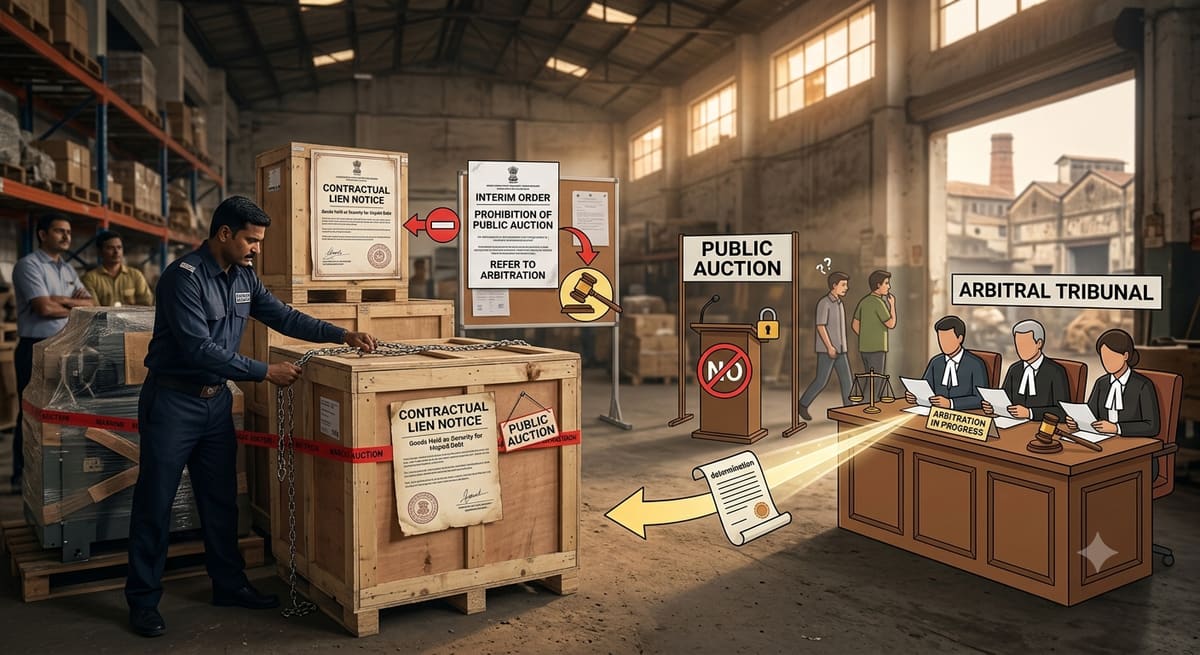
The Bombay High Court has clarified the scope of assignment of arbitration clauses in loan agreements, holding that where the original agreement permits assignment and the borrower accepts the assignee's rights, the arbitration clause travels with the assignment. The Court granted interim protective measures under Section 9 of the Arbitration and Conciliation Act, 1996, including a restraint on alienation of hypothecated assets and a bank guarantee for the admitted liability.
Background & Facts
The Genesis
The petitioner, Kotak Mahindra Bank Limited, is a scheduled commercial bank engaged in lending and financial services. The respondent, Sitaram Energy and Logistics Limited, is a logistics company that availed a term loan from Family Credit Limited, the original lender, on 27 June 2014. The loan was secured by a Deed of Hypothecation creating security over the respondent's assets.
The Underlying Transaction
- Loan Agreement (27 June 2014): The respondent borrowed Rs.12,35,63,477 from Family Credit Limited. The agreement contained a broad assignment clause (Clause 10.1) permitting the lender to assign its rights without prior notice to the borrower.
- Deed of Hypothecation (27 June 2014): Created security over the respondent's assets in favor of the original lender.
- Merger (24 January 2017): Family Credit Limited merged with L&T Finance Limited.
- Deed of Assignment (29 March 2019): L&T Finance Limited assigned all rights under the Loan Agreement and security documents to the petitioner for consideration. The Deed defined "Borrowers" to include the respondent and "Underlying Documents" to include the Loan Agreement, security documents, and other connected instruments.
Key Facts
- Assignment Communication (22 April 2024): The assignor informed the respondent that the Loan Agreement and all rights had been assigned to the petitioner. The communication stated that all terms and conditions of the Loan Agreement would remain unchanged and continue for the benefit of the petitioner.
- Loan Recall Notice (22 April 2024): The petitioner demanded payment of outstanding dues amounting to Rs.11,63,41,502.
- Arbitration Invocation (16 January 2025): The petitioner invoked the arbitration agreement by issuing a notice under the Arbitration and Conciliation Act, 1996, and sought disclosure of the status of hypothecated assets.
- Third-Party Rights (February 2025): The petitioner discovered that third-party rights had been created in respect of Vehicle No. GJ 16 AF 8906, one of the hypothecated assets.
- Annual Reports (2023, 2025): The respondent's Annual Reports for the financial years ending 31 March 2023 and 31 March 2025 acknowledged outstanding dues of approximately Rs.8.03 crores and Rs.7.60 crores respectively to the original lender.
Procedural History
- 31 March 2025: The petitioner filed Arbitration Petition (L) No.5535 of 2025 against the borrower and Arbitration Petition (L) No.5944 of 2025 against the co-borrowers under Section 9 of the Arbitration and Conciliation Act, 1996, seeking interim and protective reliefs.
- 28 November 2025: The Court granted interim reliefs in terms of prayer clauses (a), (b), and (c).
- 16 January 2026: The respondent filed an incomplete Affidavit of Disclosure consisting of a one-page Profit and Loss Statement.
- 19 June 2026: The Court directed the respondent to file a comprehensive Affidavit of Disclosure.
- 7 July 2026: The respondent filed a further affidavit.
- 14 July 2026: The petitioner filed an additional affidavit highlighting admissions in the respondent's disclosures regarding asset depletion.
- 22 July 2026: The matter was reserved for judgment.
- 23 July 2026: The judgment was pronounced.
Relief Sought
The petitioner sought:
- Restraint on the respondents from selling, transferring, or creating third-party rights in the hypothecated assets.
- Freezing of all bank accounts of the respondents.
- A garnishee order directing Oil and Natural Gas Corporation Limited (ONGC) to deposit rental income directly with the petitioner.
- Appointment of a Court Receiver with authority to take possession and sell the respondents' properties.
- Direction to the respondents to furnish security for the admitted outstanding amount.
The Legal Issue
The central question was whether the arbitration clause contained in the Loan Agreement dated 27 June 2014 travels with the assignment of the loan agreement and security documents to the petitioner, and whether the petitioner has locus to invoke arbitration under Section 9 of the Arbitration and Conciliation Act, 1996.
Arguments Presented
For the Petitioner
The petitioner argued that Clause 10.1 of the Loan Agreement expressly permitted assignment and defined "Borrower" and "Lender" to include successors and permitted assigns. The Deed of Assignment transferred all rights, title, interest, benefits, and security interests under the underlying documents to the petitioner. The petitioner relied on Siemens Factoring Private Limited v. Future Enterprises Private Limited, DLF Power Limited v. Mangalore Refinery & Petrochemicals Limited, and Tata Communications Ltd. v. Rudrapriya Constructions LLP to submit that the arbitration clause travels with the assignment where the original agreement permits assignment and the borrower accepts the assignee's rights.
The petitioner also pointed to the respondent's conduct: the respondent continued to make payments to the petitioner after the assignment and did not object to the petitioner's authority to enforce the Loan Agreement. The petitioner relied on Exhibit E to the petition, which contained details of payments made by the respondents to the petitioner after the assignment.
For the Respondent
The respondents argued that the Deed of Assignment did not expressly transfer the arbitration agreement. They relied on Section 7(5) of the Arbitration and Conciliation Act, 1996, and the Supreme Court's decision in M.R. Engineers and Contractors Private Limited v. Som Datt Builders Limited to submit that a mere transfer of contractual rights does not automatically transfer the arbitration agreement. They relied on Vishranti CHSL v. Tattva Mittal Corporation Private Limited to argue that the assignee cannot be presumed to have agreed to arbitration unless there is clear material showing such intention.
The respondents submitted that the Deed of Assignment was a commercial transfer of receivables and did not assign the arbitration agreement. They pointed to Clause 5.2 of the Deed, which authorized the petitioner to collect receivables but did not refer to arbitration. They also relied on the definition of "Purchase Consideration" in the Deed, which indicated that the assignment was a commercial transfer of receivables.
The Court's Analysis
The Court examined the contractual framework and the conduct of the parties. It noted that Clause 10.1 of the Loan Agreement expressly permitted assignment and defined "Borrower" and "Lender" to include successors and permitted assigns. The Deed of Assignment transferred all rights, title, interest, benefits, and security interests under the underlying documents to the petitioner. The Court observed that the Deed authorized the petitioner to institute recovery proceedings in its own name and right.
"The Deed of Assignment dated 29 March 2019 executed between L&T Finance Limited and the petitioner... Clause 2.1.1 transfers the assignor's rights, title and interest in the receivables and also authorises the petitioner to institute recovery proceedings or take legal action in its own name and right and as a legal acquirer and not as representative or agent of the assignor."
The Court distinguished M.R. Engineers and Vishranti CHSL on the ground that those cases involved mere references to other agreements, whereas in the present case, the original agreement contemplated assignment and the borrower accepted the assignee's rights. The Court relied on DLF Power Limited and Siemens Factoring Private Limited to hold that where the original agreement permits assignment and the parties act upon the assignment, the arbitration clause travels with the assignment.
"In the present case, the factual position appears to be different. The Loan Agreement authorised assignment by the lender and the borrower had accepted such an arrangement from the beginning. After execution of the Deed of Assignment, the respondents received a communication informing them that the Loan Agreement had been assigned in favour of the petitioner... The respondents continued to deal with the petitioner under the same arrangement. Payments were also made to the petitioner after the assignment."
The Court also considered the respondent's admissions in their Annual Reports regarding outstanding liability and their incomplete disclosures of assets. The Court held that these circumstances created a reasonable apprehension that the subject matter of arbitration required protection.
The Court rejected the petitioner's prayer for freezing all bank accounts and a blanket garnishee order, holding that such drastic measures were not justified on the material available. However, the Court granted interim protection by:
- Restraint on alienation of hypothecated assets.
- Direction to the respondents to file a comprehensive Affidavit of Disclosure.
- Direction to maintain true and proper accounts of receivables.
- Direction to furnish a bank guarantee for the admitted liability of Rs.7,60,21,638.
- Appointment of a Court Receiver as Receiver without actual possession to prepare an inventory and symbolic possession report.
- Direction to ONGC not to release security deposits or terminal payments without prior notice to the petitioner.
The Court emphasized that its observations were prima facie and confined to the adjudication of the Section 9 petition. The Arbitral Tribunal would decide the disputes uninfluenced by any observations contained in the order.
The Verdict
The Court partly allowed the petitions. It held that the petitioner has locus to invoke the arbitration agreement and granted interim protective measures under Section 9 of the Arbitration and Conciliation Act, 1996, including:
- Restraint on the respondents from selling, transferring, or creating third-party rights in the hypothecated assets, except in the ordinary course of business and with prior leave of the Arbitral Tribunal or the Court.
- Direction to the respondents to file a comprehensive Affidavit of Disclosure within three weeks.
- Direction to maintain true and proper accounts of receivables and not to assign, divert, or encumber receivables otherwise than in the ordinary course of business.
- Direction to furnish an unconditional and irrevocable Bank Guarantee of Rs.7,60,21,638 within six weeks.
- Direction to ONGC not to release any security deposit or terminal payment without two weeks' prior written notice to the petitioner.
- Appointment of the Court Receiver, High Court, Bombay, as Receiver without actual possession to prepare an inventory and symbolic possession report within eight weeks.
- Rejection of the prayers for freezing all bank accounts, a blanket garnishee order, and appointment of a Receiver with actual possession and power to sell.
The interim protection granted by the order shall continue until the Arbitral Tribunal considers any application under Section 17 of the Arbitration and Conciliation Act, 1996, and passes appropriate orders, or until further orders of the Court, whichever is earlier.
What This Means For Similar Cases
Assignment Clauses Must Be Construed Broadly
- Contractual liberty to assign: Where the original agreement expressly permits assignment and defines "Borrower" and "Lender" to include successors and permitted assigns, the arbitration clause travels with the assignment.
- Conduct of parties: Where the borrower accepts the assignee's rights and continues to perform obligations under the assigned contract, the arbitration clause is incorporated by conduct.
Interim Protection Under Section 9 Is Context-Dependent
- Prima facie material: Interim protection under Section 9 requires prima facie material showing a reasonable apprehension that the subject matter of arbitration may become unavailable or ineffective.
- Proportionality: The Court must balance the need for protection with the impact on the respondent's business. Drastic measures such as freezing all bank accounts or a blanket garnishee order are not granted lightly.
- Disclosure obligations: Parties must comply with directions for disclosure of assets and liabilities. Incomplete or delayed disclosures may support the grant of protective measures.
Arbitral Tribunal's Role Remains Paramount
- Prima facie observations: The Court's observations are confined to the adjudication of the Section 9 petition and do not influence the Arbitral Tribunal's decision on merits.
- Continuation of protection: The Arbitral Tribunal may continue, modify, or vacate the interim measures granted by the Court upon constitution.
Practical Takeaways for Practitioners
- Drafting assignment clauses: Ensure that assignment clauses expressly transfer the arbitration agreement where the parties intend such transfer.
- Documenting acceptance: Record the borrower's acceptance of the assignment and continued performance under the assigned contract.
- Seeking interim protection: Gather prima facie material showing asset depletion or dissipation to justify interim protection under Section 9.
- Compliance with disclosure: Comply fully with directions for disclosure of assets and liabilities to avoid adverse inferences.