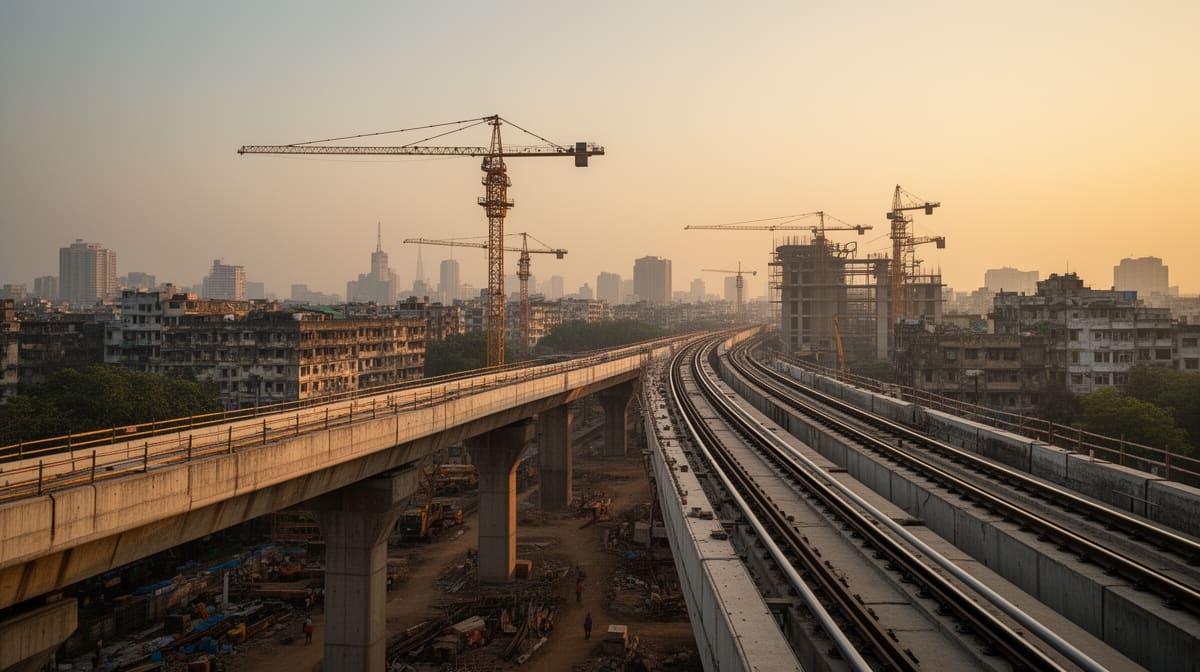
The Bombay High Court has reaffirmed that arbitral awards cannot be invalidated merely because a party disagrees with the arbitrator’s assessment of evidence or adopts a different methodology to quantify damages. In a landmark ruling, the Court upheld a majority arbitral award granting over Rs. 496 crores in compensation to Mumbai Metro One Private Limited (MMOPL) for delays in the provision of Right of Way (ROW) by the Mumbai Metropolitan Region Development Authority (MMRDA), emphasizing that courts must show deference to arbitral findings unless they are perverse or based on no evidence.
Background & Facts
The Dispute
The dispute arose under the Concession Agreement (CA) dated 7 March 2007 for the construction of Mumbai Metro Line-1 (VAG Corridor) under a Build-Own-Operate-Transfer (BOOT) model. MMRDA, as the project implementation agency, was obligated to provide encumbrance-free ROW within 180 days of the CA. MMOPL, the Special Purpose Vehicle (SPV) formed by MMRDA and private consortiums, alleged that MMRDA’s failure to timely hand over ROW, including delays in relocating utilities and clearing encumbrances, caused a four-year delay in achieving Commercial Operation Date (COD), escalating project costs from Rs. 2,356 crores to Rs. 4,026 crores.
Procedural History
- 2007: Concession Agreement executed between MMRDA and MMOPL.
- 2014: Commercial operations commenced on 8 June 2014, four years beyond the original schedule.
- 2015: MMOPL filed Statement of Claim before a three-member Arbitral Tribunal seeking Rs. 1,372 crores in damages across six heads.
- 2023: Majority Award (by Justices Patil and Misra) granted Rs. 496.48 crores in compensation; Dissenting Award (by Justice Jeevan Reddy) dismissed all claims.
- 2024: MMRDA filed Section 34 petition challenging the majority award.
- 2025: Bombay High Court heard arguments and reserved judgment.
- 24 February 2026: Court delivered judgment upholding the majority award.
Relief Sought
MMRDA sought to set aside the majority arbitral award under Section 34 of the Arbitration and Conciliation Act, 1996, contending that:
- The Tribunal erred in interpreting the CA to impose liability for utility relocation within 180 days.
- MMOPL was only entitled to extension of concession period, not monetary compensation.
- The quantum of damages awarded was based on no evidence and speculative assumptions.
- The Tribunal failed to apply consistent evidentiary standards across claims.
Relief Granted
The Arbitral Tribunal awarded:
- Rs. 35 crores for withheld Viability Gap Fund tranches.
- Rs. 13.16 crores for differential rent at Wadala land.
- Rs. 30.48 crores for cost of steel bridge instead of concrete.
- Rs. 411.70 crores for increased project costs under four heads: system works, overheads, interest, and opportunity cost.
The Legal Issue
The central question was whether an arbitral award can be set aside under Section 34 of the Arbitration and Conciliation Act, 1996 merely because the arbitrator: (1) interpreted contractual obligations differently from the party’s view; (2) awarded monetary compensation despite the contract providing only for extension of time; (3) quantified damages using a rough-and-ready methodology in absence of detailed documentary proof; and (4) applied inconsistent evidentiary standards across similar claims.
Arguments Presented
For the Petitioner
Mr. J.P. Sen, Senior Advocate for MMRDA, argued:
- The CA’s definition of ‘encumbrances’ explicitly excluded utilities, making the Tribunal’s interpretation of Article 13.4 irrational.
- Article 4.4 of the CA provided the exclusive remedy for delay - extension of concession period - and barred monetary compensation.
- The Tribunal’s award of Rs. 100 crores for overheads and Rs. 125 crores for interest was based on no evidence, as MMOPL failed to produce invoices, bank statements, or work orders.
- The Tribunal inconsistently rejected claims for PMC fees due to lack of documentation but awarded similar heads without proof.
- The foreign exchange loss claim of Rs. 163 crores was inflated and contradicted MMOPL’s own balance sheet showing only Rs. 39 crores of cumulative loss.
- Reliance on board minutes as proof of project cost escalation was legally impermissible without independent audit or verification.
For the Respondent
Mr. J.J. Bhatt, Senior Advocate for MMOPL, countered:
- The Tribunal correctly interpreted Article 13.4 in context of Articles 4.1, 9.1, and 13.7, holding MMRDA responsible for utility relocation within 180 days.
- Indian Contract Act, 1872, Sections 55 and 73, permit damages for breach even if contract provides only for extension of time, as held in MBL Infrastructures v. DMRC and P.M. Paul v. Union of India.
- The Tribunal’s methodology for quantifying foreign exchange loss was reasonable, relying on RBI data, board-approved vendor payments, and historical exchange rates.
- The award of Rs. 100 crores for overheads was a conservative, equitable estimate based on the project’s scale and duration, not a speculative guess.
- MMRDA’s nominee directors on MMOPL’s board had participated in approving revised project costs, making the financial statements admissible.
- The dissenting award’s factual observations cannot override the majority’s detailed, evidence-based analysis spanning over 600 pages.
The Court's Analysis
The Court undertook a rigorous examination of the arbitral award under the well-settled principles of Section 34, reaffirming that courts must not act as appellate forums. The judgment emphasized that interference is permissible only if the award is perverse, based on no evidence, or involves patent illegality.
"The Arbitral Tribunal has conducted a meticulous, 600-page factual analysis of each sub-stretch, each encumbrance, and each delay. To set aside such an award merely because another view is possible would undermine the very purpose of arbitration."
The Court upheld the Tribunal’s interpretation of Article 13.4, finding that the definition of ‘encumbrances’ - while excluding existing utilities - did not negate MMRDA’s obligation to ensure the site was free from all impediments, including utilities, within 180 days. The Tribunal’s reading was consistent with the CA’s overall scheme and the parties’ conduct, including execution of supplemental agreements extending timelines due to utility delays.
On the issue of monetary compensation, the Court held that the absence of an express bar on damages in the CA did not preclude an award under the Indian Contract Act. Citing MBL Infrastructures Ltd. v. Delhi Metro Rail Corporation, the Court affirmed that contractual remedies are not exhaustive and do not oust statutory rights to compensation for breach.
Regarding the quantum of damages, the Court found no perversity in the Tribunal’s approach. For the foreign exchange loss claim of Rs. 163.22 crores, the Tribunal relied on board-approved vendor contracts, RBI exchange rate data, and the timing of actual payments - a methodology that, while not perfect, was grounded in evidence and not speculative.
The Court acknowledged the Tribunal’s inconsistency in rejecting the PMC fee claim for lack of documentation but awarding Rs. 100 crores for overheads without supporting invoices. However, it declined to set aside the award on this ground, noting:
"The Tribunal’s award of Rs. 100 crores for overheads, though based on a general inference, was a conservative estimate reflecting the undeniable reality of prolonged project execution. The claim was reduced from Rs. 255 crores, and the Tribunal explicitly acknowledged the absence of detailed records. This is not perversity - it is judicial pragmatism in the face of complex commercial reality."
The Court further held that the Tribunal’s reliance on board minutes and audited financial statements was valid, given MMRDA’s 26% equity stake and its nominee’s role on the audit committee. The minutes were corroborated by special resolutions amending MMOPL’s Articles of Association to raise additional debt - a clear indicium of acceptance of the revised cost.
The Court rejected MMRDA’s reliance on the balance sheet figure of Rs. 39.25 crores as foreign exchange loss, noting it reflected book entries for accounting purposes, not actual currency conversion losses incurred during delayed procurement.
The Verdict
The petitioner’s challenge failed. The Bombay High Court upheld the majority arbitral award in its entirety. The Court held that monetary compensation for delay in provision of ROW is permissible under the Indian Contract Act even where the contract provides only for extension of time, and that an arbitral tribunal’s reasonable, evidence-based estimation of damages - even in absence of perfect documentation - cannot be set aside merely because it differs from the parties’ preferred methodology.
What This Means For Similar Cases
Arbitral Estimation of Damages Is Valid Where Evidence Is Incomplete
- Practitioners must now argue that where a party proves breach and the nature of loss is inherently difficult to quantify (e.g., overheads, opportunity cost), tribunals may use rough-and-ready estimates.
- Courts will not interfere if the estimate is conservative, grounded in project scale, duration, and general commercial logic.
- Failure to produce invoices or bank statements does not automatically invalidate a claim if the tribunal’s methodology is rational and supported by some evidence.
Contractual Extension of Time Does Not Bar Monetary Compensation
- Parties cannot rely on clauses providing only for time extensions to immunize themselves from liability for consequential losses.
- Section 73 of the Indian Contract Act, 1872, operates independently of contractual remedies unless there is an express exclusion.
- Arbitrators may award damages for delay-induced cost escalation even if the contract does not explicitly permit it, provided the breach is established.
Board Minutes and Financial Statements Are Admissible Against Shareholder-Entities
- When a public authority holds equity in an SPV and participates in governance (e.g., through board or audit committee representation), its nominee’s participation in approving financial statements or revised budgets constitutes constructive knowledge.
- Audited financial statements and board resolutions approving project cost revisions are admissible as evidence against the shareholder-entity, even if not directly signed by it.
- Mere absence of direct payment records does not negate liability if the financial impact is reflected in the SPV’s official books and approved by the shareholder’s representatives.