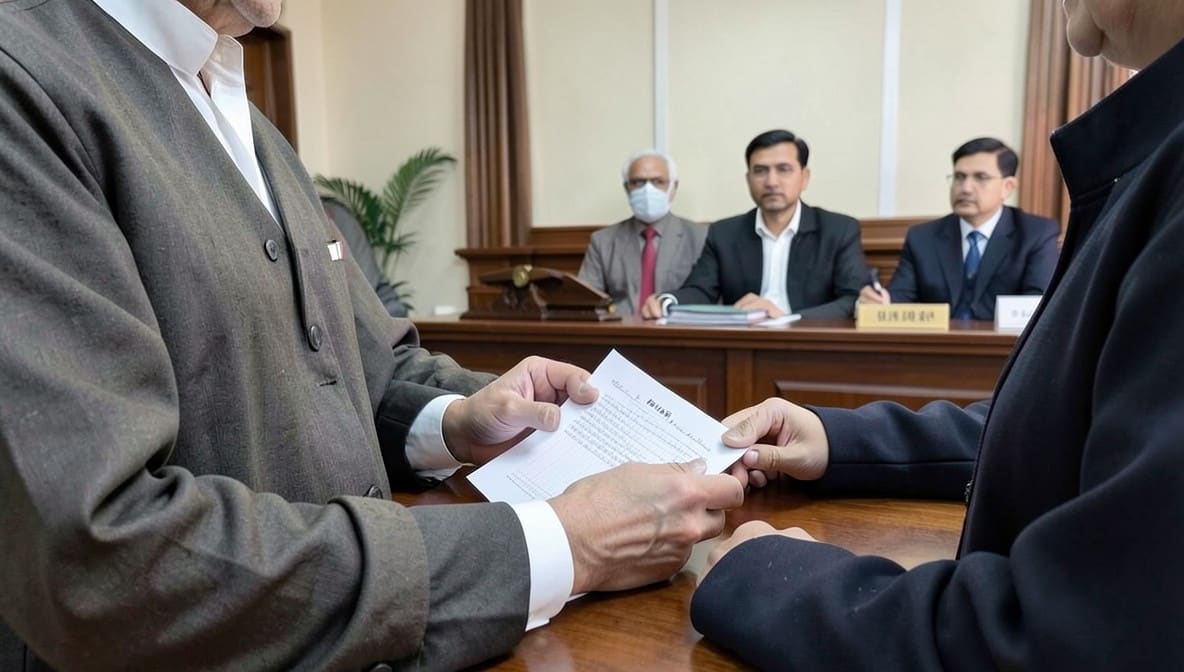
The Madhya Pradesh High Court has clarified that procedural non-compliance with statutory prerequisites for registering an FIR can be a decisive factor in granting anticipatory bail, even where serious allegations of religious conversion are involved. This ruling reinforces that due process is not a technicality but a constitutional imperative.
Background & Facts
The Dispute
The applicant, Chimansingh Bathole, is apprehending arrest in connection with Crime No. 430/2025 registered at Police Station Kantaphod, Dewas. The complainant alleges that the applicant attempted to forcibly convert him to Christianity. The case invokes Sections 296(A) and 351(3) of the Bharatiya Nagrik Suraksha Sanhita, 2023 (BNS), and Section 3/5 of the Madhya Pradesh Freedom of Religion Act, 2021.
Procedural History
- 2025: Crime No. 430/2025 registered at Police Station Kantaphod based on oral complaint
- 2026: Applicant filed anticipatory bail application under Section 482 of BNS, 2023 and Section 438 of CrPC, 1973
- No written complaint was submitted to the police, as required under Section 4 of the MP Freedom of Religion Act, 2021
Relief Sought
The applicant seeks anticipatory bail, arguing that the FIR is legally unsustainable due to non-compliance with mandatory procedural requirements and that the alleged offences under BNS are bailable.
The Legal Issue
The central question was whether an anticipatory bail application can be granted where the FIR is registered solely on an oral complaint, in direct violation of a statutory mandate requiring a written complaint under the Madhya Pradesh Freedom of Religion Act, 2021.
Arguments Presented
For the Appellant/Petitioner
Counsel for the applicant argued that Section 4 of the MP Freedom of Religion Act, 2021 explicitly requires a written complaint for registration of an FIR under its provisions. The absence of such a document renders the FIR legally defective. Further, Sections 296(A) and 351(3) of the Bharatiya Nagrik Suraksha Sanhita, 2023 are classified as bailable offences, negating the need for custodial interrogation. Reliance was placed on Arnesh Kumar v. State of Bihar to argue that arrest is not automatic even for non-bailable offences, let alone bailable ones.
For the Respondent/State
The State did not dispute that the FIR was registered on an oral complaint alone. However, it contended that the gravity of the allegation - forced religious conversion - justified investigation and potential arrest. It argued that procedural lapses, if any, could be cured during investigation and should not preclude arrest at the threshold stage.
The Court's Analysis
The Court examined the statutory framework under the Madhya Pradesh Freedom of Religion Act, 2021, particularly Section 4, which mandates that a police officer shall register an FIR only upon receipt of a written complaint. The Court held that this is not a mere procedural formality but a substantive condition precedent to the exercise of police power under the Act. The absence of a written complaint renders the FIR legally infirm from inception.
"The requirement of a written complaint under Section 4 is not a technicality but a safeguard against misuse of penal provisions targeting religious conversion."
The Court further noted that Sections 296(A) and 351(3) of the Bharatiya Nagrik Suraksha Sanhita, 2023 are bailable offences, and the Supreme Court in Arnesh Kumar v. State of Bihar has consistently held that arrest must be a last resort, especially where the offence is bailable and no material suggests flight risk or tampering with evidence. The Court rejected the State’s argument that gravity alone justifies arrest, emphasizing that procedural compliance is non-negotiable under the rule of law.
The Court also observed that the applicant had no prior criminal record and was willing to cooperate with investigation, making custodial interrogation unnecessary.
The Verdict
The applicant won. The Court held that an FIR registered without a written complaint as mandated by the MP Freedom of Religion Act, 2021, is legally unsustainable, and granted anticipatory bail. The applicant is directed to execute a personal bond of Rs. 25,000 and furnish a solvent surety, while remaining available for police interrogation.
What This Means For Similar Cases
Procedural Compliance Is Non-Negotiable
- Practitioners must challenge FIRs registered in violation of mandatory statutory conditions, even in sensitive cases involving religious conversion
- Oral complaints alone cannot sustain FIRs where the statute requires written complaints
- Courts may grant anticipatory bail at the threshold if the FIR is procedurally defective
Bailable Offences Cannot Justify Custodial Arrest
- Where the alleged offence is bailable under the Bharatiya Nagrik Suraksha Sanhita, 2023, arrest must be justified by exceptional circumstances
- The presumption of innocence and the right to liberty under Article 21 override speculative fears of tampering
- Courts must apply the triple test for arrest - gravity, flight risk, and evidence preservation - before permitting custody
Anticipatory Bail as a Procedural Safeguard
- Anticipatory bail is not merely a remedy for the accused but a check on arbitrary police action
- Courts are empowered to intervene at the FIR stage where statutory violations are evident
- Applicants must be prepared to demonstrate willingness to cooperate with investigation to strengthen bail claims