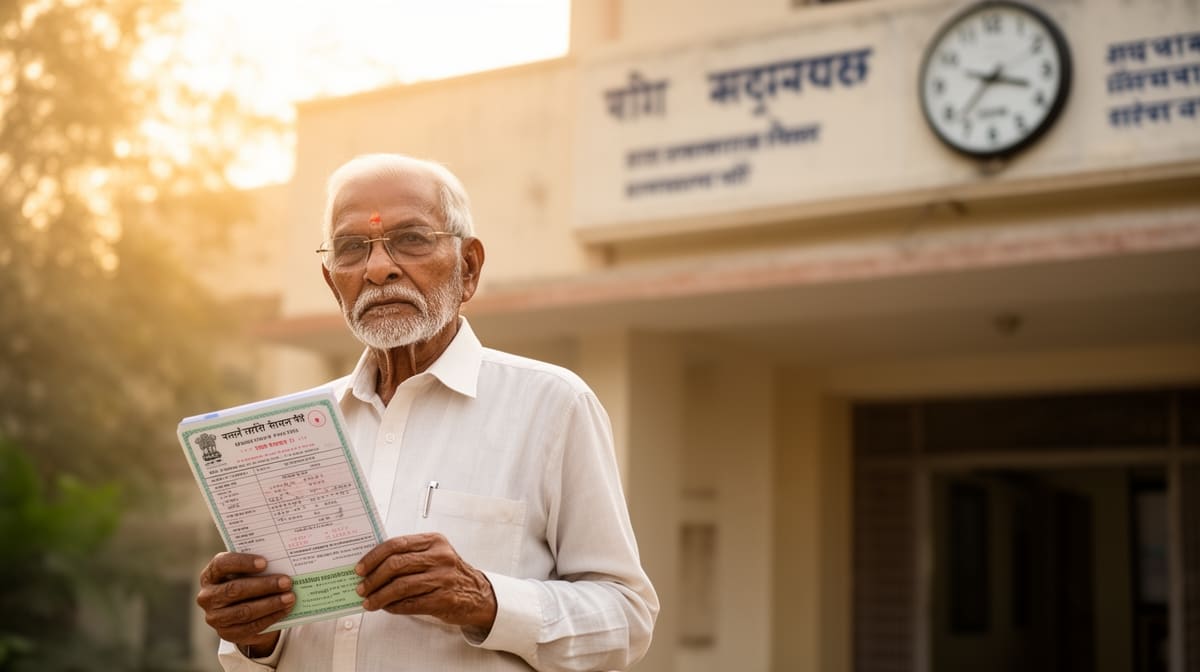
The Madhya Pradesh High Court has affirmed that a government servant’s entitlement to an annual increment crystallizes on the day of superannuation, making it payable from the next day regardless of administrative delay. This ruling reinforces the Supreme Court’s doctrinal clarity on pensionary benefits and sets a binding standard for state authorities across India.
Background & Facts
The Dispute
Hariprasad Sharma, a retired government employee, superannuated on 30.06.2014 after completing a full year of good service. He claimed entitlement to an annual increment due on 01.07.2014, the day immediately following his retirement. Despite the Government of Madhya Pradesh issuing a circular on 15.03.2024 directing all departments to grant such increments to retirees on June 30 or December 31, his claim remained unaddressed for over a decade.
Procedural History
- 30.06.2014: Petitioner superannuated from service.
- 01.07.2014: Annual increment crystallized but was not granted.
- 2023: Supreme Court in Director (ADMN) and HR KPTCL v. C.P. Mundinamani held that increments crystallize upon completion of qualifying service.
- 20.02.2025: Supreme Court in Union of India v. M. Siddaraj clarified that enhanced pension with one increment is payable from 01.05.2023, but not retrospectively beyond that date.
- 2026: Petitioner filed this writ petition seeking arrears and interest.
Relief Sought
The petitioner sought payment of the annual increment from 01.07.2014, along with interest on arrears, and directed the State to implement the Supreme Court’s directives in his case.
The Legal Issue
The central question was whether the right to an annual increment crystallizes on the date of superannuation, and if so, whether the petitioner is entitled to the benefit despite delayed litigation, in light of the Supreme Court’s rulings in C.P. Mundinamani and Union of India v. M. Siddaraj.
Arguments Presented
For the Petitioner
The petitioner relied on C.P. Mundinamani to argue that the increment becomes a vested right upon completion of one year of good service, and crystallizes on the day of retirement. He contended that the State’s circular of 2024 confirmed the legal position, and that delay in filing the petition cannot defeat a statutory right that had already vested. He further cited Union of India v. M. Siddaraj to assert that his case fell within the scope of those who had filed writ petitions before the High Court and were entitled to the benefit.
For the Respondent/State
The State argued that while the circular applied broadly, it did not create retrospective liability for claims filed after a long delay. It contended that the Supreme Court’s order in M. Siddaraj limited enhanced pension to increments from 01.05.2023 onwards, and that the petitioner’s claim for arrears from 2014 was barred by laches and the principle of equitable estoppel. It further submitted that the petitioner had not exhausted administrative remedies before approaching the Court.
The Court's Analysis
The Court examined the Supreme Court’s reasoning in C.P. Mundinamani, which established that the right to an annual increment is not contingent on administrative approval but arises automatically upon completion of qualifying service. The Court noted that the increment is not a discretionary benefit but a statutory entitlement under service rules.
"The entitlement to receive increment crystallizes when the Government servant completes a requisite length of service with good conduct and becomes payable on the succeeding day."
The Court then turned to Union of India v. M. Siddaraj, where the Supreme Court held that while enhanced pension with one increment is payable from 01.05.2023, this date was not a ceiling on the crystallization of the right itself, but a ceiling on the payment of arrears for those who had not filed claims before that date. The Court held that the petitioner’s right crystallized on 01.07.2014, and while the payment of arrears for the period prior to 01.05.2023 was not mandated under M. Siddaraj, the State was still obligated to grant the increment prospectively from that date.
The Court rejected the State’s argument on laches, noting that the right to the increment was not extinguished by delay, especially where the State had issued a circular affirming the entitlement. The Court emphasized that administrative inaction cannot override a crystallized statutory right.
The Verdict
The petitioner succeeded. The Court held that the annual increment crystallizes on the day following superannuation and is a vested right. While arrears prior to 01.05.2023 are not payable under M. Siddaraj, the petitioner is entitled to the benefit of the increment from 01.05.2023 onwards, and the State must process his claim accordingly.
What This Means For Similar Cases
Crystallization Is Automatic, Not Discretionary
- Practitioners must argue that annual increments are not subject to administrative discretion once qualifying service is completed.
- Delay in filing a writ petition does not extinguish the crystallized right, though it may limit arrears under M. Siddaraj.
- State circulars affirming entitlement can be invoked to counter claims of laches.
Prospective Relief Is Mandatory Even Without Arrears
- Even if arrears for periods before 01.05.2023 are barred, the increment must be granted prospectively from that date.
- Pension authorities must recalculate pensions from 01.05.2023 for all eligible retirees, regardless of when the claim was filed.
- Failure to do so invites writ jurisdiction under Article 226.
Administrative Remedies Are Not a Bar to Writ Jurisdiction
- While exhaustion of remedies is generally preferred, where a statutory right is clearly crystallized, courts will not insist on administrative delay.
- Petitioners should file representations alongside writ petitions to preserve procedural posture, but non-compliance by authorities does not defeat the underlying right.