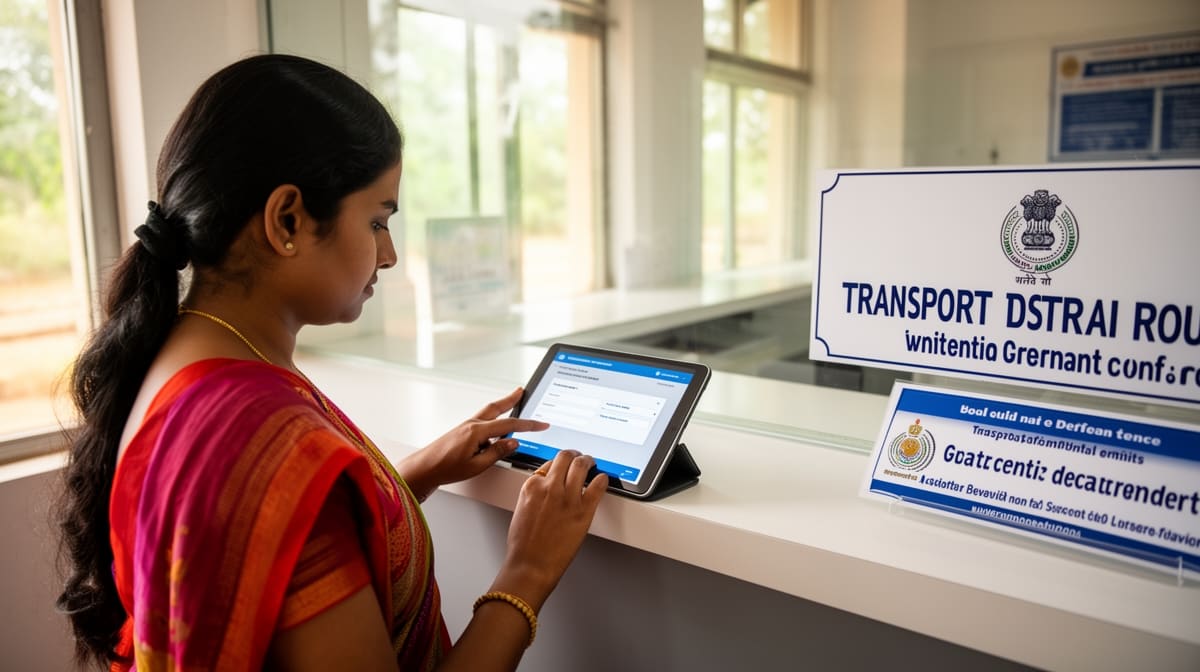
The Madras High Court has reinforced the principle that administrative authorities cannot refuse to accept legally prescribed online applications on technical grounds. In a clear directive to the Regional Transport Officer, the Court mandated the receipt and substantive consideration of an auto rickshaw permit application filed through the designated digital portal, affirming that procedural compliance with digital systems is not optional but a constitutional obligation under Article 226.
Background & Facts
The Dispute
The petitioner, K. Andiyammal, sought an auto rickshaw permit to operate within a 30 km radius of Yercaud Bus Stand in Salem District. She submitted her application on 05.01.2026 in Form CCPA, accompanied by the prescribed fee, through the official online portal as mandated by state transport regulations. The respondent, the Regional Transport Officer, Salem East, refused to receive the application, citing alleged non-compliance with procedural norms, despite the application being submitted through the government-designated digital channel.
Procedural History
The petitioner filed this writ petition under Article 226 of the Constitution of India, seeking a writ of mandamus to compel the RTO to accept and process her application. The matter was heard on an expedited basis due to its similarity to two prior judgments of the same Court:
- WP No.13551 of 2025 (A. Rajavel v. RTO, Salem East), decided on 16.04.2025, directed the RTO to receive online applications and decide on merits within eight weeks.
- WP No.17275 of 2025, decided shortly thereafter, followed the same principle.
Relief Sought
The petitioner sought a direction to the respondent to receive her application filed on 05.01.2026 in Form CCPA via the online portal, and to decide the same on its merits within a stipulated time.
The Legal Issue
The central question was whether an administrative authority can refuse to receive a digitally submitted permit application that complies with the prescribed form and fee, merely on the ground of alleged procedural irregularities, when the state has itself mandated online submission as the primary mode of application.
Arguments Presented
For the Petitioner
Counsel for the petitioner relied on the precedents set in A. Rajavel v. RTO, Salem East and WP No.17275 of 2025, arguing that the State’s own digital infrastructure must be respected. He contended that rejecting applications on technicalities defeats the purpose of digitization and violates the principle of reasonable administrative conduct under Article 14. He emphasized that the application was complete, properly formatted, and paid for through the official portal.
For the Respondent
The Government Advocate did not dispute the factual compliance of the application but argued that the RTO retained discretion to reject applications on grounds of non-conformity with internal guidelines. No statutory provision or rule was cited to support this claim, and no evidence was produced to show that the petitioner’s submission deviated from Form CCPA requirements.
The Court's Analysis
The Court observed that the State had explicitly introduced Form CCPA and the online submission mechanism to streamline the permit process and eliminate arbitrary discretion. Refusing to receive an application that meets all formal requirements is not an exercise of discretion - it is an abdication of statutory duty.
"The State cannot mandate online submission as the sole mode of application and then refuse to receive applications submitted through that very channel on speculative grounds."
The Court noted that the identical issue had been settled in two prior judgments, and there was no material distinction in the facts of the present case. The principle of stare decisis required uniformity in judicial direction. The Court further held that the RTO’s failure to act on the application amounted to a violation of the petitioner’s right to equal treatment under Article 14 and the right to livelihood under Article 21.
The Court emphasized that the duty to receive and decide applications is not discretionary but mandatory. The eight-week timeline for decision was imposed to prevent indefinite delay, which would render the remedy illusory.
The Verdict
The petitioner succeeded. The Court held that administrative authorities must accept digitally submitted applications that comply with prescribed form and fee, and must decide them on merits within eight weeks. The writ petition was disposed of with a direction to the RTO to receive the application and decide it within the stipulated period.
What This Means For Similar Cases
Online Applications Cannot Be Rejected on Technical Grounds
- Practitioners must now assert that if a digital application is submitted through the government’s designated portal, meets the form requirements, and includes payment, refusal to receive it is ultra vires.
- Any claim of "non-compliance" must be substantiated with specific, objective deviations - not vague assertions.
Mandamus Is Available for Failure to Receive Applications
- Writs of mandamus are not limited to failures to decide, but extend to failures to even receive applications that are complete and properly filed.
- This expands the scope of judicial review in administrative law to include pre-decisional procedural obstruction.
Digitization Mandates Procedural Uniformity
-
Government digitization initiatives create binding obligations on officials to use the system as intended.
-
Internal guidelines that contradict statutory or publicly notified digital procedures are unenforceable.
-
File writ petitions immediately if an online application is rejected without substantive reason.
-
Cite A. Rajavel v. RTO and this judgment to establish binding precedent in Tamil Nadu.
-
Demand compliance with the eight-week timeline in all pending permit applications.