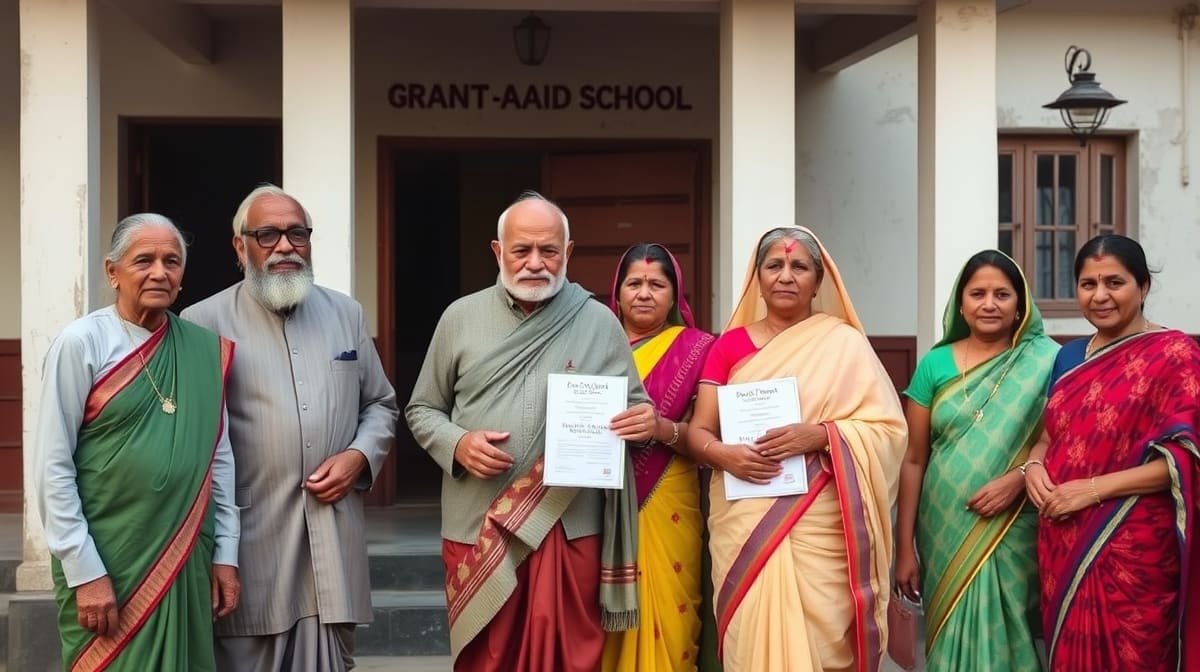
The Bombay High Court has directed the Maharashtra government to extend 100% grant-in-aid to Adarsh Madhyamik Vidyalay, Beed from 30.06.2014, holding that the absence of a distinguishing factor justified the denial of benefits to the petitioners' institution. The Court allowed the writ petition, directing the release of grant-in-aid and arrears within six months.
Background & Facts
The Genesis
The petitioners are employees of Adarsh Madhyamik Vidyalay, Beed, a school run by respondent No.4-Institution. The school was initially granted permission on a permanent non-grant basis. However, subsequent changes in government policy led to the deletion of the word 'permanent' from the grant-in-aid scheme.
Key Facts
- The school was initially granted permission on a permanent non-grant basis.
- A Government Resolution dated 20/07/2009 deleted the word 'permanent' from the grant-in-aid policy.
- The Government issued a Government Resolution on 15/11/2011, calling for proposals from schools for grant-in-aid.
- The school's proposal was submitted, and certain minor deficiencies were noted. A fresh proposal was submitted subsequently.
- Another Government Resolution dated 30.06.2014 decided to provide grant-in-aid in a phase-wise manner: 20% for the academic year 2013-14, 40% for 2014-15, and 100% from the academic year 2017-18.
- Despite the school being found eligible, it was not brought on 100% grant-in-aid basis.
- The petitioners argued that other schools in Beed district and other districts were brought on 100% grant-in-aid basis without any distinguishing factor.
Procedural History
- The petitioners approached the High Court with a grievance that the Government had not brought the school on 100% grant-in-aid as per government policy.
- The case was taken for final disposal at the admission stage by consent of the parties.
The Parties' Positions
Petitioners' Case:
- The Government had taken a decision to provide grant-in-aid in a phase-wise manner but had not granted 100% grant-in-aid to the school.
- The petitioners relied on judgments in Writ Petition No.5208/2018 and Writ Petition No.11011/2018, where this Court directed the respondents to extend grant-in-aid benefits to eligible institutions.
Respondents' Case:
- The Government argued that it is the right of the Government to recognize schools for grant-in-aid based on inspection reports and priorities.
- The Government contended that there was no discrimination, only a question of priority.
The Legal Issue
The central question was whether the Government's refusal to extend 100% grant-in-aid to Adarsh Madhyamik Vidyalay, Beed, despite its eligibility, amounted to discrimination and violated the principles of equality enshrined in the Constitution of India.
Arguments Presented
For the Petitioners
The petitioners argued that the Government had taken a decision to provide grant-in-aid in a phase-wise manner but had not granted 100% grant-in-aid to the school despite its eligibility. They relied on judgments in Writ Petition No.5208/2018 and Writ Petition No.11011/2018, where this Court directed the respondents to extend grant-in-aid benefits to eligible institutions. The petitioners contended that the Government had not shown any distinguishing factor to deny grant-in-aid to the school.
For the Respondent
The Government argued that it is the right of the Government to recognize schools for grant-in-aid based on inspection reports and priorities. The Government contended that there was no discrimination, only a question of priority. It was submitted that the Government could not be compelled to extend grant-in-aid to every eligible institution simultaneously.
The Court's Analysis
The Court examined the Government's policy and the eligibility of the school. It noted that the Government had decided to extend grant-in-aid in a phase-wise manner and that the school was found eligible for 100% grant-in-aid from the academic year 2017-18. However, the school had not been brought on 100% grant-in-aid basis despite its eligibility.
The Court observed that the Government had not shown any distinguishing factor to deny grant-in-aid to the school. It relied on its earlier judgments in Writ Petition No.5208/2018 and Writ Petition No.11011/2018, where it had directed the respondents to extend grant-in-aid benefits to eligible institutions.
"This Court, in Writ Petition No.11011/2018 by considering various judgments, found that the institutions in those petitions were held eligible to receive grants and still no grants were paid. In the present case, the Government could not show any distinguishing factor to deny grant-in-aid to respondent No.4-Institution."
The Court held that the absence of a distinguishing factor justified the denial of benefits to the school, amounting to discrimination.
The Verdict
The Court allowed the writ petition and directed the respondents to extend the benefits and sanction and release grant-in-aid in favour of Adarsh Madhyamik Vidyalay, Beed, run by respondent No.4-Institution. The grant was to be paid from the date of eligibility, i.e., 30.06.2014, along with arrears within a period of six months from the date of the order.
What This Means For Similar Cases
Grant-in-Aid Is Not Discretionary
The judgment clarifies that grant-in-aid, once eligibility is established, cannot be arbitrarily denied without a distinguishing factor. Institutions found eligible must receive benefits as per government policy.
Phase-Wise Implementation Must Be Uniform
- The Government cannot selectively implement phase-wise grant-in-aid policies without valid reasons.
- Institutions eligible for higher phases must receive benefits without undue delay.
- Courts will intervene if eligibility is established but benefits are denied without justification.
Discrimination in Policy Implementation Is Actionable
- The absence of a distinguishing factor in denying benefits amounts to discrimination.
- Institutions can challenge arbitrary denial of grant-in-aid if similarly situated institutions receive benefits.
- Courts will direct the release of benefits and arrears if eligibility is established.