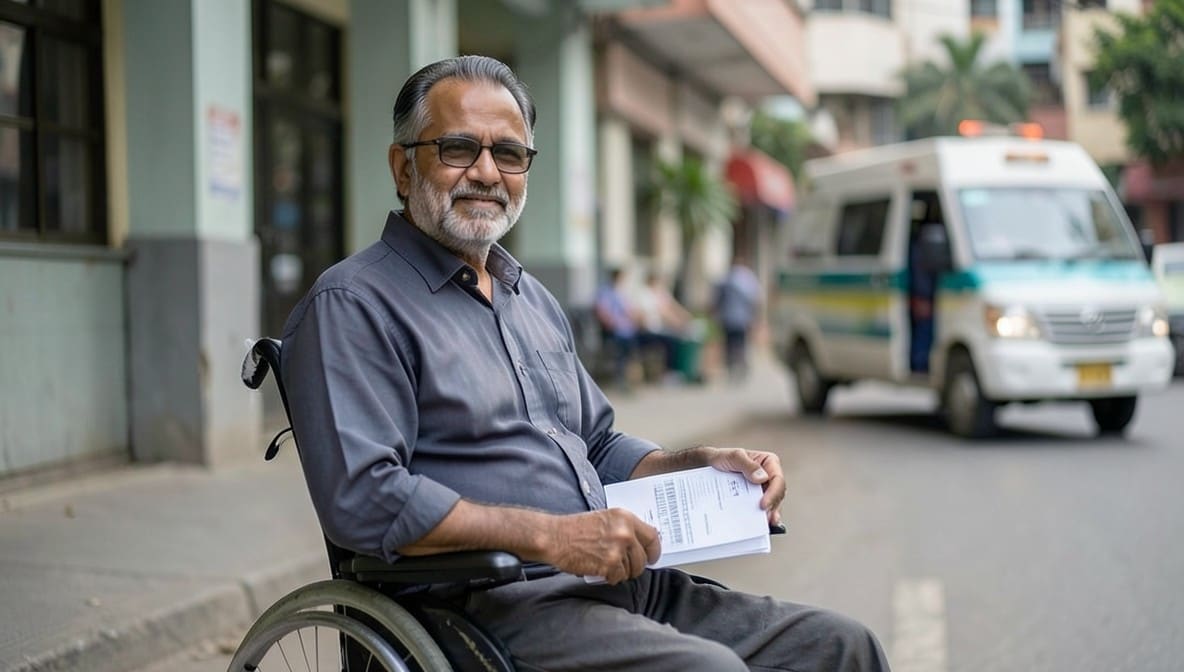
The Punjab and Haryana High Court has clarified that in motor accident claims, a claimant suffering 100% functional disability due to bilateral amputation is entitled to full compensation for loss of earning capacity, irrespective of the absence of documentary income proof. The judgment reinforces the principle that functional incapacity, not mere physical injury, must drive the assessment of future losses.
Background & Facts
The Dispute
The appellant, Ishwar Singh, was a passenger in a jeep bearing registration No. HR-16A-0706 on 07.02.1999 when, due to dense fog, the vehicle collided with a tractor and came to a standstill on the roadside. Subsequently, another jeep, bearing registration No. HR-16A-6098 and driven rashly and negligently, rammed into the stationary vehicle. The collision resulted in the death of the driver of the first jeep and grievous injuries to the appellant. The appellant sustained multiple injuries leading to the amputation of both legs below the knee, rendering him permanently and totally disabled.
Key Facts
- The accident occurred on 07.02.1999 in Haryana
- The appellant was 45 years old at the time of the accident
- Medical records and a duly proved disability certificate established 100% permanent functional disability
- The appellant claimed a monthly income of ₹3,500/- but produced no salary slips, bank statements, or tax returns
- He was engaged in self-employed work, though the nature was not specified
- The Motor Accident Claims Tribunal, Rohtak, awarded ₹3,30,000/- as compensation on 20.07.2001
- The appellant filed this appeal challenging only the inadequacy of compensation, not the finding of negligence
Procedural History
- 07.02.1999: Date of accident
- Before 20.07.2001: Claim petition filed under the Motor Vehicles Act seeking ₹10,00,000/-
- 20.07.2001: Motor Accident Claims Tribunal, Rohtak, awarded ₹3,30,000/-
- 01.04.2026: Appeal heard and reserved
- 02.04.2026: Judgment pronounced by the Punjab and Haryana High Court
Relief Sought
The appellant sought enhancement of compensation to reflect full loss of earning capacity, additional damages for pain and suffering, loss of amenities, and future attendant care, arguing that the Tribunal’s award was inadequate and failed to apply settled legal principles.
The Legal Issue
The central question was whether a claimant suffering 100% functional disability due to bilateral leg amputation is entitled to full compensation for loss of future earning capacity, even in the absence of documentary proof of income, and whether the Tribunal erred in not applying the multiplier and future prospects correctly.
Arguments Presented
For the Appellant
Learned counsel contended that the Tribunal failed to appreciate the legal principle laid down in Raj Kumar v. Ajay Kumar (2011 ACJ 1), which holds that where an injury results in total incapacity to carry on any vocation, functional disability must be treated as 100%. He argued that the appellant’s age (45 years) warranted the application of a multiplier of 14, and that even without documentary income proof, the court must rely on minimum wages under National Insurance Company Limited v. Pranay Sethi (2017) 16 SCC 680. He further submitted that the Tribunal ignored the entitlement to compensation for pain and suffering, loss of amenities, and attendant care.
For the Respondent
Counsel for the insurance company did not dispute the extent of disability but argued that the absence of any documentary evidence of income rendered the appellant’s claim speculative. He submitted that the Tribunal’s award of ₹3,30,000/- was reasonable and that enhancing compensation without verified income would set a dangerous precedent.
The Court's Analysis
The Court observed that the finding of negligence against the driver of the second jeep had attained finality, as no respondent had challenged it. The scope of the appeal was therefore confined to the quantum of compensation. The Court emphasized that the distinction between physical and functional disability is critical in assessing loss of earning capacity. Citing Raj Kumar v. Ajay Kumar, the Court held that where an injury results in total incapacity to pursue any occupation, functional disability must be deemed 100%, regardless of the claimant’s prior income.
"In cases where the injury results in total incapacitation to carry on the vocation, the functional disability has to be treated as 100%."
Regarding income, the Court noted the absence of documentary proof but relied on the principle in National Insurance Company Limited v. Pranay Sethi, which permits the use of minimum wages as a baseline for self-employed persons. The Court adopted the Haryana minimum wage of ₹1,901/- per month in 1999, rounded to ₹1,900/- per month (₹22,800/- per annum). Applying a 25% addition for future prospects, as mandated for claimants under 55 years, the annual income was enhanced to ₹28,500/-. Multiplying this by the appropriate multiplier of 14 (for age 45), the loss of future earning capacity was calculated at ₹3,99,000/-.
The Court further held that compensation for non-pecuniary losses must be substantial given the gravity of bilateral amputation. Citing R.D. Hargange v. Pest Control (India) Pvt. Ltd. (1995 SCC 1 551), it awarded ₹25,000/- for pain and suffering and ₹1,00,000/- for loss of amenities. For attendant care, the Court accepted a modest monthly cost of ₹1,000/- and applied the same multiplier of 14, resulting in ₹1,68,000/-. The Tribunal’s award of ₹30,000/- for medical expenses was affirmed.
The Verdict
The appeal was partly allowed. The appellant is entitled to an enhanced compensation of ₹3,92,000/-, to be paid jointly and severally by respondents Nos. 4 and 5, along with interest at 7.5% per annum from the date of filing of the claim petition until realization. The total compensation, inclusive of the original award, amounts to ₹7,22,000/-. No order as to costs.
What This Means For Similar Cases
Functional Disability Trumps Physical Injury Assessment
- Practitioners must now argue that 100% functional disability from catastrophic injuries (e.g., bilateral amputation, spinal cord injury) warrants full loss of earning capacity, irrespective of prior income
- Disability certificates must be treated as conclusive proof of functional incapacity under Raj Kumar v. Ajay Kumar
- Courts cannot reduce compensation merely because the claimant was self-employed or lacked formal income records
Minimum Wage as Baseline for Income Estimation
- In the absence of income proof, courts must use the applicable state minimum wage as the starting point for calculating earning capacity
- Future prospects of 25% must be added for claimants under 55 years, as per Pranay Sethi
- Multipliers must be applied strictly based on age, not arbitrarily reduced
Non-Pecuniary Heads Require Substantial Awards
- Pain and suffering, loss of amenities, and attendant care are not discretionary but mandatory components of compensation
- Awards for these heads must reflect the severity of permanent disability, not be nominal or token
- Attendant care costs must be calculated using realistic monthly estimates and the same multiplier as loss of earnings