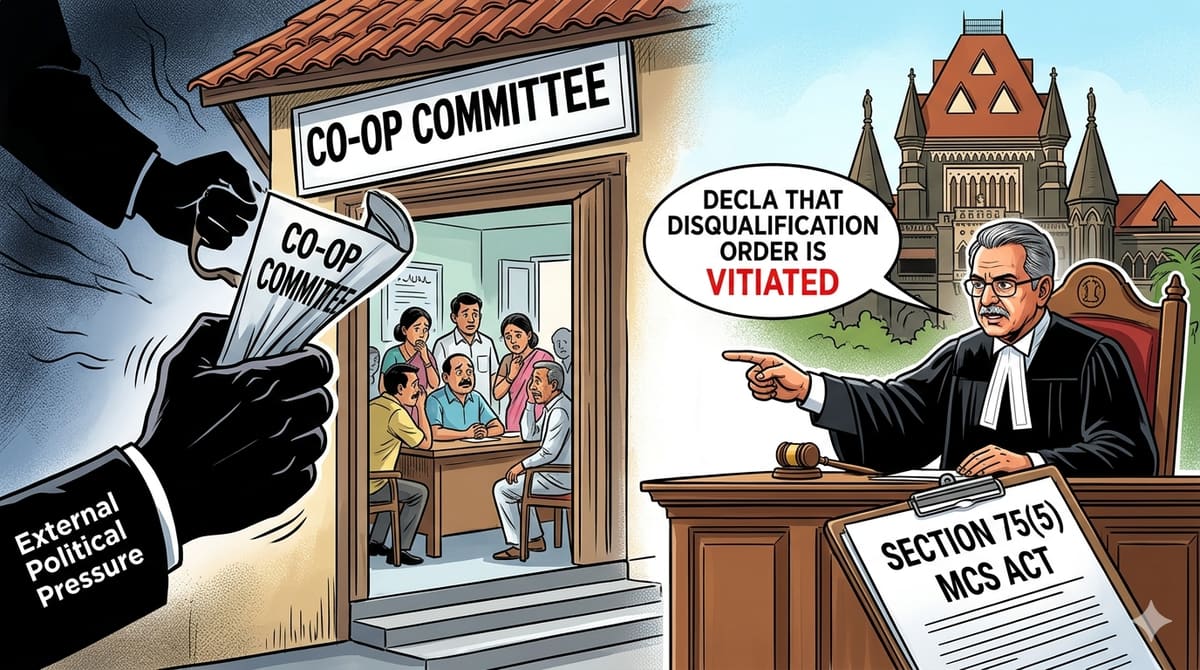
The Bombay High Court has affirmed that a national sports federation’s policy-making body - the General Council - retains legal authority to disaffiliate member units even when its executive functions are suspended by the government. This judgment clarifies the constitutional boundaries of authority within self-governed sports bodies and reinforces the principle that suspension of operational functions does not equate to suspension of structural governance.
Background & Facts
The Dispute
The petitioner, Maharashtra Wrestling Association (MWA), a trust registered under the Maharashtra Public Trusts Act, 1950, was affiliated with the Wrestling Federation of India (WFI) since 1960 and was the sole recognized state-level wrestling body in Maharashtra. The dispute arose when WFI, through its General Council, disaffiliated MWA on 18/04/2023 and granted affiliation to Maharashtra Rajya Kustigir Sangh (Kustigir Sangh), the fifth respondent. MWA challenged this action as illegal, arbitrary, and violative of natural justice, alleging that WFI lacked authority to act due to a government-imposed suspension of its activities.
Key Facts
- MWA was affiliated with WFI continuously since 1960 and was recognized by the Maharashtra Olympic Association.
- On 30/06/2022, WFI’s Executive Committee passed a resolution to dissolve MWA, which was challenged and set aside by the Bombay High Court on 09/11/2022 in Writ Petition No. 12237/2022.
- The High Court held that MWA’s elected body would continue to function until its tenure ended in December 2023.
- On 15/11/2022, WFI issued a show-cause notice to MWA alleging:
- Failure to hold elections since 2015 without seeking WFI’s permission
- Non-submission of audited accounts and annual reports
- Organizing commercial tournaments (Maharashtra Kesari) without WFI’s approval
- Misuse of government grants and falsification of documents
- Fudging of wrestlers’ age records
- MWA responded to the notice on 22/11/2022 and 02/12/2023.
- On 21/01/2023, the Ministry of Youth Affairs and Sports suspended all “ongoing activities” of WFI due to allegations of sexual harassment, financial mismanagement, and administrative arbitrariness against its leadership.
- An Oversight Committee was appointed on 23/01/2023 with a mandate to complete its inquiry within four weeks.
- The Oversight Committee submitted its report on 05/04/2023 and ceased to exist.
- On 03/04/2023, WFI’s Disciplinary Committee submitted a report recommending disaffiliation of MWA based on findings of financial irregularities, misuse of WFI’s name, and failure to conduct national competitions.
- On 16/04/2023, WFI’s General Council ratified the recommendation and disaffiliated MWA, granting affiliation to Kustigir Sangh.
- On 18/04/2023, WFI formally issued the disaffiliation order.
- On 21/07/2023, the Returning Officer of WFI elections rejected MWA’s claim to nominate members to the electoral college, citing lack of valid affiliation.
- On 21/12/2023, the newly elected General Council of WFI ratified the disaffiliation of MWA and affiliation of Kustigir Sangh.
- Kustigir Sangh subsequently obtained affiliation from the Maharashtra Olympic Association and the Indian Olympic Association.
Procedural History
- 30/06/2022: WFI Executive Committee resolves to dissolve MWA.
- 09/11/2022: Bombay HC quashes dissolution order; affirms MWA’s elected body continues till December 2023.
- 15/11/2022: WFI issues show-cause notice to MWA.
- 21/01/2023: Ministry suspends “ongoing activities” of WFI; appoints Oversight Committee.
- 23/01/2023: Oversight Committee formally appointed with a 4-week mandate.
- 03/04/2023: Disciplinary Committee recommends disaffiliation of MWA.
- 16/04/2023: WFI General Council approves disaffiliation of MWA and affiliation of Kustigir Sangh.
- 18/04/2023: WFI issues formal disaffiliation order.
- 21/07/2023: Returning Officer rejects MWA’s nomination to electoral college.
- 05/04/2023: Oversight Committee submits report and ceases to exist.
- 24/04/2023: Ministry declares WFI’s election process null and void; directs IOA to form Transitory Committee.
- 21/12/2023: Newly elected General Council of WFI ratifies disaffiliation of MWA and affiliation of Kustigir Sangh.
- 31/07/2023: Writ Petition No. 9607/2023 filed by MWA.
- 15/06/2026: Bombay HC delivers judgment.
The Parties' Positions
Petitioner (MWA): Argued that WFI’s authority was suspended on 21/01/2023, rendering the General Council legally incompetent to act. Contended that the Disciplinary Committee was invalid without an Executive Committee, and that the disaffiliation order was procedurally flawed, politically motivated, and violated natural justice.
Respondents (WFI, Union of India, Kustigir Sangh): Contended that the Ministry’s suspension applied only to day-to-day operational functions of the Executive Committee, not to the General Council. Asserted that the General Council, as the sovereign policy-making body, retained full authority to disaffiliate under Article XXVI of the WFI Constitution. Argued that MWA was afforded due process through show-cause notice and hearing, and that the findings of financial misconduct were substantiated.
Relief Sought
MWA sought:
- Quashing of the disaffiliation order dated 18/04/2023
- Quashing of the Returning Officer’s order dated 21/07/2023
- Declaration that Kustigir Sangh’s affiliation is invalid
- Mandamus directing WFI to reinstate MWA’s affiliation
- Stay on implementation of all impugned orders
The Legal Issue
The central question was whether the General Council of the Wrestling Federation of India retained the legal authority to disaffiliate a member association under its Constitution when the Union of India had suspended the “ongoing activities” of the Federation’s Executive Committee, and whether such suspension extended to the policy-making body of the Federation.
Arguments Presented
For the Petitioner
The petitioner, through Senior Advocate Darius Khambata, argued that the Ministry’s order dated 21/01/2023 suspending “all activities” of WFI rendered the entire governance structure - including the General Council, Executive Committee, and Disciplinary Committee - legally inoperative. Relied on the principle that a suspended body cannot exercise any function, including quasi-judicial or policy-making roles. Cited Article XXVI of the WFI Constitution, which requires action to be taken on the recommendation of the President or Executive Committee, neither of which could function during suspension. Argued that the Disciplinary Committee, being a sub-committee of the Executive Committee, was invalidly constituted. Asserted that the disaffiliation was a politically motivated act to eliminate a dissenting body and violated principles of natural justice, as MWA was not served with the 18/04/2023 order. Invoked BCCI v. Cricket Association of Bihar and Zee Telefilms to argue that WFI, as a public functionary, was subject to judicial review.
For the Respondent
The Union of India and WFI, represented by Senior Advocates Abhay Khandeparkar and Yash Momaya, countered that the Ministry’s suspension was narrowly confined to “ongoing activities” such as ranking competitions and day-to-day administration - not the structural or constitutional functions of the General Council. Emphasized that the General Council is a permanent, elected body comprising representatives of state associations and is not an operational unit. Cited the Ministry’s clarification dated 24/04/2023, which explicitly targeted only the Executive Committee and not the General Council. Argued that the Disciplinary Committee’s function was quasi-judicial and not an “activity” subject to suspension. Highlighted that MWA participated voluntarily in the proceedings before the Disciplinary Committee and did not raise any objection to jurisdiction at the time. Noted that the disaffiliation was ratified by the newly elected General Council on 21/12/2023, rendering the challenge moot. Asserted that WFI is not a “State” under Article 12 but is amenable to writ jurisdiction under Article 226 due to its public function, and that the petition was maintainable.
The Court's Analysis
The Court undertook a detailed examination of the WFI Constitution, the Ministry’s orders, and the nature of the General Council’s role. It held that the General Council is not an operational body but the sovereign policy-making authority of the Federation, composed of elected representatives from state associations, and is constitutionally distinct from the Executive Committee.
"The General Council is the Federation’s electorate, its sovereign body, the source of its authority and therefore, it is incorrect to presume that it stood suspended by the Government of India."
The Court noted that the Ministry’s order dated 21/01/2023 explicitly suspended only “ongoing activities,” including ranking competitions and financial disbursements, and directed the Executive Committee to abstain from day-to-day administration. There was no mention of suspending the General Council, nor did the Ministry possess any statutory power under the Societies Registration Act, 1960, to suspend a society’s governing body.
The Court further held that the Disciplinary Committee, though appointed from the Executive Committee, performed a quasi-judicial function under Article XIX and XXVI of the Constitution. Its report was not an operational act but a recommendation subject to ratification by the General Council. The fact that MWA participated in the proceedings without objection and that the report was subsequently ratified by the newly elected General Council on 21/12/2023 rendered the challenge to the process legally untenable.
The Court declined to examine the merits of the allegations against MWA, noting that its jurisdiction under Article 226 is limited to procedural fairness, not factual adjudication. It found that MWA had been served with a show-cause notice, given an opportunity to respond, and that the Disciplinary Committee’s findings were based on documented evidence of financial irregularities and misuse of WFI’s name.
Regarding the Returning Officer’s order dated 21/07/2023, the Court held that it was a balanced and cautious decision, refusing to allow either faction to nominate members to the electoral college due to the unresolved dispute over affiliation. The Court observed that the matter had since been resolved by the ratification of affiliation to Kustigir Sangh and that MWA had not challenged the 21/12/2023 ratification.
The Verdict
The petition was dismissed. The Bombay High Court upheld the disaffiliation of the Maharashtra Wrestling Association by the Wrestling Federation of India dated 18/04/2023, affirmed the Returning Officer’s order dated 21/07/2023, and declined to set aside the affiliation of Maharashtra Rajya Kustigir Sangh. The Court held that the General Council retained constitutional authority to act despite suspension of the Executive Committee’s operational functions, and that the disaffiliation process complied with natural justice. No costs were awarded. The interim application was disposed of.
What This Means For Similar Cases
Governance Bodies Are Structurally Distinct from Operational Units
- Practitioners must distinguish between a federation’s policy-making body (e.g., General Council) and its executive/operational body (e.g., Executive Committee) when challenging suspensions.
- Suspension of day-to-day activities does not automatically invalidate constitutional powers vested in permanent, elected governing bodies.
- Legal challenges must be framed around the specific function being exercised, not the general status of the organization.
Ratification by a Legally Constituted Body Can Cure Procedural Defects
- A decision initially taken by a body under disputed authority may be validated if later ratified by a fully constituted, legally elected body.
- Failure to challenge such ratification within a reasonable time may render the original challenge moot.
- Practitioners must monitor subsequent ratifications and file timely challenges to avoid procedural estoppel.
Quasi-Judicial Functions Are Not Automatically Suspended
- Disciplinary and quasi-judicial functions of sports federations are not considered “activities” subject to administrative suspension unless explicitly prohibited.
- Participation in proceedings without objection waives the right to later challenge jurisdiction on grounds of suspension.
- Sports federations may proceed with disciplinary actions during government oversight if the Constitution permits and due process is followed.