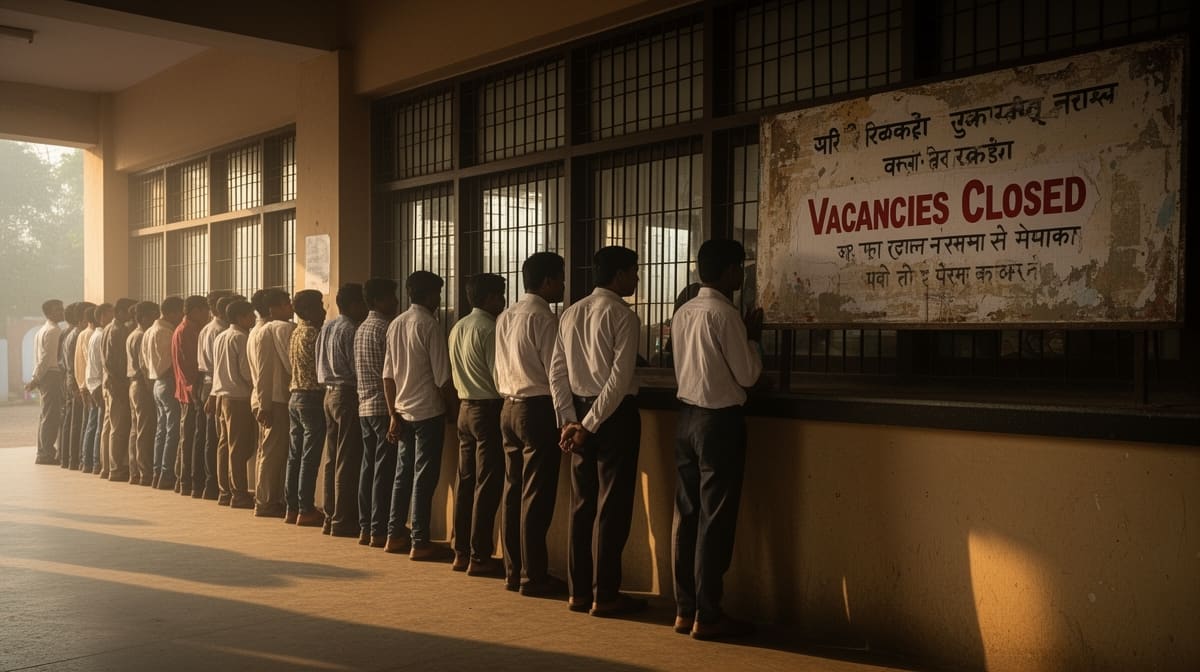
The Jharkhand High Court has upheld the constitutional validity of the Jharkhand Law Officer Engagement Rules, 2026, while striking down Rule 3(7) as incurably vague and manifestly arbitrary. The Division Bench, comprising Chief Justice M.S. Sonak and Justice Manoj Prasad, rejected challenges to the Rules' source of power, eligibility criteria, and restrictions on Law Research Officers, but directed the State Government to reconsider the monthly retainer fee of Rs 20,000 for Law Research Officers, which falls below the minimum wage for highly skilled labour in the State.
Background & Facts
The Dispute
Three writ petitions were filed challenging the Jharkhand Law Officer Engagement Rules, 2026 (notified on 25 June 2026), and two subsequent notifications dated 24 July 2026 determining cadre strength and fee structure for Law Officers. The petitioners - a practicing advocate, a public interest litigant, and the Young Lawyers' Association of Jharkhand High Court - contended that the Rules were ultra vires Articles 14, 19, 162, 165, and 217 of the Constitution and Section 30 of the Advocates Act, 1961.
Key Facts
- The Jharkhand Law Officer Engagement Rules, 2026 were notified on 25 June 2026 (Annexure-I)
- Two notifications dated 24 July 2026 determined: (i) cadre strength of Law Officers (Annexure-II), and (ii) monthly retainership fees (Annexure-III)
- A Notice Inviting Online Applications for Law Officer posts was issued by the Principal Secretary-cum-Legal Remembrancer (Annexure-IV)
- The Rules purported to be framed under the proviso to Article 309 of the Constitution
- Rule 6 prescribed graded experience requirements: 15 years for Senior Additional Advocate General, 12 years for Additional Advocate General and Standing Counsel (High Court), 20 years for Supreme Court Standing Counsel and arguing counsel
- Rule 9 barred Law Research Officers (requiring 2-5 years practice) from appearing in courts or accepting private briefs during engagement
- Rule 3(7) mandated that Boards, Corporations, and other authorities funded by the State engage counsel only from the State's panel through the Advocate General
- The notification dated 24 July 2026 fixed monthly retainer for Law Research Officers at Rs 20,000
- The State's minimum wage notification dated 25 May 2026 prescribed Rs 21,336 for highly skilled workers in Ranchi Municipal Corporation area (Category-A)
- Previous working strength was 145 Law Officers and Associate Counsel; new Rules provided for 81 posts (66 arguing counsel + 15 Law Research Officers)
Procedural History
- 25 June 2026: Jharkhand Law Officer Engagement Rules, 2026 notified
- 24 July 2026: Two notifications issued - cadre strength determination and fee structure
- 2026: W.P.(C) No. 6967 of 2026 filed by Lal Gyan Ranjan Nath Shah Deo
- 2026: W.P.(PIL) No. 6148 of 2026 filed by Rajeev Kumar Singh
- 2026: W.P.(Filing) No. 9721 of 2026 filed by Young Lawyers' Association
- 5 October 2026: Matters reserved for judgment
- 27 October 2026: Judgment pronounced by Division Bench
The Parties' Positions
Petitioners argued: (1) Rules cannot be framed under Article 309 as Law Officers are not State employees; (2) Rule 6's experience requirements exceed constitutional minimums for Advocate General (10 years) and High Court Judges (10 years); (3) Rule 9 violates Article 19(1)(g) and Section 30 Advocates Act; (4) Rule 3(7) encroaches on statutory autonomy of Boards/Corporations; (5) Fee structure is arbitrary, especially Rs 20,000 for Law Research Officers; (6) Notice Inviting Applications should have been issued by Advocate General.
State (Respondents) contended: (1) Rules derive from Article 162 (executive power), erroneous Article 309 reference not fatal; (2) Experience requirements are policy decisions with rational nexus; (3) Rule 9 restriction is co-extensive with voluntary paid retainer, saved by Article 19(6); (4) Rule 3(7) is a coordination mechanism; (5) Fee determination is economic policy; (6) Notice issued by Member Secretary of Selection Committee; (7) Petitioners lack locus standi.
Relief Sought
Petitioners sought: (i) Declaration that Rules are ultra vires and unconstitutional; (ii) Quashing of notifications dated 24 July 2026; (iii) Quashing of Notice Inviting Applications; (iv) Direction to frame fresh Rules in compliance with State of Punjab v. Brijeshwar Singh Chahal (2016) 6 SCC 1.
The Legal Issue
The central questions were: (1) Whether the Jharkhand Law Officer Engagement Rules, 2026, are invalid for citing Article 309 instead of Article 162 as the source of power; (2) Whether prescribing more than 10 years' legal practice for Law Officer posts violates Articles 165 and 217; (3) Whether Rule 9's restriction on Law Research Officers' private practice violates Article 19(1)(g) and Section 30 of the Advocates Act; (4) Whether Rule 3(7) impermissibly controls statutory bodies' choice of counsel; (5) Whether the fee structure and cadre strength notifications are arbitrary; (6) Whether the Notice Inviting Applications issued by the Principal Secretary-cum-Legal Remembrancer degrades the Advocate General's office.
Arguments Presented
For the Petitioners
Counsel relied on Vijay Kumar Vimal v. State of Bihar (2018 SCC OnLine Pat 1541) where the Patna High Court struck down similar Rules. They argued that Law Officers are not State employees, so Article 309 does not apply. On Rule 6, they contended that Articles 165(1) and 217 prescribe only 10 years' practice for Advocate General and High Court Judges, so higher requirements for subordinate posts are ultra vires. On Rule 9, they submitted the embargo on private practice violates the fundamental right to practice under Article 19(1)(g) and Section 30 Advocates Act. On Rule 3(7), they argued executive instructions cannot override statutory autonomy of Boards/Corporations. On fees, they highlighted Rs 20,000 is below minimum wage for highly skilled labour. On the Notice, they cited U.P. State Law Officers Ministerial Staff Association v. State of U.P. (2023:AHC:219833-DB) requiring Advocate General's signature.
For the Respondent/State
Senior Advocate Meenakshi Arora admitted Article 309 reference was erroneous but submitted Rules derive from Article 162, citing M.T. Khan v. Government of A.P. (2004) 2 SCC 267 and State of Karnataka v. Muniyalla (1985) 1 SCC 196. She argued experience requirements are policy decisions with minimal judicial review, citing J. Rangaswami v. Government of Andhra Pradesh (1990) 1 SCC 288. On Rule 9, she submitted the bar is co-extensive with voluntary retainer, enrolment not cancelled, right under Section 30 not withdrawn, citing Modern Dental College v. State of M.P. (2016) 7 SCC 353. On Rule 3(7), she argued Government can control funded bodies' counsel engagement. On fees, she submitted determination is economic policy, several applicants applied despite Rs 20,000. On Notice, she argued issuance by Member Secretary of Selection Committee is administrative, not degrading Advocate General's office. She also challenged petitioners' locus standi.
The Court's Analysis
The Court first examined the nature of State Law Officers' engagement, relying on U.P. State Law Officers Association v. State of U.P. (1994) 2 SCC 204. The Supreme Court held these are "predominantly professional contractual engagements between a professional and a client for a specified or unspecified period" - not employment. The lawyer-client relationship is one of trust and confidence, applying equally to public bodies. However, as trustees of public interest, the State must engage the most competent counsel through merit-based selection.
On judicial review scope, the Court applied the Tata Cellular v. Union of India (1994) 6 SCC 651 principles: review concerns decision-making process, not merits; grounds are illegality, irrationality, procedural impropriety. In Johri Mal (AIR 2004 SC 3800), the Supreme Court held courts are "normally chary of overturning" State's counsel engagement decisions unless exceptional case is made out. Policy decisions attract minimal review unless arbitrary, discriminatory, mala fide, or contrary to constitutional/statutory provisions (Michigan Rubber v. State of Karnataka, 2012; Santosh B. Naik v. State of Goa, 2026 INSC 1089).
Article 309 reference error: The Court held the Rules derive authority from Article 162 (executive power), not Article 309. Citing M.T. Khan, State of Karnataka v. Krishnaji Shrinivas Kulkarni (1994) 2 SCC 558, and Union of India v. Tulsiram Patel (1985) 3 SCC 398, the Court ruled: "an order is not invalidated by the non-mention or incorrect mention of a provision of law, provided the power exists."* The error is not fatal.
Rule 6 (experience requirements): The Court distinguished constitutional posts (Advocate General, High Court Judge) from professional engagements under Article 162. Articles 165 and 217 prescribe minimum 10 years, not maximum. The State may prescribe higher qualifications for professional engagements. Graded requirements (12, 15, 20 years) have rational nexus with post responsibilities. Citing Chief Manager, PNB v. Amit Kumar Das (2021) 12 SCC 80, the Court held employer determines relevance of qualifications; courts are "not fit instruments to gauge experience or utility." The Vijay Kumar Vimal decision was distinguished - it did not lay down a blanket ceiling of 10 years.
Rule 9 (Law Research Officers' restriction): The Court applied the fourfold test from Modern Dental College: (1) legitimate aim - securing exclusive attention and confidentiality; (2) rational connection - desk-based research requires clean bar; (3) necessity - lesser restrictions would not prevent conflict; (4) balance - temporary condition of voluntary engagement vs State's interest. The restriction is "ex contractu" - advocate freely accepts engagement with honorarium. Enrolment not cancelled; right under Section 30 revives on disengagement. The Court noted analogous restrictions in Central Law Officers Rules 1987, Andhra Pradesh Rules 1999, and High Court Law Researcher schemes. Vijay Kumar Vimal was distinguished - there, assisting counsel were barred from arguing for Government after pleadings; here, appearance exclusion is part of post definition.
Rule 3(7) (Boards/Corporations' counsel choice): The Court found Rule 3(7) "incurably vague" and "manifestly arbitrary." The expressions "Boards, Corporations and other authorities" and "funded and run by the funds of the State Government" are undefined and admit multiple interpretations. The final sentence - "there shall be no retained counsel for such bodies in the department of State Government" - is "utterly incomprehensible."* Applying the void for vagueness doctrine (State of Madhya Pradesh v. Baldeo Prasad, AIR 1961 SC 293; K.A. Abbas v. Union of India, 1970; Kartar Singh v. State of Punjab, 1994; Shreya Singhal v. Union of India, 2015), the Court held the provision fails to provide fair notice and vests uncanalised discretion. Executive instructions under Article 162 cannot override statutory powers of Boards/Corporations to engage counsel (e.g., Section 523 Jharkhand Municipal Act, 2011). Rules 7(3) and 13 do not address this autonomy issue. Rule 3(7) is severable - its striking down does not impair remaining Rules.
Cadre strength notification: The Court found the State followed Brijeshwar Singh Chahal guidelines: Rules 3(4), 3(5) mandate workload assessment; Rule 4 constitutes Search Committee with Advocate General as Chairperson; Rule 5 constitutes Selection Committee. Strength increased from 29 to 66 arguing counsel. Judicial review minimal; no manifest arbitrariness shown.
Fee structure notification: The Court declined to strike down but expressed "prima facie reservations" on Rs 20,000 for Law Research Officers. The minimum wage for highly skilled labour in Ranchi (Category-A) is Rs 21,336 (basic Rs 19,396 + DA Rs 1,940). Paying less than minimum wage to professionals with 2-5 years practice "appears perilously close to the State exploiting the unfortunate plight of young Advocates."* The Court directed reconsideration within three months.
Notice Inviting Applications: Issuance by Principal Secretary-cum-Legal Remembrancer (Member Secretary of Selection Committee) is administrative; engagement follows committee recommendation including Advocate General. Does not infringe Article 165. U.P. State Law Officers Ministerial Staff Association does not lay down blanket proposition; even if it did, the Court respectfully disagreed.
Locus standi: Petitioners are practicing advocates/association directly affected by Rules governing their profession. Public interest in statutory bodies' autonomy and rule of law supports standing under Article 226. No requirement to have applied for posts.
The Verdict
The Division Bench disposed of the petitions with the following orders: (a) Rejected preliminary objection on locus standi; (b) Rejected challenge to Rules' Article 309 reference - Rules validly derive from Article 162; (c) Rejected challenges to Rule 6 (eligibility) and Rule 9 (Law Research Officers' restrictions); (d) Struck down Rule 3(7) as ultra vires Article 14 - incurably vague, manifestly arbitrary, impermissible encroachment on statutory autonomy; (e) Rejected challenge to cadre strength notification dated 24 July 2026; (f) Rejected challenge to fee structure notification dated 24 July 2026; (g) Directed State Government to reconsider monthly retainer fee for Law Research Officers (currently Rs 20,000) and decide within three months; (h) Rejected challenge to Notice Inviting Applications. No costs awarded. Rule made absolute in part.
What This Means For Similar Cases
Executive Power Can Sustain Professional Engagement Rules Despite Citation Error
- A Rule framed under Article 162 (executive power) for professional contractual engagements is not invalidated by erroneously citing Article 309 as the source
- Courts will trace the actual source of power; incorrect mention of constitutional provision is not fatal if power exists (M.T. Khan, Tulsiram Patel)
- Practical takeaway: When drafting Rules for Law Officers, cite Article 162 expressly to avoid litigation, but existing Rules with Article 309 reference survive challenge
Experience Requirements for Law Officers Are Policy Decisions With Minimal Judicial Review
- State may prescribe experience exceeding constitutional minimums (10 years for Advocate General/Judge) for subordinate Law Officer posts
- Graded requirements (12/15/20 years) for different categories are permissible if they have rational nexus with post responsibilities
- Courts will not evaluate comparative merits of qualifications (J. Rangaswami, PNB v. Amit Kumar Das)
- Practical takeaway: States have wide latitude to set eligibility criteria for Law Officers; challenges on arbitrariness grounds face high threshold
Restrictions on Private Practice During Full-Time State Engagement Are Constitutionally Permissible
- Rule 9-type restrictions (bar on court appearances and private briefs for Law Research Officers) are reasonable restrictions under Article 19(6)
- Restriction is co-extensive with voluntary paid retainer; enrolment under Advocates Act not cancelled; right revives on disengagement
- Fourfold test (Modern Dental College) applies: legitimate aim (confidentiality, undivided attention), rational connection, necessity, proportionality
- Analogous restrictions exist in Central Rules, State Rules, and High Court Law Researcher schemes
- Practical takeaway: States can impose full-time exclusivity conditions on Law Research Officers; advocates accepting such posts cannot later challenge the restriction
Executive Instructions Cannot Override Statutory Autonomy of Boards/Corporations
- Rule 3(7)-type provisions are void for vagueness if terms like "Boards, Corporations, other authorities," "funded and run by State funds" are undefined
- Statutory bodies (Municipal Corporations, PSUs, etc.) have independent power to engage counsel under their governing statutes
- Executive fiat cannot curtail this statutory autonomy, even if State provides funding
- Conflict of interest concerns must be addressed through statutory mechanisms, not executive instructions
- Practical takeaway: States must amend governing statutes of Boards/Corporations if they wish to control counsel engagement; standalone executive Rules will be struck down
Fee Structures for Law Officers Attract Minimal Review But Must Not Fall Below Minimum Wage Benchmarks
- Monthly retainer determination is economic policy; courts ordinarily do not substitute their judgment
- However, fees below minimum wage for highly skilled labour raise constitutional concerns under Article 14 and 21
- Court may not strike down but can direct reconsideration with specific timeline (here: three months)
- Practical takeaway: States should benchmark Law Research Officer retainers against minimum wage notifications; exploiting junior advocates' plight may invite judicial intervention
Notice Inviting Applications Need Not Be Issued by Advocate General Personally
- Administrative issuance by Member Secretary of Selection Committee (Principal Secretary, Law) is valid
- Engagement follows committee process where Advocate General participates
- Does not degrade constitutional office of Advocate General
- Practical takeaway: Routine administrative notices for Law Officer recruitment can be issued by Law Department; Advocate General's signature not constitutionally mandated