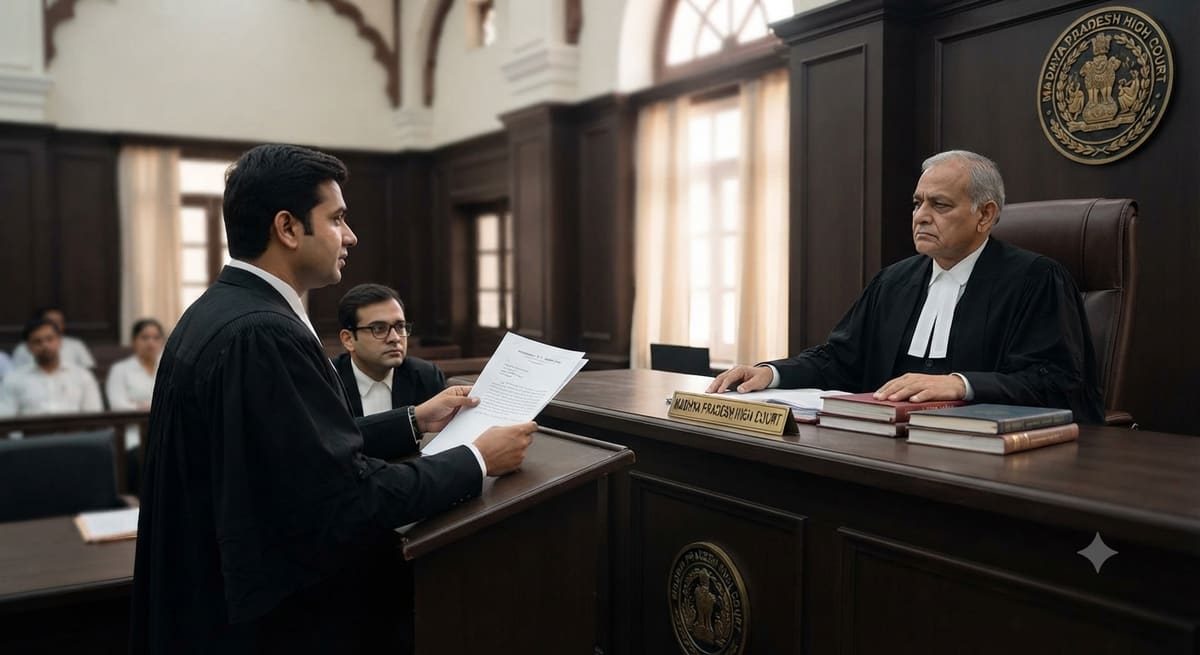
The Madhya Pradesh High Court has intervened in a service matter involving the transfer of a female government employee who serves as the Secretary of a registered association for SC/ST employees. While reaffirming that transfers are generally an incident of service, the Court directed the competent authority to reconsider her representation under the Transfer Policy, staying the impugned order until a reasoned decision is passed. This judgment underscores the importance of adhering to transfer exemptions for association office bearers and ensuring timely consideration of representations.
Background & Facts
The Dispute
The petitioner, Babita Dhakar, is a government employee serving as the Secretary of AJAK, a registered association of Scheduled Caste and Scheduled Tribe (SC/ST) employees in Madhya Pradesh. She challenged an order dated 16.06.2026 (Annexure P-1) issued by Respondent No. 2, which transferred her from Dabra, District Gwalior, to Nateran, District Vidisha - a distance of approximately 300 kilometers. The petitioner contended that under the Transfer Policy, she was exempted from transfer due to her role as the association's secretary.
Key Facts
The petitioner is employed as a government servant and serves as the Secretary of AJAK, a registered association of SC/ST employees
The Transfer Policy exempts office bearers of recognized associations from transfers
On 16.06.2026, the petitioner was transferred from Dabra (Gwalior) to Nateran (Vidisha), a distance of about 300 km
The petitioner is a female employee, and the transfer imposed significant hardship
The petitioner had earlier filed W.P. No. 19480/2022, which was allowed by a coordinate Bench of this Court on 05.02.2026, directing the respondents to convene a review Departmental Promotion Committee (DPC) to consider her candidature for promotion to the post of Assistant Director as on 16.01.2014
Despite the earlier order, the petitioner's case for promotion remained under consideration, and she feared post-promotion transfer
Procedural History
16.01.2014: Other incumbents were granted promotion to the post of Assistant Director, but the petitioner's case remained pending
Sometime in 2022: Petitioner filed W.P. No. 19480/2022 seeking consideration for promotion
05.02.2026: The High Court allowed the writ petition and directed the respondents to convene a review DPC for the petitioner's promotion
16.06.2026: Impugned transfer order (Annexure P-1) issued, transferring the petitioner from Dabra to Nateran
24.06.2026: Present writ petition (W.P. No. 22351/2026) filed before the High Court
Relief Sought
The petitioner sought the following reliefs:
Quashing of the impugned order dated 16.06.2026 (Annexure P-1)
Direction to the respondents to decide her representation in accordance with the Transfer Policy
Costs of the petition, if any
The Legal Issue
The central question before the Court was whether the impugned transfer order dated 16.06.2026 violated the Transfer Policy exemption for office bearers of recognized associations, and whether the respondents were obligated to consider the petitioner's representation in a time-bound manner.
Arguments Presented
For the Petitioner
The petitioner relied on the Transfer Policy, which exempts office bearers of recognized associations from transfers
She contended that the impugned transfer order was arbitrary and failed to consider her exemption under the policy
The petitioner highlighted that she is a female employee and the transfer imposed undue hardship, given the distance of approximately 300 km
She cited a similar case, Natthu Singh Yadav v. The State of Madhya Pradesh and others (W.P. No. 31488/2024), decided by this Court on 15.10.2024, where relief was granted on analogous grounds
The petitioner made a limited prayer for the respondents to decide her representation in a time-bound manner
For the Respondent/State
The learned Government Advocate opposed the prayer for quashing the transfer order, arguing that transfers are an incident of service and no employee has a vested right to a particular posting
However, the respondent did not oppose the innocuous prayer for deciding the petitioner's representation in accordance with law
The Court's Analysis
The Court began by reiterating the well-settled legal principle that transfer is an incident of service, and no employee has a vested right to be posted at a particular place. The Court observed that the employer is the best judge of organizing its workforce, and a transfer order cannot be subjected to judicial review unless it is influenced by mala fides or arbitrary exercise of power. The Court emphasized that the concept of equality under Articles 14 and 16 of the Constitution of India does not apply to cases of transfers.
However, the Court noted the specific circumstances of the case:
"In the present case, vide impugned order dated 16.06.2026, petitioner has been transferred from Dabra, District Gwalior to Nateran, District Vidisha. She is serving as Secretary of AJAK, a registered association of SCST Employees and as per Transfer Policy, she is exempted from transfer."
The Court acknowledged that the petitioner had earlier succeeded in W.P. No. 19480/2022, where the respondents were directed to convene a review DPC for her promotion. Despite this, her case remained under consideration, and she feared further transfers post-promotion. Given the limited prayer made by the petitioner - which was not opposed by the respondent - the Court disposed of the petition with specific directions.
The Verdict
The Court disposed of the writ petition with the following directions:
The petitioner shall submit a fresh representation, along with all relevant documents, before the respondent/competent authority within 7 days from the date of the judgment (24.06.2026)
The respondent/competent authority shall consider and decide the representation by passing a speaking and reasoned order on the basis of the Transfer Policy dated 22.05.2026, within three weeks from the date of receipt of the certified copy of the order
Until the respondent/competent authority decides the representation, the impugned order dated 16.06.2026 (Annexure P-1) shall remain stayed, and no coercive action shall be taken against the petitioner
The petitioner shall continue at her present place of posting, i.e., Dabra, District Gwalior, until further orders
The Court clarified that it had not expressed any opinion on the merits of the case.
What This Means For Similar Cases
Transfer Policy Exemptions Must Be Honoured
Government employees serving as office bearers of recognized associations are often exempted from transfers under state-specific Transfer Policies
This judgment reinforces that such exemptions must be strictly adhered to, and any deviation must be justified by a speaking and reasoned order
Practitioners should ensure that representations seeking exemption from transfers are decided in a time-bound manner, failing which judicial intervention may be sought
Judicial Review of Transfers: Limited but Possible
While courts generally defer to the employer's discretion in matters of transfers, this judgment demonstrates that judicial review is possible where:
The transfer order violates a specific policy exemption (e.g., for association office bearers)
The transfer imposes undue hardship (e.g., long-distance transfers for female employees)
The employer fails to consider representations in a timely manner
Practitioners should argue for stay of coercive action pending decision on representations, as granted in this case
Gender and Hardship Considerations in Transfers
This judgment highlights the gender-sensitive approach adopted by the Court, noting the hardship imposed on a female employee due to a long-distance transfer
While the Court did not delve into the merits of the transfer, it implicitly recognized the disproportionate impact of such transfers on female employees
Future litigants can cite this judgment to argue for stay of transfers where hardship is evident, particularly for women or employees with special circumstances