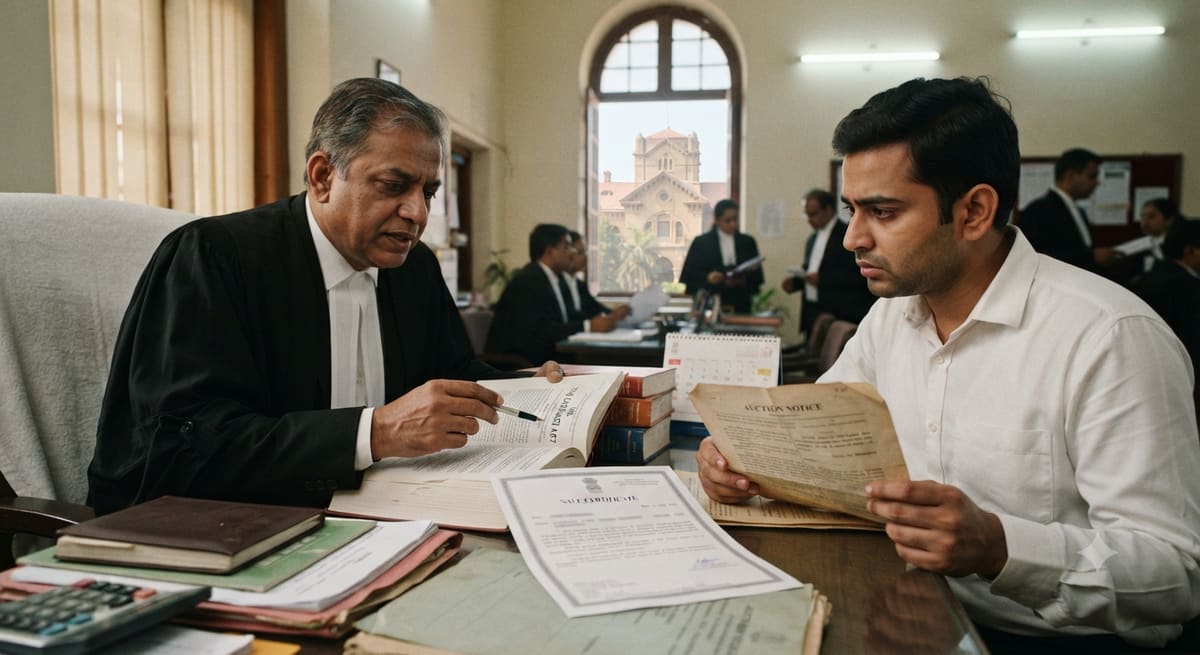
The Delhi High Court affirmed that deductions of tax at source (TDS) on interest payments can constitute a payment on account of a debt, thereby extending the limitation period under Section 19 of the Limitation Act, 1963. Consequently, the Court upheld the trial court’s refusal to strike out a 2017 recovery suit on the ground of limitation.
Background & Facts
The Dispute
The petitioner, Amit Gupta, and the respondents, Sandeep Gupta and Krishna Gupta, shared a friendly relationship. In 2008, the respondents advanced a loan to the petitioner without executing any formal loan agreement. The petitioner deducted tax at source (TDS) on the interest payable and issued signed balance confirmations acknowledging the amount due. These confirmations were executed up to March 2014, while TDS deductions continued until 31 March 2015 and were deposited with the Income Tax Department, as evidenced by Form 26AS and Form 16-A for FY 2014-15.
Key Facts
- 2008: Loan advanced by respondents to petitioner; no written loan agreement.
- Up to March 2014: Petitioner issued signed balance confirmations each year.
- Up to 31 March 2015: Petitioner deducted TDS on interest and deposited it with the Income Tax Department (Form 26AS, Form 16-A).
- 29 May 2017: Respondents served a legal notice demanding repayment.
- 2017: Respondents instituted recovery suit CS No. 1854/2017 in the Additional District Court, South East, Saket Courts, New Delhi.
- After filing of suit: Petitioner filed an application under Order VII Rule 11 of the CPC seeking dismissal of the plaint on the ground of limitation.
Procedural History
- 2008: Loan advanced.
- 29 May 2017: Legal notice served.
- 2017: Recovery suit CS No. 1854/2017 filed.
- Date not specified: Petitioner's application under Order VII Rule 11 filed.
- Trial Court: Dismissed the application, holding limitation to be a mixed question of fact and law requiring evidence.
- 24 August 2026: Petition under Article 227 filed (CM(M) 1345/2019 & CM(M) 1346/2019) and decided by a single judge of the Delhi High Court.
Parties' Positions
- Petitioner: Argues the suit is barred by limitation; the three-year period under Article 19 of the Limitation Act expired in 2011. Relies on Ramisetty Venkatanna v. Nasyam Jamal Saheb and S.P. Brothers v. Biren Ramesh Kadakia to contend that TDS certificates do not amount to acknowledgment of debt.
- Respondents: Contend that continuous TDS deductions and signed balance confirmations constitute payment on account of the debt, thereby extending the limitation period under Section 19 of the Limitation Act, as held in Ansal Housing Ltd. v. Samyak Projects Pvt. Ltd. and affirmed by the Division Bench in Samyak Projects (P) Ltd. v. Ansal Housing Ltd..
Relief Sought
The petitioner sought dismissal of the recovery suit on the ground of limitation and a declaration that the trial court’s order was illegal.
The Legal Issue
Whether the recovery suit filed in 2017 for a loan advanced in 2008 is barred by limitation under Article 19 of the Limitation Act, 1963, considering the petitioner’s TDS deductions and signed balance confirmations as acknowledgments or payments on account of the debt.
Arguments Presented
For the Petitioner
The petitioner submitted that the statutory limitation period of three years expired in 2011, rendering the 2017 suit time-barred. He relied on Ramisetty Venkatanna v. Nasyam Jamal Saheb to argue that a cleverly drafted plaint cannot revive a barred cause of action. He further cited S.P. Brothers v. Biren Ramesh Kadakia and ACTAL v. India Infoline Ltd. to contend that a TDS certificate is merely a statutory compliance document and does not constitute an acknowledgment of debt within the meaning of Section 25 of the Evidence Act.
For the Respondent
The respondent argued that each TDS deduction made by the petitioner up to 31 March 2015 represents a payment on account of the loan interest, thereby invoking Section 19 of the Limitation Act, which provides a fresh limitation period when payment is made before the expiry of the prescribed period. The respondent relied heavily on Ansal Housing Ltd. v. Samyak Projects Pvt. Ltd. and the subsequent Division Bench judgment in Samyak Projects (P) Ltd. v. Ansal Housing Ltd., which held that TDS deposits extend the limitation period. The respondent also distinguished the petitioner’s reliance on S.P. Brothers as being factually inapplicable.
The Court's Analysis
The Court began by reiterating that limitation is a mixed question of fact and law, requiring a factual enquiry when the pleadings and documents raise a triable issue. It quoted the trial court’s reasoning that the issue could not be decided at the threshold without examining the material concerning TDS deductions and balance confirmations.
"The question of limitation is a mixed question of fact and law which needs to be decided after taking evidence on record."
The Court examined the statutory framework of Section 19 of the Limitation Act, 1963, which states that a fresh period of limitation begins when a payment on account of the debt is made before the expiry of the prescribed period, provided the payment is acknowledged. It then evaluated whether the TDS deductions qualify as such a payment. Referring to Ansal Housing Ltd. and Samyak Projects (P) Ltd., the Court held that the deposit of TDS against a specific transaction constitutes a payment on account of the debt and therefore extends the limitation period.
The Court distinguished the petitioner’s reliance on S.P. Brothers and ACTAL, observing that those decisions dealt with the evidentiary effect of TDS certificates, not with the statutory computation of limitation. It further noted that the Kirtikumar Shantilal Chandan decision cited by the petitioner was distinguishable and did not override the binding precedent of Samyak Projects.
Having considered the material on record - namely, the signed balance confirmations and the TDS deductions up to 31 March 2015 - the Court concluded that the trial court was correct in holding that the limitation issue required evidentiary assessment and could not be dismissed summarily. Consequently, there was no patent illegality or jurisdictional error warranting interference under Article 227.
The Verdict
The petition under Article 227 was dismissed. The Delhi High Court upheld the trial court’s order refusing to strike out the recovery suit on limitation grounds. No monetary relief, costs, or specific compliance deadline were imposed.
What This Means For Similar Cases
Limitation Must Be Fact-Intensive
- Courts will treat limitation as a mixed question of fact and law when documents such as TDS deductions or balance confirmations raise a triable issue.
- Parties cannot rely solely on the passage of time; they must examine whether any payment or acknowledgment occurred before the limitation expired.
TDS Deductions Can Extend Limitation
- A deduction and deposit of TDS that is directly linked to the debt in question is deemed a payment on account under Section 19, thereby resetting the limitation clock.
- Practitioners should gather and preserve TDS certificates, Form 26AS extracts, and related correspondence to substantiate any claim of extended limitation.
Order VII Rule 11 Is Not a Shortcut
- The power to dismiss a plaint on limitation grounds is exercised with circumspection; a mere allegation of time-barred cause of action is insufficient where the pleadings raise factual issues.
- Counsel must be prepared to present evidence on the effect of payments or acknowledgments before seeking dismissal at the threshold.
Precedent Hierarchy Matters
- Decisions of other High Courts are persuasive but not binding; the Delhi High Court gave precedence to its own Division Bench rulings over Bombay High Court judgments on the same issue.
- Practitioners should cite the controlling authority of Samyak Projects (P) Ltd. v. Ansal Housing Ltd. when arguing that TDS deductions extend limitation.