Topic

recruitment rules

Recruitment rules in India govern the procedures, eligibility, and selection criteria for government and public sector jobs, ensuring fairness and compliance with statutory frameworks.

29 articlesLatest 0 month ago
Recruitment Rules | Mandatory Waiting List Preparation Even After Subsequent Advertisement: Bombay HC Upholds Candidate's Right to Appointment
Case Law Analysis
|Bombay High Court

Recruitment Rules | Mandatory Waiting List Preparation Even After Subsequent Advertisement: Bombay HC Upholds Candidate's Right to Appointment

Bombay High Court rules that failure to prepare a waiting list under a recruitment advertisement does not extinguish a candidate's right to appointment if a vacancy arises within the operative period, even if a subsequent advertisement is issued. The judgment reinforces statutory compliance in public recruitment, ensuring transparency and fairness for reserved category candidates.

Recruitment Rules Prevail | Permanent Absorption Without PSC Selection Violates Service Law : CAT Jammu
Case Law Analysis
|Central Administrative Tribunal

Recruitment Rules Prevail | Permanent Absorption Without PSC Selection Violates Service Law : CAT Jammu

CAT Jammu rules that permanent absorption in a post mandating Public Service Commission selection cannot bypass statutory recruitment rules, even for employees with long temporary service. The judgment reinforces that lateral entry or absorption must comply with prescribed selection processes, impacting government hiring policies and service law compliance.

Article 14 | Recruitment Rules Cannot Be Supplemented by Circulars Imposing Additional Degree Requirements : MP HC Jabalpur
Case Law Analysis
|Madhya Pradesh High Court

Article 14 | Recruitment Rules Cannot Be Supplemented by Circulars Imposing Additional Degree Requirements : MP HC Jabalpur

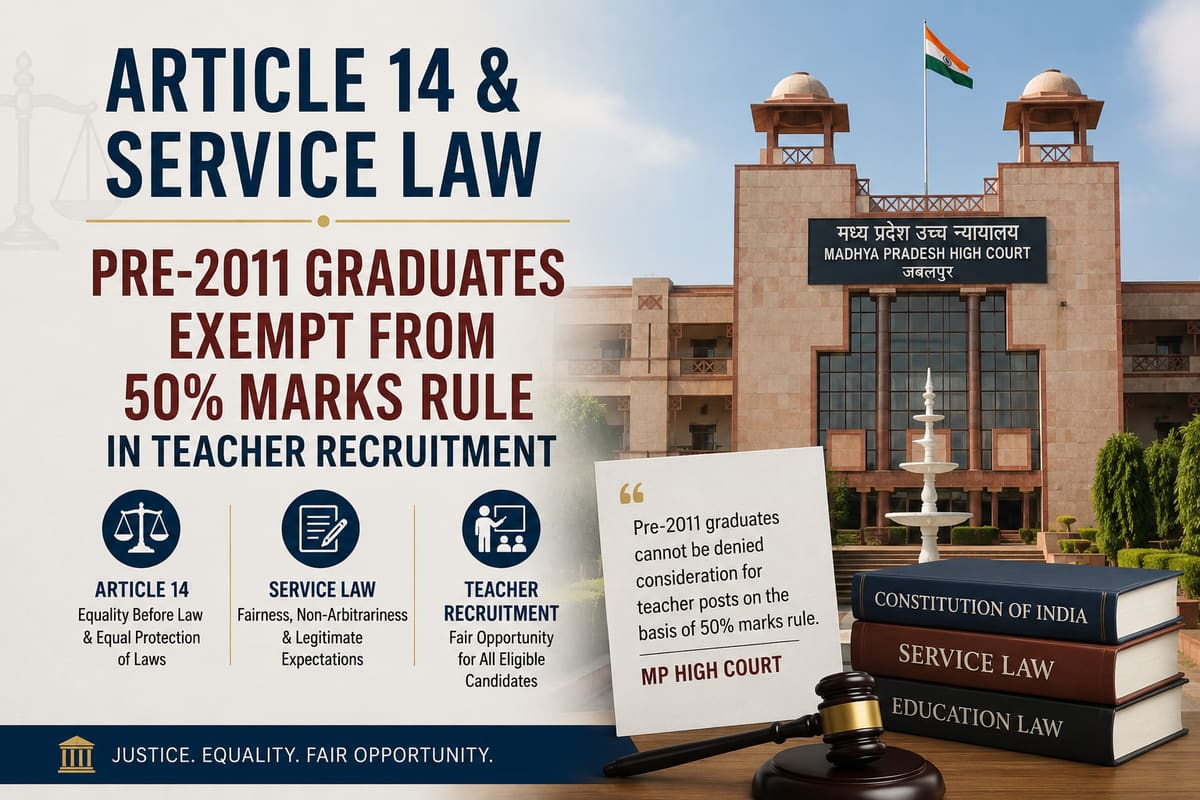
The Madhya Pradesh High Court struck down a state circular demanding an undergraduate degree in Home Science for Uchha Madhyamik Shikshak appointments, holding that such added conditions violate Article 14 when absent from the formal recruitment rules. This ruling protects candidates with valid postgraduate qualifications from arbitrary administrative overreach and reinforces the primacy of statutory recruitment frameworks.

Article 309 Overrides Central Council Regulations | State Recruitment Rules Prevail in Service Law Disputes : Allahabad HC
Case Law Analysis
|Allahabad High Court

Article 309 Overrides Central Council Regulations | State Recruitment Rules Prevail in Service Law Disputes : Allahabad HC

Allahabad HC rules that State recruitment rules under Article 309 of the Constitution override Central Council recommendations, barring post-selection challenges by candidates who participated without objection. The judgment reinforces the supremacy of State service laws in employment disputes, impacting public sector recruitment across India.

Mandatory Educational Qualifications Must Exist at Application Stage for Public Recruitment | Rajasthan PSC Case : SC
Case Law Analysis
|Supreme Court of India

Mandatory Educational Qualifications Must Exist at Application Stage for Public Recruitment | Rajasthan PSC Case : SC

The Supreme Court ruled that candidates must possess prescribed educational qualifications at the time of submitting their application for public service posts, not merely by the interview stage. This decision reinforces strict compliance with statutory eligibility criteria, impacting recruitment processes across public service commissions.

Judicial Directives Override Recruitment Rules | Delhi HC Permits Interview-Only Selection for Uniformity and Administrative Necessity : Delhi HC
Case Law Analysis
|Delhi High Court

Judicial Directives Override Recruitment Rules | Delhi HC Permits Interview-Only Selection for Uniformity and Administrative Necessity : Delhi HC

The Delhi High Court ruled that recruitment authorities may deviate from advertised weightage criteria and rely solely on interview marks if compelled by binding judicial directives and administrative necessity, ensuring uniform treatment of all candidates. This holding underscores the flexibility of administrative bodies in public employment recruitment while balancing fairness and legal compliance.