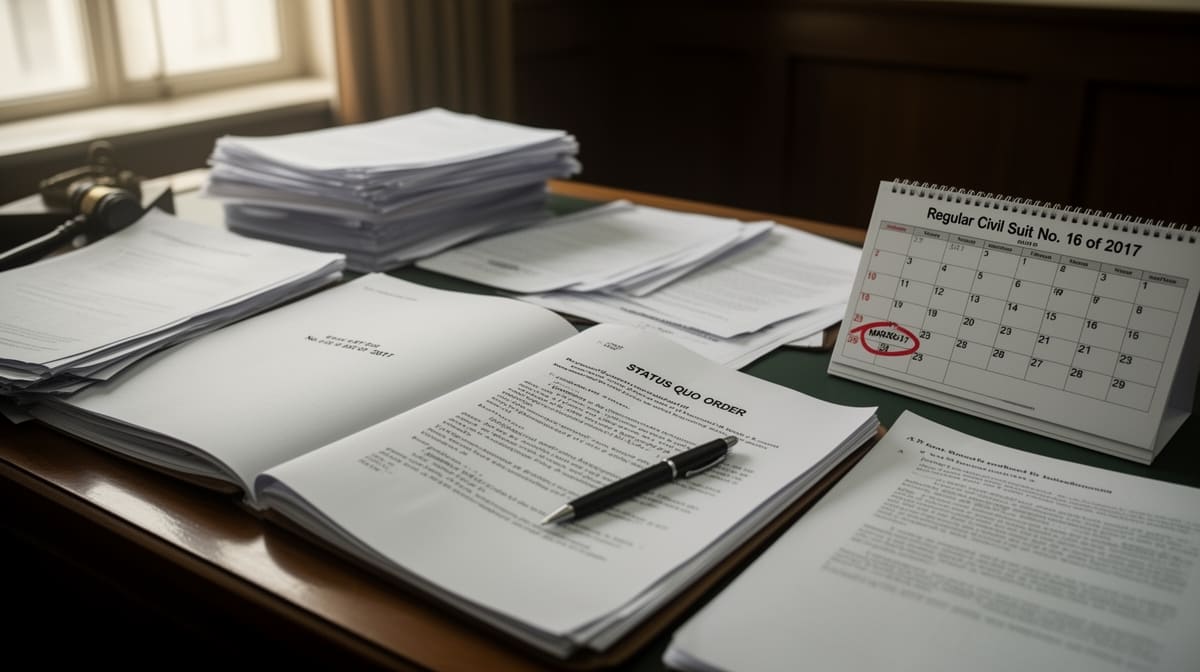
The Bombay High Court has clarified a critical procedural boundary in civil litigation: once a suit is dismissed under Order VII Rule 11 of the CPC for failure to comply with mandatory statutory disclosures, no interim stay can be granted on appeal. This ruling reinforces the finality of preliminary dismissal orders and curbs procedural misuse.
Background & Facts
The Dispute
The plaintiff, M/s. Vaishnavi Developers, filed a suit claiming to be a registered partnership firm under the Partnership Act, 1932. However, it failed to produce a partnership certificate or disclose the names of its partners, despite repeated demands by the defendant. The Trial Court held that this omission rendered the plaint non-compliant with Section 69(2) of the Partnership Act, 1932, which bars unregistered firms from instituting suits.
Procedural History
- 2025: Trial Court dismissed the suit under Order VII Rule 11 CPC for non-compliance with Section 69(2)
- April 23, 2025: District Judge granted an interim stay on the dismissal order, permitting the suit to proceed pending appeal
- 2026: Appellants challenged the stay order before the Bombay High Court, arguing it contradicted binding Supreme Court precedent
Relief Sought
The appellants sought vacation of the stay order, contending that the District Judge lacked jurisdiction to stay proceedings after a suit had been dismissed under Order VII Rule 11 CPC.
The Legal Issue
The central question was whether an appellate court may grant an interim stay on a suit dismissed under Order VII Rule 11 CPC, when the dismissal operates as a final rejection of the plaint and terminates the original proceedings.
Arguments Presented
For the Appellant
The appellants relied on IEEE Mumbai Section Welfare Association v. Global IEEE Institute for Engineers, where the Supreme Court held that a suit dismissed under Order VII Rule 11 CPC is not a suit in the eyes of law - it is a rejection of the plaint. Therefore, any appeal against such an order cannot be treated as a continuation of the suit, and interim relief like stay cannot be granted to revive what no longer exists.
For the Respondent
The respondent argued that the stay was necessary to prevent irreparable loss, as the suit involved substantial commercial interests. They contended that the dismissal was procedural and that the merits of the case had not been adjudicated, thus justifying interim protection.
The Court's Analysis
The Court examined the nature of Order VII Rule 11 CPC and its effect on the institution of a suit. It emphasized that dismissal under this rule is not a decree but a rejection of the plaint at the threshold, rendering the suit non-existent in law. The Court observed:
"When the plaint is rejected under Order VII Rule 11 CPC, the suit is deemed never to have been instituted. An appeal against such an order is not an appeal against a decree or order in a pending suit; it is a challenge to the rejection of the document itself."
The Court distinguished this from cases where a suit is dismissed on merits or for default, where the proceedings remain alive. It held that granting a stay in such circumstances would effectively nullify the Trial Court’s finding and permit litigants to circumvent the mandatory requirements of Section 69(2) of the Partnership Act. The Supreme Court’s decision in IEEE Mumbai was binding and directly applicable. The District Judge’s order was therefore unsustainable in law.
The Verdict
The appellants succeeded. The Bombay High Court set aside the stay order, holding that no interim relief can be granted against a dismissal under Order VII Rule 11 CPC, as the suit ceases to exist upon rejection of the plaint. The appeal was allowed with costs.
What This Means For Similar Cases
Stay Orders Are Prohibited After Plaint Rejection
- Practitioners must not seek or accept stays on suits dismissed under Order VII Rule 11 CPC
- Any such stay is void ab initio and subject to immediate vacation
- Applications for stay in such cases should be withdrawn or opposed on jurisdictional grounds
Compliance with Section 69(2) Is Non-Negotiable
- Firms must produce partnership certificates and disclose partner names before filing suit
- Failure to do so invites automatic dismissal, regardless of the merits of the claim
- Courts will not entertain procedural leniency where statutory compliance is mandatory
Appeals Against Order VII Rule 11 Dismissals Are Limited
- Appeals are confined to challenging the correctness of the rejection
- No interim reliefs, injunctions, or ad-interim orders can be granted pending appeal
- Litigants must ensure complete compliance before filing to avoid irreversible procedural loss