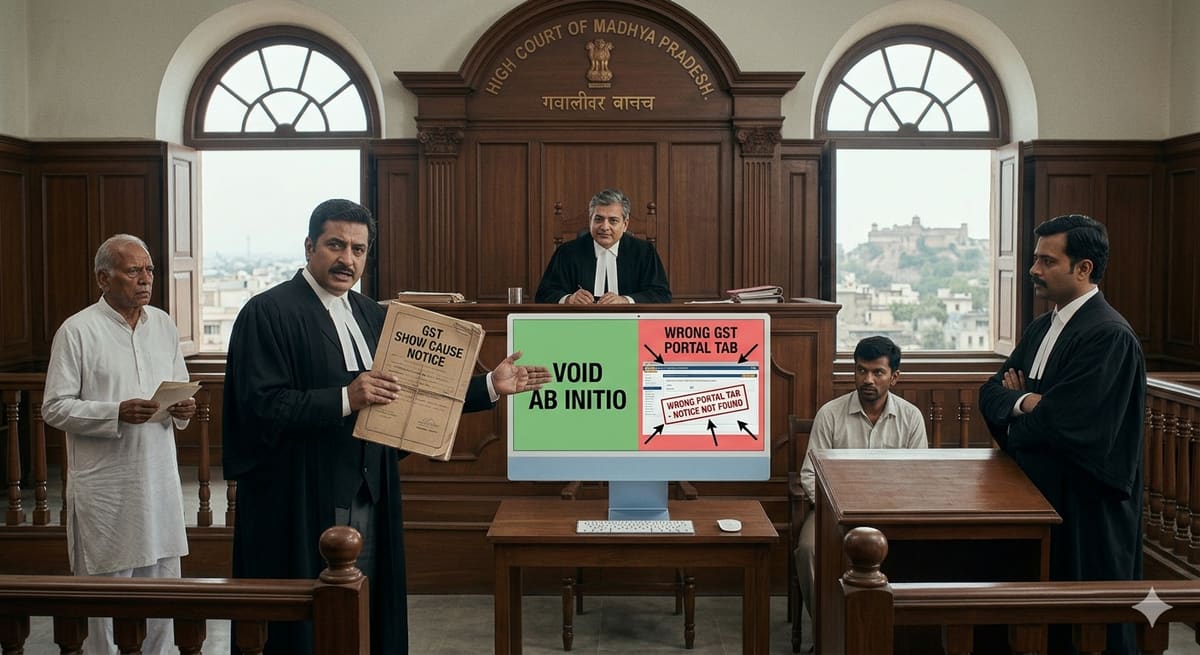
A landmark ruling by the Bombay High Court at Goa has affirmed that technical failures in government digital platforms cannot override the substantive legal rights of taxpayers. The Court directed a corporate taxpayer to pay IGST via demand draft to circumvent a systemic glitch in the ICEGATE portal, ensuring compliance with judicial precedents that prioritize legal entitlements over administrative inefficiencies.
Background & Facts
The Dispute
M/S JSW Steel Limited challenged the automatic computation of interest on IGST payments through the ICEGATE portal, despite a final adjudication order explicitly holding that no interest was payable. The dispute arose from a conflict between a binding administrative order and a malfunctioning digital system that erroneously added interest to the taxpayer’s liability.
Procedural History
- 2017 - 2018: Three Bills of Entry were processed, triggering IGST liability.
- 2024: Order-in-Original dated 02.04.2024, issued by the Assistant Commissioner of Customs, held that no interest was payable under Section 28AA of the Customs Act, 1962, relying on Mahindra and Mahindra v. Union of India and its affirmation by the Supreme Court.
- Post-2024: Despite the order, ICEGATE continued to auto-calculate and demand interest, rendering the adjudication ineffective.
- 2026: Petition filed under Article 226 seeking a writ of mandamus to rectify the portal and quash the erroneous interest demand.
Relief Sought
The petitioner sought:
- Quashing of interest components in reassessed Bills of Entry
- Rectification of ICEGATE to reflect the Order-in-Original
- Declaration of entitlement to input tax credit under Cosmo Films Limited and Circular No. 16/2023-Cus.
The Legal Issue
The central question was whether the substantive right of an assessee to avoid interest, as established by a binding adjudication order and affirmed by higher courts, can be nullified by a technical failure in the ICEGATE portal.
Arguments Presented
For the Petitioner
Mr. Rohan Shah, Senior Advocate, argued that the petitioner’s right to avoid interest was crystallized by the Order-in-Original, which was grounded in binding precedents from the Bombay High Court and the Supreme Court. He contended that allowing a technical glitch to override judicial findings violates Article 141 of the Constitution and the principle of rule of law. Reliance was placed on Larsen and Toubro Ltd. v. Union of India and Shah Nanji Nagsi Exports Pvt. Limited v. UOI, where the courts held that system failures cannot deprive taxpayers of their lawful rights.
For the Respondent
The State conceded the existence of the glitch but argued that the petitioner must pay the interest and seek refund later. It relied on Circular No. 27/2024-Customs, claiming it provided a procedural mechanism. It further contended that since the department had filed an appeal against the Order-in-Original, the petitioner’s rights were not yet final and could not be enforced pending appellate outcome.
The Court's Analysis
The Court rejected the State’s contention that pendency of appeal negated the enforceability of the Order-in-Original. It emphasized that judicial discipline under Article 141 requires lower authorities to comply with binding precedents regardless of pending appeals. The Court observed that the department’s appeal does not suspend the legal effect of the order until stayed.
"The substantive rights of assessee's cannot be denied on account of technical glitches."
The Court cited Larsen and Toubro and Shah Nanji Nagsi Exports to reinforce that digital infrastructure is a public service tool, not a barrier to legal entitlements. It noted that the earlier directives to fix the ICEGATE glitch had expired without compliance, rendering the State’s inaction a violation of constitutional obligations.
The Circular dated 23.12.2024 was held to be irrelevant as it did not address the specific malfunction preventing accurate payment. The Court concluded that the petitioner should not be forced into litigation or financial hardship due to systemic negligence.
The Verdict
The petitioner succeeded. The Court held that substantive rights under binding judicial orders cannot be overridden by technical failures in government portals. It directed JSW Steel to pay IGST via demand draft, which would be treated as valid payment under ICEGATE, with all statutory benefits flowing accordingly.
What This Means For Similar Cases
Substantive Rights Trump Systemic Errors
- Practitioners must now argue that any administrative action contradicting a binding judicial or quasi-judicial order is ultra vires, even if the system enforces it automatically.
- Taxpayers can invoke Shah Nanji Nagsi and Larsen and Toubro to resist forced payments where adjudication has already ruled against liability.
Payment via Alternative Means Is Permissible
- Where digital systems fail to reflect lawful entitlements, courts may permit alternative payment methods (e.g., demand draft, RTGS) to preserve rights.
- Practitioners should immediately file applications seeking such relief, attaching the relevant order and proof of portal malfunction.
Circulars Cannot Override Judicial Directives
- Departmental circulars that conflict with court rulings are legally inoperative.
- Advocates must challenge reliance on circulars in writ petitions by citing the hierarchy of legal authority: Constitution > Statute > Judicial Order > Circular.