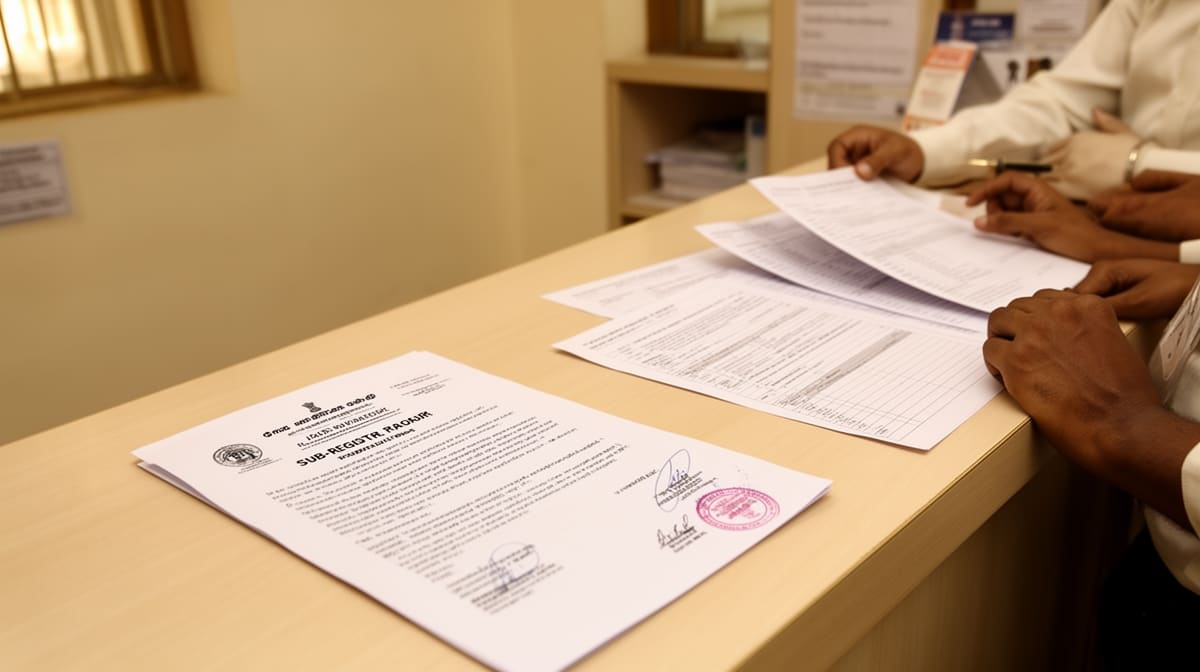
The Bombay High Court has clarified that a Sub-Registrar’s role in property registration is strictly procedural and does not extend to verifying title or assessing market value. This judgment quashes a criminal FIR against a revenue officer, reinforcing the limits of criminal liability for administrative functionaries acting within statutory bounds.
Background & Facts
The Dispute
The dispute arises from the registration of an Agreement for Sale dated 03.01.2025, concerning a 4-hectare plot at Gat No. 1276/38, Wagholi, Pune. The property, allegedly owned by Respondent No. 2, Aparna Yashpal Varma, was purportedly sold by vendors including Noel Joseph Das and others to vendees including Girish Ramchandra Kamte and others for Rs. 8.16 crores. Respondent No. 2 alleges that the vendors had no title to the property and that the Agreement was fraudulently registered at an undervalued rate to evade stamp duty.
Key Facts
- The Applicant, Popatrao S/o Ramchandra Bhoi, is a Senior Revenue Officer serving as Sub-Registrar (Class II) No. 20 at the Haveli Registry Office, Pune.
- The Agreement for Sale (No. 184 of 2025) was registered on 03.01.2025.
- The property’s valuation, as per the 2022-2023 Ready Reckoner rates published on www.igrmaharashtra.gov.in, was Rs. 8.06 crores.
- Stamp duty and registration fees were calculated and paid based on this valuation.
- A zone certificate classified the land as being in an Agriculture No Development Zone.
- A lis pendens was registered on 07.02.2023, and a written communication was sent to the Inspector General of Registration on 30.08.2024, cautioning against transactions involving the property.
- Respondent No. 2 claims ownership based on a 1991 sale deed, which she alleges is forged and inserted into the records.
- The impugned FIR (No. 0257 dated 12.06.2025) names the Applicant as Accused No. 16, alleging collusion to undervalue the instrument.
Procedural History
- 03.01.2025: Agreement for Sale registered by the Applicant at Haveli Registry Office.
- 07.02.2023: Lis pendens registered in respect of the property.
- 30.08.2024: Written communication sent by Respondent No. 2 to Inspector General of Registration, Maharashtra, requesting no transaction be permitted.
- 12.06.2025: FIR No. 0257 registered at Wagholi Police Station under Sections 318(4), 336(3), 338, 340(2), 61(2), 201 of BNS and Section 82 of the Registration Act, 1908.
- 23.03.2026: Criminal Application No. 873 of 2025 filed before the Bombay High Court seeking quashing of the FIR.
The Parties' Positions
For the Applicant
The Applicant contends that his role as Sub-Registrar is confined to verifying compliance with procedural requirements under the Registration Act and Maharashtra Registration Rules. He asserts that he had no authority to investigate title, verify authenticity of documents, or assess market value. He relied on the Ready Reckoner rates and confirmed payment of stamp duty and registration fees before registration.
For Respondent No. 2
Respondent No. 2 alleges that the Applicant knowingly registered the Agreement despite the existence of a lis pendens and despite the forged 1991 sale deed. She claims the Applicant failed to cross-check the 7/12 extract and deliberately undervalued the property to facilitate fraud.
Relief Sought
The Applicant seeks quashing of FIR No. 0257 dated 12.06.2025, on the ground that no cognizable offence is made out against him in his official capacity as Sub-Registrar.
The Legal Issue
The central question was whether a Sub-Registrar commits a cognizable offence under the Bharatiya Nyay Sahita, 2023 and the Registration Act, 1908 by registering a document without independently verifying the vendor’s title or the market value of the property, when stamp duty and registration fees have been paid as per the declared valuation.
Arguments Presented
For the Appellant/Petitioner
The Applicant’s counsel, Ms. Priya Gondhalekar, relied on Rule 44 of the Maharashtra Registration Rules, which limits the Sub-Registrar’s duty to verifying payment of stamp duty and registration fees based on the declared value. She cited the Supreme Court’s decision in K. Gopi v. Sub Registrar and Ors. (2026) 2 SCC 696, which held that a registering officer has no adjudicatory power to determine title or ownership. She emphasized that the Applicant acted strictly within his statutory mandate and that allegations of fraud or collusion must be directed at the parties to the transaction, not the registering officer.
For the Respondent/State
The State, through Mr. Sukanta Karmakar, conceded that the charge sheet had been filed against other accused but did not contest the legal position on the Sub-Registrar’s duties. Respondent No. 2’s counsel, Mr. Aditya Mithe, argued that the Applicant had a duty to verify title through the 7/12 extract and the lis pendens, and that failure to do so amounted to abetment of fraud. He contended that the undervaluation was intentional and that the Applicant’s inaction facilitated criminal activity.
The Court's Analysis
The Court undertook a detailed examination of the statutory framework governing the duties of a Sub-Registrar under the Registration Act, 1908, and the corresponding rules. It noted that the impugned FIR contained no specific allegation of non-payment of stamp duty or procedural irregularity in the registration process. The only grievance was that the property was allegedly undervalued and that title was not verified.
"The registering officer is not concerned with the title held by the executant. He has no adjudicatory power to decide whether the executant has any title. Even if an executant executes a sale deed or a lease in respect of a land in respect of which he has no title, the registering officer cannot refuse to register the document if all the procedural compliances are made and the necessary stamp duty as well as registration charges/fee are paid."
The Court held that the Supreme Court’s observations in K. Gopi v. Sub Registrar and Ors. are directly applicable. The Sub-Registrar’s function is ministerial, not judicial. His obligation ends once he is satisfied that the parties are present, admit execution, and the requisite fees are paid. The validity of title, authenticity of documents, or market valuation beyond the declared amount are beyond his purview.
The Court further observed that the Respondent No. 2’s claim of undervaluation was unsubstantiated. The declared value of Rs. 8.06 crores matched the Ready Reckoner rate, and no evidence was produced to show that the declared value was false or manipulated by the Applicant. The existence of a lis pendens, while relevant to civil remedies, does not impose a criminal duty on the Sub-Registrar to investigate its validity.
The Court also applied the principles in State of Haryana v. Bhajan Lal (1992 Supp (1) SCC 335) to prevent abuse of the criminal process. It held that allowing criminal proceedings against a public servant for performing a purely administrative function, without any evidence of mala fide or active participation in fraud, would chill the functioning of public offices and invite frivolous litigation.
The Verdict
The Applicant succeeded. The Court quashed FIR No. 0257 dated 12.06.2025 registered against him under Sections 318(4), 336(3), 338, 340(2), 61(2), 201 of the Bharatiya Nyay Sahita, 2023 and Section 82 of the Registration Act, 1908. There shall be no order as to costs. The impugned FIR is set aside in its entirety with respect to the Applicant.
What This Means For Similar Cases
Sub-Registrars Are Not Title Investigators
- Practitioners must advise clients that criminal complaints against registering officers for failure to verify title or market value are legally unsustainable.
- Any dispute over ownership or valuation must be pursued through civil remedies, not criminal prosecution.
Procedural Compliance Shields Public Functionaries
- If a Sub-Registrar has verified payment of stamp duty and registration fees as per declared value, and parties have appeared and admitted execution, no criminal liability arises.
- Allegations of fraud must target the parties to the transaction, not the administrative officer.
FIRs Against Officials Must Meet Prima Facie Threshold
- Courts will intervene under Section 528 BNSS where the allegations, even if accepted at face value, do not constitute a cognizable offence.
- This judgment reinforces that public servants performing routine duties cannot be dragged into criminal proceedings absent clear evidence of collusion or mala fide intent.