The Punjab and Haryana High Court has reaffirmed that proving execution of an agreement to sell is only the first step in claiming specific performance. The court emphasized that equitable relief requires continuous readiness and willingness to perform, and prolonged inaction, even after the vendor’s title is perfected, disentitles a plaintiff from relief.
Background & Facts
The Dispute
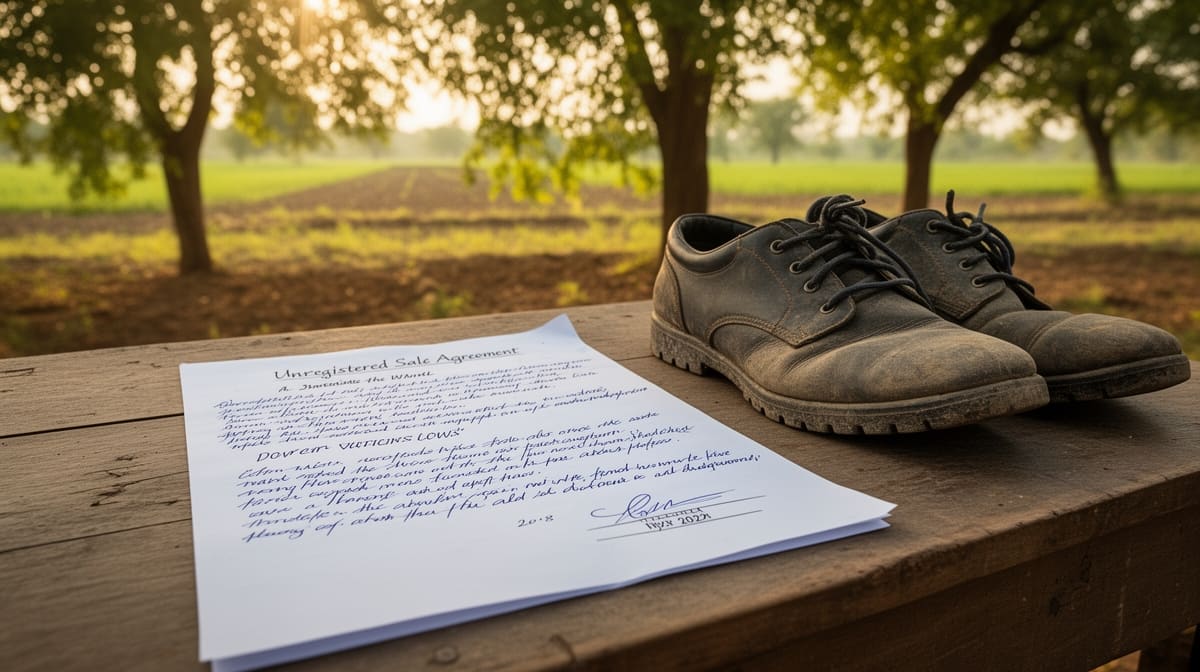
The appellant, Suraj Bhan, filed a suit for specific performance of an agreement to sell dated 08.12.2008, seeking possession of immovable property against respondents, the legal representatives of the deceased vendor Khushi Ram and others. He claimed to have paid ₹10,00,000 as earnest money on the date of the agreement and received physical possession of the land. The agreement did not specify a date for execution of the sale deed, as the vendors’ title was subject to pending mutation arising from a release deed.
Key Facts
- The agreement to sell dated 08.12.2008 was executed between the appellant and defendants No.1 to 4.
- On 13.01.2009, the appellant paid an additional ₹50,000 and executed a fresh agreement to sell, which fixed 30.04.2009 as the deadline for execution of the sale deed.
- Mutation in favor of the defendants was sanctioned on 13.01.2009, thereby completing the condition precedent for sale deed execution.
- The appellant did not take any steps to enforce the agreement between 30.04.2009 and 2014.
- He claimed to have appeared before the Sub-Registrar on 24.01.2014 and 17.02.2014 with the balance consideration, but no documentary evidence supported these claims.
- The suit was filed on 17.04.2014, more than five years after the fixed deadline and over five years after mutation was completed.
- The defendants denied the authenticity of the 08.12.2008 agreement, alleging forgery, and contended that only the 13.01.2009 agreement was valid.
Procedural History
- 08.12.2008: Agreement to sell executed.
- 13.01.2009: Additional payment of ₹50,000 made; second agreement executed with fixed date of 30.04.2009 for sale deed.
- 13.01.2009: Mutation in favor of defendants sanctioned.
- 17.04.2014: Suit for specific performance filed in the Court of Civil Judge (Senior Division).
- 26.02.2019: Trial Court dismissed the suit, holding failure to prove readiness and willingness.
- 31.08.2024: First Appellate Court affirmed the trial court’s findings.
- 20.04.2026: Regular Second Appeal dismissed by the Punjab and Haryana High Court.
Relief Sought
The appellant sought a decree for specific performance of the agreement dated 08.12.2008, delivery of possession of the suit land, and consequential reliefs including damages.
The Legal Issue
The central question was whether a plaintiff who proves execution of an agreement to sell is entitled to specific performance if he fails to demonstrate continuous readiness and willingness to perform, and if his delay in seeking enforcement exceeds a reasonable time after the vendor’s title is perfected.
Arguments Presented
For the Appellant
Counsel argued that the execution of the 08.12.2008 agreement was established, and since no specific date was fixed in that document, limitation would commence only upon the defendants’ refusal to perform. He contended that the appellant had always been ready and willing, pointing to alleged appearances before the Sub-Registrar in January and February 2014. He further argued that the subsequent agreement dated 13.01.2009 was merely supplementary and did not extinguish the original agreement.
For the Respondent
The respondents contended that the 08.12.2008 agreement was forged, and the only valid agreement was the one dated 13.01.2009, which fixed a clear deadline of 30.04.2009. They argued that the appellant’s failure to act within a reasonable time after the mutation was sanctioned on the same date, coupled with his five-year silence, demonstrated lack of readiness and willingness. They also emphasized that the appellant selectively relied on the older agreement while ignoring the later one, undermining his bona fides.
The Court's Analysis
The Court emphasized that specific performance is an equitable remedy, not a matter of right, and requires the plaintiff to establish continuous readiness and willingness to perform his part of the contract. The court noted that while the First Appellate Court accepted the execution of the 08.12.2008 agreement, this alone was insufficient to grant relief.
"The crucial question is whether the plaintiff discharged the burden of proving his readiness and willingness."
The Court observed that the mutation in favor of the defendants was completed on 13.01.2009, the very day the second agreement was executed, fixing 30.04.2009 as the deadline. The appellant’s failure to act after this date, despite being fully aware that the condition precedent was satisfied, was fatal to his claim.
The Court rejected the appellant’s explanation of oral assurances in January and February 2014 as unsubstantiated by independent evidence. It held that such uncorroborated oral assertions cannot override the long period of inaction.
"Such prolonged inaction, in the considered view of this Court, is wholly inconsistent with the conduct expected of a party seeking equitable relief of specific performance."
The Court further noted that the appellant’s selective reliance on the 2008 agreement while ignoring the 2009 agreement, which he himself signed, cast serious doubt on his credibility. The Court also rejected the limitation argument, holding that even in the absence of a fixed date, a plaintiff must act within a reasonable time once performance becomes possible. Five years of inaction after the vendor’s title was perfected could not be considered reasonable.
The Court concluded that the concurrent findings of the lower courts were based on proper appreciation of evidence and correct application of law, and therefore could not be disturbed under Section 100 CPC, which limits appellate jurisdiction to substantial questions of law.
The Verdict
The appellant’s Regular Second Appeal was dismissed. The High Court upheld the dismissal of the suit for specific performance. No costs were awarded. The findings of the trial and first appellate courts were affirmed. The appellant’s claim for possession and consequential relief was rejected in its entirety.
What This Means For Similar Cases
Readiness and Willingness Must Be Proven Continuously
- Practitioners must document and present evidence of ongoing attempts to perform - not just initial readiness.
- Mere assertion of willingness without corroboration (e.g., registered notices, bank drafts, witness testimony) will not suffice.
- Delay beyond the fixed date in any subsequent agreement, even if the original agreement lacks a date, will be fatal.
Equitable Relief Is Not Guaranteed by Proof of Contract Alone
- Courts will scrutinize conduct over time, not just the existence of a document.
- Selective reliance on multiple agreements undermines credibility and may lead to dismissal.
- The doctrine of laches applies strictly in specific performance cases; unreasonable delay defeats the claim even if the contract is valid.
Reasonable Time Is Contextual and Demands Diligence
- Once a condition precedent (e.g., mutation, clearance) is fulfilled, the buyer must act promptly.
- A delay of more than five years after the vendor’s title is perfected is unlikely to be considered reasonable.
- Courts will not extend equitable relief to parties who sleep on their rights, even if technical limitation has not expired.