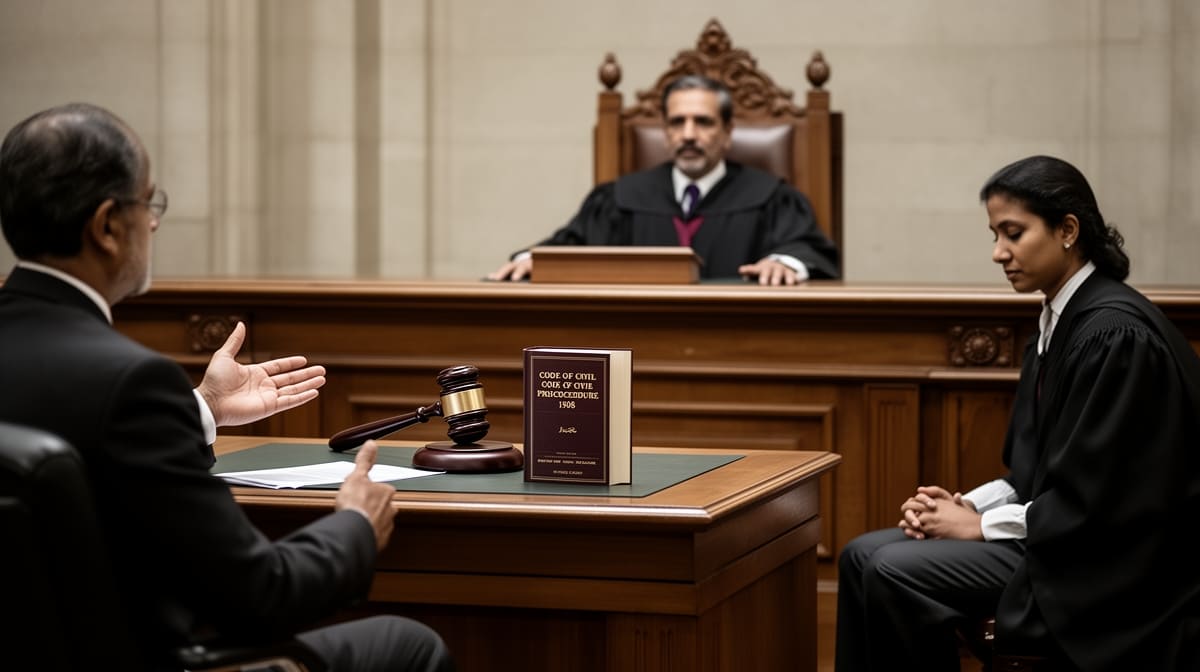
The Bombay High Court has affirmed that a self-operative court order, conditioned on timely payment and accepted by the debtor as an undertaking, operates as a binding legal trigger for insolvency upon default - without requiring further adjudication. This ruling underscores the enforceability of judicial undertakings and the consequences of repeated non-compliance in insolvency proceedings.
Background & Facts
The Dispute
The insolvency petition was initiated by Dinesh Kumar Agarwal, the petitioning creditor, against Malti Jayant Soni and others, the judgment debtors, arising from unpaid decretal amounts owed to two judgment creditors: Jwaladutta Jankidas HUF and Sacha Finance and Developers Co. The debt arose from prior civil decrees, and the debtors had repeatedly failed to satisfy their obligations despite multiple court interventions.
Key Facts
- The debtors had previously undertaken to pay the full decretal amount, including interest, by 15 February 2026, as recorded in an order dated 16 January 2026.
- As a condition for the initial extension, the debtors were directed to pay Rs. 5,00,000 to Tata Memorial Hospital, Mumbai, only if payment was not made by 15 February 2026.
- On 20 February 2026, the Court extended the deadline to 22 February 2026, again conditioning insolvency on non-payment.
- On 20 February 2026, the Court further imposed an additional obligation: payment of Rs. 5,00,000 to the Kranti Agrani Dr. G. D. Bapu Lad Memorial Trust, Kundal, if the original decretal amount remained unpaid.
- The debtors were explicitly warned that failure to pay by the extended deadline would result in automatic insolvency declaration "without recourse to the Court."
- The debtors accepted these terms in writing and in court, with counsel affirming their understanding.
- As of 13 March 2026, the debtors admitted to having made only partial payments and had failed to clear the decretal amount, the interest, or the two additional Rs. 5,00,000 payments.
Procedural History
- 16 January 2026: Court passes order directing payment of decretal amount and interest by 15 February 2026; conditional Rs. 5,00,000 payment to Tata Memorial Hospital if unpaid.
- 20 February 2026: Court grants one-week extension to 22 February 2026; adds second Rs. 5,00,000 payment to Kranti Agrani Trust as further condition; declares insolvency automatic on non-compliance.
- 22 February 2026: Debtors fail to pay any of the required amounts.
- 9 March 2026: Court extends deadline by two weeks to 9 March 2026, reaffirming self-operative insolvency clause.
- 10 March 2026: Matter listed for compliance; debtors admit non-payment.
- 13 March 2026: Court declares debtors insolvent and makes motions absolute.
Relief Sought
The petitioning creditor sought declaration of insolvency under the Presidency Towns Insolvency Act, 1909, and appointment of the Official Assignee to administer the debtor’s estate. The debtors sought further extensions and a stay of the insolvency declaration.
The Legal Issue
The central question was whether a self-operative court order, explicitly conditioning insolvency on non-payment of specified amounts by a fixed date and accepted by the debtor as an undertaking, can trigger insolvency without further judicial hearing.
Arguments Presented
For the Petitioning Creditor
The counsel argued that the debtors had been granted three successive opportunities to comply, each time with explicit warnings that failure would result in automatic insolvency. The Court’s orders were not mere suggestions but binding undertakings. Reliance was placed on the principle that courts must not be used as instruments of delay, and repeated non-compliance warrants immediate enforcement.
For the Judgment Debtors
The debtors’ counsel contended that administrative and financial difficulties prevented timely payment, and that the Court should exercise discretion to grant further time. They argued that insolvency is a drastic remedy and should not be triggered mechanically, especially where partial payments had been made.
The Court's Analysis
The Court rejected the debtor’s plea for further leniency, emphasizing that the orders dated 16 January and 20 February 2026 were not discretionary directions but self-operative conditions accepted by the debtor as solemn undertakings. The Court noted:
"The judgment-debtor has taken undue advantage of the leniency shown by the Court from time to time."
It held that the debtor’s repeated assurances, followed by consistent failure, amounted to abuse of process. The Court clarified that the phrase "without recourse to the Court" in its orders was not mere rhetoric but a legally operative clause, consistent with the principle that courts may impose conditions that automatically trigger consequences upon breach.
The Court further observed that the Presidency Towns Insolvency Act, 1909, permits adjudication upon such clear, self-executing triggers, especially where the debtor has been afforded multiple chances. The debtor’s admission of partial payment confirmed the breach of the undertaking, rendering the insolvency declaration inevitable.
The Verdict
The judgment debtors were declared insolvent under the Presidency Towns Insolvency Act, 1909. The Official Assignee is directed to take control of the debtors’ estate and proceed in accordance with the Act. Notice of Motion Nos. 12 and 15 of 2025 are made absolute. The prayer for stay was rejected. The debtors’ failure to pay the decretal amount, interest, and two separate Rs. 5,00,000 payments by 9 March 2026 triggered automatic insolvency without further hearing.
What This Means For Similar Cases
Self-Operative Orders Are Legally Binding
- Practitioners must treat court orders containing "automatic consequence" clauses as binding contractual undertakings.
- Failure to comply with such orders will not invite a hearing on mercy - it will trigger the stated consequence, including insolvency.
- Counsel must advise clients that accepting such terms is a legal gamble with existential consequences.
Repeated Non-Compliance Eliminates Equitable Relief
- Courts will not grant successive extensions to parties who exploit judicial goodwill.
- Partial payments do not negate a material breach of a self-operative condition.
- The doctrine of clean hands applies: debtors who repeatedly default forfeit the right to equitable relief.
Strategic Implications for Creditors
- Creditors should seek explicit self-operative language in settlement orders: "Failure to pay by [date] shall result in [consequence]."
- Such orders reduce litigation costs and accelerate enforcement.
- Insolvency petitions can be filed immediately upon breach without waiting for fresh adjudication.