The Customs, Excise and Service Tax Appellate Tribunal (CESTAT) Kolkata has clarified that the limitation period for filing an appeal under the Finance Act, 1994 commences only upon actual receipt of the impugned order, particularly when earlier communications - including Show Cause Notices and hearing intimations - were never effectively served. This ruling reinforces the principle that procedural fairness cannot be sacrificed for technical compliance.
Background & Facts
The Dispute
The appellant, M/s. Puja Transport Services, proprietor Sri Shiv Mangal Bajpayee, was assessed for service tax arrears for the period 2012-13. The Department issued a Show Cause Notice (SCN) and multiple intimations for personal hearing, but none were successfully delivered to the appellant’s registered address. The adjudicating authority proceeded ex parte and passed an Order-in-Original dated 31.08.2018. The appellant remained unaware of this order until their bank account was attached in December 2024.
Key Facts
- The Show Cause Notice was served by affixing it on the notice board under Section 37C(c) of the Central Excise Act, 1944 read with Section 169(f) of the CGST Act, 2017, due to alleged non-service by post or messenger
- Three personal hearing intimations dated 11.06.2018, 14.06.2018, and 18.06.2018 were also deemed unserved, as the Range Officer reported the appellant could not be located at the given address
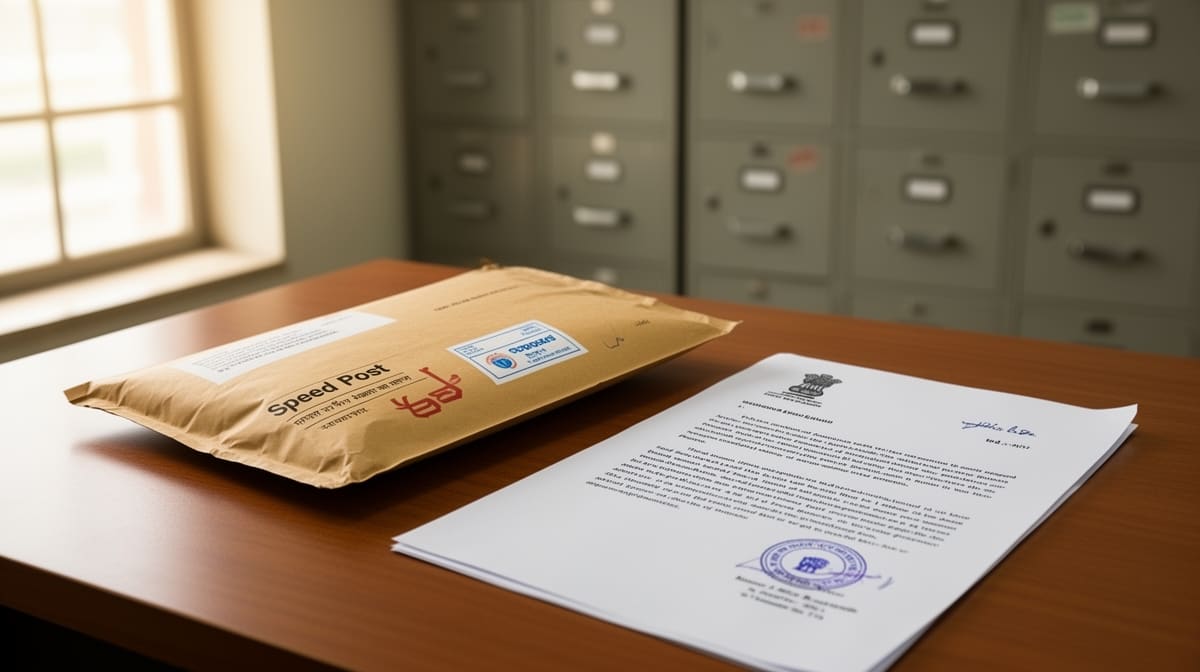
- The Order-in-Original dated 31.08.2018 was claimed to have been served via Speed Post (EMS No. EJ239855805IN) on 07.09.2018
- The appellant had no knowledge of the order until their bank account was frozen on 24.12.2024
- On 23.01.2025, the appellant formally requested a copy of the order from the Department and received it on the same day
Procedural History
- 31.08.2018: Order-in-Original passed by Assistant Commissioner, Service Tax, Division-IV, Jamshedpur
- 07.09.2018: Department claimed service of Order-in-Original via Speed Post
- 24.12.2024: Bank account of appellant attached by Department
- 23.01.2025: Appellant received copy of Order-in-Original after written request
- 03.03.2025: Appeal filed before Commissioner (Appeals), CGST & Central Excise, Ranchi
- 29.09.2025: Commissioner (Appeals) dismissed appeal on grounds of limitation, holding date of service as 07.09.2018
- 03.10.2025: Impugned order communicated to appellant
- 23.03.2026: Appeal heard and decided by CESTAT Kolkata
Relief Sought
The appellant sought setting aside of the Commissioner (Appeals)’s order dated 29.09.2025 on the ground that the appeal was filed within 60 days of actual receipt of the Order-in-Original on 23.01.2025, and requested that the matter be remanded for adjudication on merits.
The Legal Issue
The central question was whether the limitation period under Section 85(3A) of the Finance Act, 1994 for filing an appeal begins from the date of presumed service via Speed Post, or from the date of actual receipt of the order, where prior communications were demonstrably unserved.
Arguments Presented
For the Appellant
The appellant argued that since the Show Cause Notice and personal hearing intimations were never served by post or personal delivery, the presumption of service of the Order-in-Original via Speed Post on 07.09.2018 was legally untenable. They relied on the principle that procedural fairness requires effective communication, and that the Department’s failure to serve earlier notices invalidated any assumption of subsequent service. The appellant produced the letter dated 23.01.2025 confirming receipt of the order and the bank attachment notice as proof of actual knowledge.
For the Respondent
The Respondent contended that the Speed Post receipt record dated 07.09.2018 constituted prima facie evidence of service under the law, and that the appellant’s failure to update their address or respond to notices amounted to negligence. They argued that the appeal was clearly time-barred under Section 85(3A), which mandates filing within 60 days of the order’s service.
The Court's Analysis
The Tribunal conducted a meticulous review of the adjudicating authority’s own records and found a critical inconsistency: if the Show Cause Notice and personal hearing intimations could not be served even by registered post or special messenger, how could the Order-in-Original have been successfully delivered via Speed Post to the same address? The Tribunal noted that the Department’s own records under paragraphs 2.1 and 3.1 of the Order-in-Original explicitly admitted non-service of prior communications.
"Thus, it is evident that earlier communications, of the Show Cause Notice and personal hearing intimation, had not been served on the appellant. Thus, I find merit in the submission of the appellant that the above Speed Post containing the Order-in-Original dated 31.08.2018 could not have been served on the same address."
The Tribunal further emphasized that the appellant’s first actual knowledge of the order arose only upon bank attachment in December 2024, and that the order was physically handed over on 23.01.2025. In the absence of any corroborative evidence from the Department proving service on 07.09.2018, the Tribunal held that the date of actual receipt - 23.01.2025 - must govern the limitation period.
The Tribunal also observed that the Commissioner (Appeals) had not examined the merits of the case at all, and that the dismissal on limitation grounds was premature and legally flawed in the context of demonstrable non-service. The principle of natural justice, particularly the right to be heard, was held to be foundational and could not be overridden by mechanical application of limitation rules.
The Verdict
The appellant succeeded. The CESTAT Kolkata set aside the Commissioner (Appeals)’s order dated 29.09.2025, held that the appeal was filed within the 60-day limitation period under Section 85(3A) of the Finance Act, 1994, and remanded the matter to the Commissioner (Appeals) for adjudication on merits. The Commissioner (Appeals) was directed to decide the case within three months from the date of receipt of this order.
What This Means For Similar Cases
Actual Receipt Overrides Presumed Service
- Practitioners must now argue that where prior notices (SCNs, hearing intimations) are proven unserved, any claim of subsequent service via post is rebuttable and must be substantiated with verifiable proof
- The burden shifts to the Department to prove actual delivery when prior communications failed
- In service tax and GST matters, reliance on Speed Post receipts alone is insufficient if the recipient’s non-receipt of earlier notices is documented
Natural Justice Trumps Procedural Formalities
- Tribunals and courts will prioritize substantive fairness over technical compliance when procedural failures are established
- Appeals dismissed solely on limitation grounds without examining merits may be set aside if the appellant can demonstrate lack of actual knowledge due to Departmental failure
- Practitioners should always request and retain copies of all communications and document non-receipt through official correspondence
Timelines for Remanded Matters Are Binding
- The three-month deadline imposed for decision on remand is enforceable and creates a clear accountability mechanism
- Delays beyond this period may be challenged through writ petitions or contempt proceedings
- Tax practitioners should track remand timelines closely and file follow-up applications if deadlines are breached