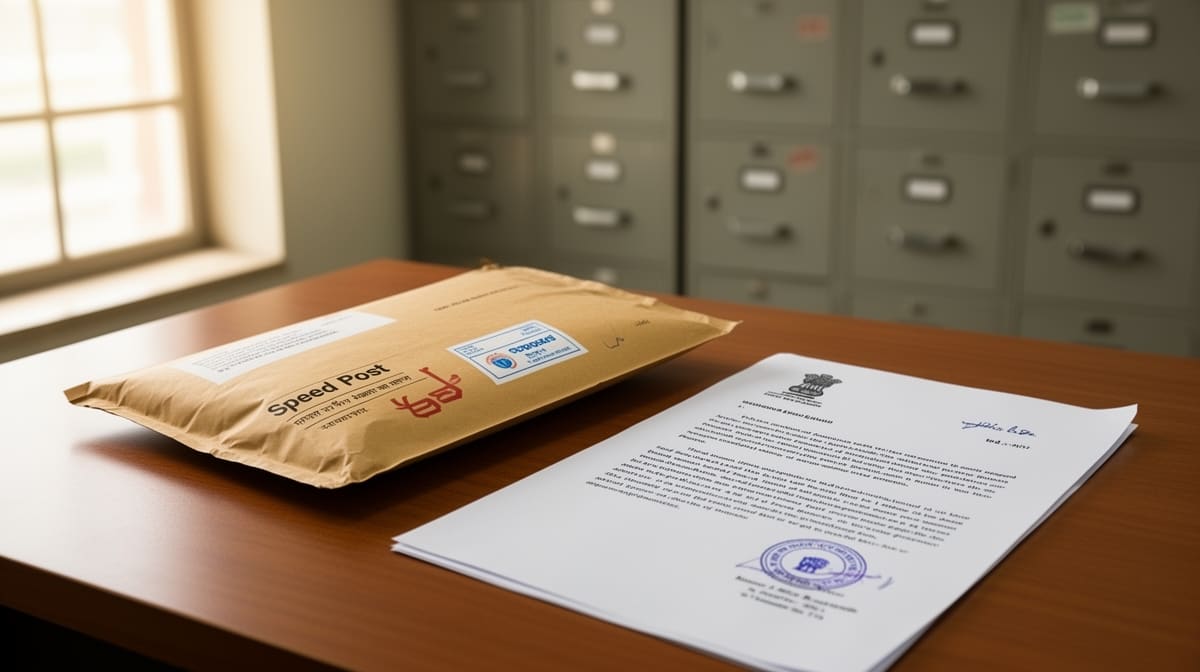
The Central Excise and Service Tax Appellate Tribunal (CESTAT) Allahabad has clarified a critical principle in indirect tax litigation: an appeal dispatched by post within the prescribed limitation period is deemed filed on time, even if received after the deadline. This ruling reinforces the legal recognition of postal dispatch as a valid mode of filing and shifts the burden to authorities to prove actual receipt delay attributable to the appellant.
Background & Facts
The Dispute
The appellant, M/s Deshraj Singh, located at Loriya Patti, Sonkh, Mathura-281006, filed an appeal against an order passed by the Commissioner of Central Excise & CGST, Agra, relating to service tax liability. The Commissioner (Appeals), Lucknow, dismissed the appeal solely on the ground of limitation, holding that the appeal was filed three days beyond the permissible period.
Key Facts
- The original order against the appellant was dated 30.06.2022
- The statutory period for filing appeal under the Finance Act, 1994, was 60 days from the date of receipt of the order
- The last date for filing appeal was therefore 29.08.2022
- The appellant filed the appeal on 22.11.2022, which was 85 days after the original order
- The appellant sought condonation of delay of 25 days
- The appeal was dispatched via post on 22.11.2022, as evidenced by a postal receipt
- The appeal was received by the office of the Commissioner (Appeals) on 29.11.2022
- The delay in receipt was therefore seven days after the last date of filing
- The appellant filed an application for condonation of delay, marked as Annexure-VII on page 51 of the appeal record
Procedural History
- 30.06.2022: Original order passed by Commissioner of Central Excise & CGST, Agra
- 29.08.2022: Last date for filing appeal (60 days from receipt of order)
- 22.11.2022: Appeal dispatched by post from Mathura
- 29.11.2022: Appeal received by Commissioner (Appeals), Lucknow
- 30.06.2023: Commissioner (Appeals) dismissed appeal solely on ground of limitation
- 13.05.2026: Hearing before CESTAT Allahabad
- 13.05.2026: Final order passed by CESTAT
Relief Sought
The appellant sought: (1) setting aside of the Commissioner (Appeals)'s order dated 30.06.2023; (2) condonation of delay in filing the appeal; and (3) remand of the appeal for adjudication on merits.
The Legal Issue
The central question was whether an appeal dispatched by post within the condonable period of limitation is deemed to have been filed on time, even if received by the appellate authority after the statutory deadline.
Arguments Presented
For the Appellant
Ms Stuti Saggi, Advocate for the appellant, submitted that the appeal was dispatched via registered post on 22.11.2022, which was within the condonable period of delay. She relied on the postal receipt as conclusive proof of dispatch and cited Skoda Auto Volkswagen India Pvt. Ltd. v. Commissioner of CGST [2021 (50) G.S.T.L. 67 (Bom.)], wherein the Bombay High Court held that the date of dispatch, not receipt, governs limitation for postal filings. She further cited Jhabboo Lal Kesara Rolling Mills by the Allahabad High Court and Bannari Amman Steels (P) Ltd. by the Kerala High Court, both affirming that delay in receipt due to postal transit cannot be attributed to the appellant.
For the Respondent
Shri Santosh Kumar, Authorized Representative for the revenue, argued that the appeal was received on 29.11.2022, which was beyond the statutory period. He contended that the Commissioner (Appeals) was bound by the statutory machinery provisions and could not extend time beyond the prescribed limit. He did not dispute the authenticity of the postal receipt but maintained that the law requires actual receipt within the limitation period.
The Court's Analysis
The Tribunal examined the statutory framework under the Finance Act, 1994, and noted that while the law prescribes a time limit for filing appeals, it does not specify whether the date of dispatch or receipt governs compliance. The Tribunal emphasized that the principle of fairness and the practical realities of postal communication must inform statutory interpretation.
"In Jhabboo Lal Kesara Rolling Mills (supra), a Division Bench of the Allahabad High Court took the view that if the appeal was sent by registered post to the appellate authority at the correct address within the period of limitation but was received beyond the period of limitation that would not render it barred by limitation."
The Tribunal observed that the appellant had acted diligently by dispatching the appeal on 22.11.2022, well within the condonable delay period, and had produced unchallenged documentary evidence of dispatch. The delay in receipt was attributable solely to postal transit, not to any fault or negligence on the part of the appellant.
The Tribunal further noted that the Commissioner (Appeals) had dismissed the appeal without even considering the application for condonation of delay (Annexure-VII), which was a procedural failure. The Tribunal held that the First Appellate Authority was legally obligated to examine the application for condonation before rejecting the appeal on limitation grounds.
The Tribunal distinguished the revenue’s reliance on mechanical application of statutory timelines, stating that such an approach defeats the purpose of providing a statutory remedy. The court affirmed that the doctrine of actus curiae neminem gravabit (the act of the court shall prejudice no one) applies: the appellant should not suffer because of delays inherent in the postal system.
The Verdict
The appeal was allowed. The Tribunal set aside the Commissioner (Appeals)'s order dated 30.06.2023 and remanded the matter for fresh consideration of the application for condonation of delay (Annexure-VII). The Commissioner (Appeals) was directed to decide the condonation application within three months from the date of receipt of this order. No view was expressed on the merits of the condonation application or the underlying tax dispute.
What This Means For Similar Cases
Dispatch Date Governs Limitation for Postal Filings
- Practitioners must retain and produce postal receipts or speed post acknowledgments as conclusive proof of timely filing
- Courts and tribunals must treat dispatch date as the operative date for limitation purposes when documents are sent via registered post
- Rejection of appeals solely on receipt date, without examining dispatch evidence, is legally unsustainable
Condonation Application Must Be Considered
- Appellate authorities cannot bypass condonation applications and dismiss appeals on limitation grounds without adjudicating the application
- The burden shifts to the revenue to prove that the delay in receipt was due to the appellant’s negligence or mala fide conduct
- Failure to consider condonation applications constitutes a denial of natural justice
Uniformity Across Tax Tribunals
- This ruling aligns CESTAT with the jurisprudence of the Bombay, Allahabad, and Kerala High Courts on GST and service tax appeals
- Practitioners may now cite this order in appeals under GST, Central Excise, and Service Tax regimes with equal force
- The principle applies equally to applications for extension of time, review petitions, and revision applications filed by post