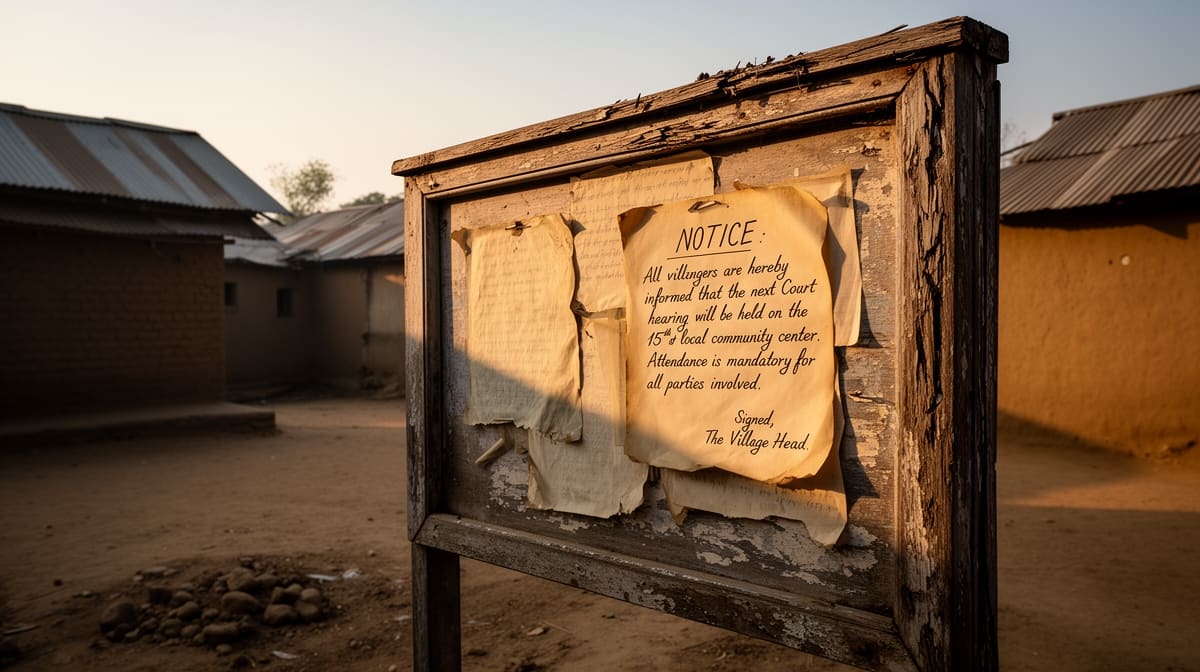
The Jharkhand High Court has reaffirmed that procedural rigour under Section 84 of the Bharatiya Nagarik Suraksha Sanhita, 2023 is non-negotiable. A proclamation issued without specifying the time and place for the accused’s appearance is legally invalid, regardless of the gravity of the offence or the accused’s conduct. This judgment reinforces the principle that due process must be visibly and precisely followed at every stage of criminal proceedings.
Background & Facts
The Dispute
The petitioner, Wasim Akram, aged 36, is the accused in Barharwa P.S. Case No. 67 of 2026, registered under unspecified provisions of the Bharatiya Nagarik Suraksha Sanhita, 2023. The case originated from an alleged criminal offence, and the Judicial Magistrate First Class, Rajmahal, issued a non-bailable warrant of arrest against the petitioner. Subsequently, on 18.04.2026, the same Magistrate issued a proclamation under Section 84 B.N.S.S., 2023, directing the petitioner to appear before the court.
Key Facts
- The petitioner is a resident of Kaharpara, P.O. Sahibganj, P.S. Sahibganj, District Sahibganj, Jharkhand.
- The non-bailable warrant was issued prior to the proclamation.
- The proclamation order dated 18.04.2026 was issued without specifying any date, time, or place for the petitioner’s appearance.
- No notice, personal or otherwise, was recorded as having been served on the petitioner prior to the issuance of the proclamation.
- The petitioner was not present in court on the date of the proclamation order.
- The petitioner filed this petition under Section 528 B.N.S.S., 2023 challenging the legality of the proclamation.
Procedural History
- Date of FIR: Not specified in judgment, but case registered as Barharwa P.S. Case No. 67 of 2026.
- Date of non-bailable warrant: 15.04.2026 (not challenged).
- Date of proclamation order: 18.04.2026 - issued without specifying time or place of appearance.
- Date of petition filing: 2026 (exact date not specified, but filed before 08.05.2026).
- Date of hearing: 08.05.2026.
- Date of judgment: 08.05.2026.
The Parties' Positions
For the Petitioner
The petitioner’s counsel contended that the proclamation under Section 84 B.N.S.S., 2023 was issued in violation of mandatory procedural requirements. The order failed to specify any time or place for the accused to appear, rendering it arbitrary and contrary to the statutory mandate. The absence of such details deprived the accused of the opportunity to comply and rendered the proclamation legally void.
For the Respondent/State
The Additional Public Prosecutor argued that the accused was expected to appear before the court within 30 days of the proclamation, and therefore, no illegality had occurred. It was submitted that the omission of specific time and place was a mere technicality and did not prejudice the accused.
Relief Sought
The petitioner sought quashing of the proclamation order dated 18.04.2026 issued under Section 84 B.N.S.S., 2023, on the grounds of procedural illegality. The prayer to quash the earlier non-bailable warrant order dated 15.04.2026 was withdrawn.
The Legal Issue
The central question was whether Section 84 of the Bharatiya Nagarik Suraksha Sanhita, 2023 permits the issuance of a proclamation against an accused without specifying the time and place for his appearance, and whether such an omission renders the order legally unsustainable.
Arguments Presented
For the Petitioner
The petitioner’s counsel relied on the settled principle that proclamation under Section 84 B.N.S.S. is a coercive measure that must be preceded by a judicial determination of absconding or concealment. He argued that the statute requires the court to record its satisfaction on record and to explicitly state the time and place for appearance. Failure to do so violates the accused’s right to be heard and to know the conditions under which he must respond. He cited State of U.P. v. Ramesh Kumar and Rajesh Kumar v. State of Bihar to underscore that procedural compliance is not optional.
For the Respondent
The State contended that the accused was aware of the proceedings and that the 30-day window under Section 84(2) B.N.S.S. implicitly provided sufficient notice. It was submitted that the omission was a clerical oversight and did not affect the substantive rights of the accused. The State further argued that the court’s power to issue proclamation is discretionary and should not be invalidated on technical grounds.
The Court's Analysis
The Court examined the language of Section 84 of the Bharatiya Nagarik Suraksha Sanhita, 2023, which provides that a proclamation may be issued if the court is satisfied that the accused is absconding or concealing himself to evade arrest. The Court emphasized that the provision is not merely permissive but prescriptive. The phrase "shall specify the time and place" in the statutory text is mandatory, not directory.
"The court which issues the proclamation under Section 84 of B.N.S.S., must record its satisfaction that the accused in respect of whom such proclamation is made, is absconding or concealing himself to evade his arrest and in case the court decides to issue proclamation under Section 84 of B.N.S.S., it must mention the time and place for appearance of the petitioner in the order itself."
The Court held that the omission of time and place in the order dated 18.04.2026 was not a mere irregularity but a fundamental defect. Without such specification, the accused cannot be expected to comply, and the proclamation becomes a tool of arbitrary state action rather than a lawful procedural step. The State’s reliance on a 30-day implicit window was rejected as contrary to the express statutory requirement. The Court further noted that the absence of any record of service or prior notice to the accused compounded the illegality.
The Court distinguished the State’s argument by stating that procedural safeguards under the B.N.S.S. are not technicalities but essential components of fair trial and due process. The Court observed that the legislature deliberately inserted the requirement of specifying time and place to prevent abuse and ensure transparency.
The Verdict
The petition was allowed. The order dated 18.04.2026 issued by the Judicial Magistrate First Class, Rajmahal, under Section 84 B.N.S.S., 2023, was quashed and set aside. The Magistrate is directed to pass a fresh order in accordance with law, ensuring that any future proclamation explicitly specifies the time and place for the accused’s appearance. The non-bailable warrant dated 15.04.2026 remains unaffected.
What This Means For Similar Cases
Procedural Compliance Is Non-Negotiable
- Practitioners must now insist that every proclamation under Section 84 B.N.S.S. contains explicit time and place of appearance - failure to do so is grounds for immediate quashing.
- Courts must record satisfaction of absconding on record before issuing proclamation; mere suspicion is insufficient.
- Any order omitting these details is void ab initio, regardless of the accused’s conduct or the nature of the offence.
No Implicit Notice Under B.N.S.S.
- The 30-day window under Section 84(2) cannot substitute for the mandatory specification of time and place in the proclamation order.
- The accused cannot be presumed to know the court’s expectations; notice must be explicit and documented.
- Defence counsel should challenge any proclamation lacking these details at the earliest opportunity, even before filing a petition under Section 528.
Judicial Accountability in Proclamation Orders
- Magistrates must now draft proclamation orders with precision - boilerplate language will not suffice.
- The High Court’s directive to pass a "fresh order in accordance with law" implies that the Magistrate must re-examine the facts and record fresh satisfaction before reissuing the proclamation.
- This judgment elevates procedural compliance to a constitutional imperative under Article 21.