The Jharkhand High Court has reaffirmed that at the discharge stage under Section 227 CrPC, courts need not assess the credibility or probative weight of prosecution evidence - only whether the material on record prima facie discloses an offence. This ruling clarifies the threshold for proceeding to trial in corruption cases involving demand and recovery of gratification.
Background & Facts
The Dispute
The petitioner, Arvind Kumar, Executive Engineer, Rural Works Division, Simdega, was accused of demanding and receiving an illegal gratification of Rs. 1,00,000 from Hemant Kumar, proprietor of M/s Laxmi Enterprises, in exchange for releasing a pending security deposit of approximately Rs. 8,00,000 under a PMGSY road construction contract (PKG No. JH-2106, Phase VI, Agreement No. 05 PMGSY 2018-19, value Rs. 3,78,24,591). The contract was completed on 14.07.2019, and Rs. 3,13,00,000 had been released, but the remaining security deposit was withheld pending recommendations from subordinate engineers.
Key Facts
- The complainant alleged the petitioner demanded 1% of the contract value (Rs. 4,00,000) as illegal gratification for releasing the balance security deposit.
- After negotiations, it was agreed that Rs. 1,00,000 would be paid as an initial installment.
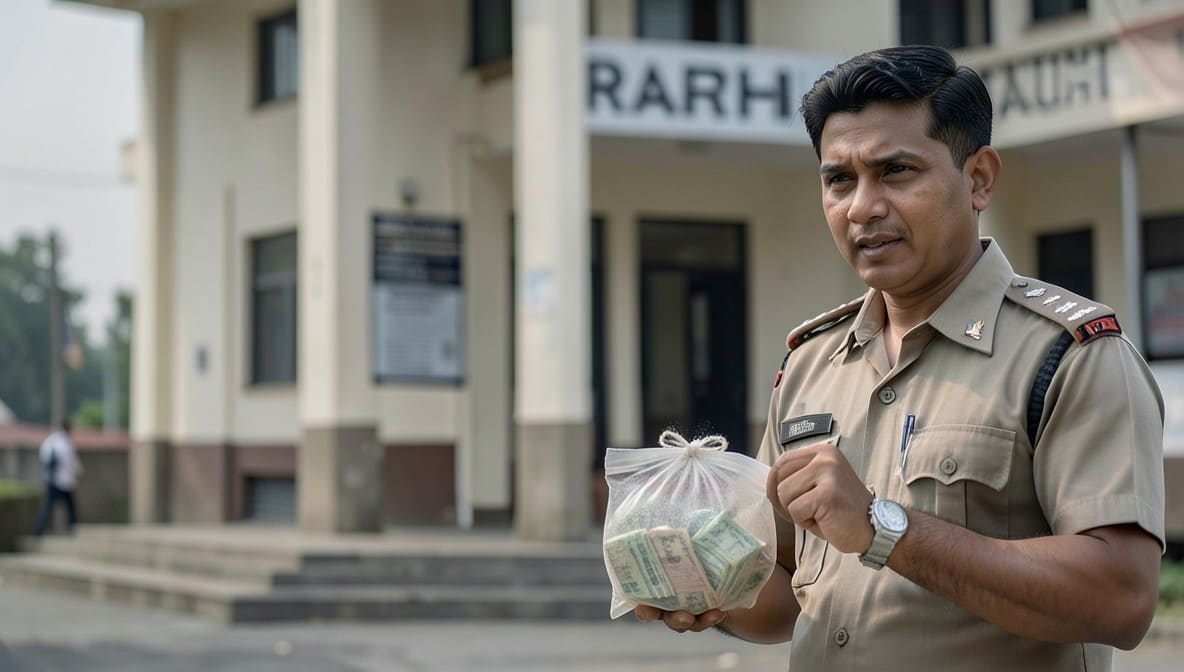
- On 15.07.2020, a trap was conducted by the Anti-Corruption Bureau (ACB), Ranchi, during which Rs. 1,00,000 smeared with phenolphthalein powder was recovered from the petitioner’s right hand.
- A G.C. Notes Memorandum was prepared in the presence of ACB officials.
- The petitioner had previously released Rs. 4,00,000 from the security deposit based on recommendations from the Junior Engineer and Assistant Engineer.
- The remaining Rs. 8,00,000 was not released due to absence of formal recommendations for further disbursement.
Procedural History
- 15.07.2020: ACB trap conducted; Rs. 1,00,000 recovered from petitioner.
- 2020: FIR registered as ACB P.S. Case No. 05 of 2020 under Section 7(a) of the Prevention of Corruption Act, 1988.
- 2022: Charge sheet submitted; cognizance taken.
- 2022: Petitioner filed discharge petition under Section 227 CrPC (now Section 250 BNSS, 2023) in Misc. Criminal Application No. 2190 of 2022.
- 05.01.2023: Special Judge, ACB, Ranchi dismissed the discharge petition, holding prima facie evidence existed to frame charges.
- 30.03.2023: Charges framed under Section 7(a) of the Prevention of Corruption Act, 1988.
- 17.04.2026: Criminal Miscellaneous Petition heard before the Jharkhand High Court.
- 24.04.2026: Judgment pronounced.
The Parties' Positions
For the Petitioner: Argued that the demand for gratification was unfounded, as the remaining Rs. 8,00,000 could not be released without formal recommendations from subordinate officers. Contended that the prosecution failed to establish any corrupt intent, and the recovery was staged or misinterpreted. Relied on Shankar Yadav v. State of Jharkhand to argue that the trial court had not examined any evidence in its discharge order.
For the Respondent-State: Maintained that the trap was lawful, the recovery was corroborated by G.C. Notes, and the complainant’s testimony was verified independently. Asserted that the trial court had properly applied the prima facie standard and that the petition was an attempt to delay trial.
Relief Sought
The petitioner sought quashing of the order dated 05.01.2023 dismissing his discharge petition, and a direction to discharge him from the proceedings under Section 227 CrPC.
The Legal Issue
The central question was whether the materials on record - including the complainant’s allegation, independent verification, and recovery of phenolphthalein-smudged currency during a trap - prima facie disclosed the essential ingredients of an offence under Section 7(a) of the Prevention of Corruption Act, 1988, sufficient to reject a discharge petition.
Arguments Presented
For the Petitioner
The petitioner’s counsel contended that the trial court’s order was mechanically worded and failed to engage with the evidence. He argued that the petitioner had already released Rs. 4,00,000 based on recommendations, and the remaining amount was withheld due to procedural non-compliance, not corruption. He cited Shankar Yadav v. State of Jharkhand to argue that a discharge order must reflect judicial reasoning on the material, not mere boilerplate conclusions. He emphasized that the burden at discharge is not on the accused to prove innocence, but on the prosecution to show a prima facie case.
For the Respondent/State
The State’s counsel countered that the trial court had meticulously reviewed the FIR, G.C. Notes, trap report, and complainant’s statement. He submitted that the recovery of currency smeared with phenolphthalein during a pre-planned trap is strong circumstantial evidence of demand and acceptance of gratification. He argued that the petitioner’s explanation - that the money was paid for legitimate reasons - could only be tested at trial, not at discharge. He further noted that trial had already commenced with examination of witnesses, making interference inappropriate.
The Court's Analysis
The Court reiterated the settled legal position that at the discharge stage under Section 227 CrPC, the court does not conduct a mini-trial or evaluate the likelihood of conviction. The sole inquiry is whether the prosecution’s material, taken at face value, discloses a prima facie case of the offence alleged.
"At this stage, the trial judge has to merely examine the evidence placed by the prosecution in order to determine whether or not the grounds are sufficient to proceed against the accused on the basis of the material produced with the charge-sheet."
The Court observed that the complainant’s allegation of demand for gratification was independently verified by the ACB before the trap. The recovery of Rs. 1,00,000 smeared with phenolphthalein from the petitioner’s hand during a pre-arranged operation constitutes direct evidence of acceptance of illegal gratification. The Court noted that the petitioner did not dispute the recovery or the presence of the chemical marker, nor did he produce any material from the charge sheet to show the allegations were inherently improbable.
The Court distinguished Shankar Yadav v. State of Jharkhand, where the trial court had not referenced any evidence or assigned reasons. In contrast, the impugned order dated 05.01.2023 explicitly referenced the trap report, G.C. Notes, and complainant’s statement, concluding that a prima facie case existed. The Court held that the trial court had discharged its duty under Section 227 CrPC.
The Court further emphasized that the petitioner’s explanation regarding procedural delays in releasing funds is a defence that must be tested during trial, not at discharge. The mere existence of a plausible alternative explanation does not negate the prima facie case.
The Verdict
The petition was dismissed. The High Court upheld the order dated 05.01.2023 dismissing the discharge petition. The petitioner shall proceed to trial on charges framed under Section 7(a) of the Prevention of Corruption Act, 1988. The Court noted that trial proceedings have already commenced with examination of witnesses, and no grounds exist to interfere with the trial court’s finding of prima facie evidence.
What This Means For Similar Cases
Prima Facie Evidence Trumps Alternative Explanations
- Practitioners must recognize that at discharge, courts do not weigh defences or assess credibility - only whether the prosecution’s material, if accepted, constitutes an offence.
- A plausible non-criminal explanation (e.g., procedural delay) does not automatically warrant discharge if the prosecution’s version satisfies the statutory ingredients.
Recovery of Smudged Currency Is Strong Prima Facie Evidence
- Recovery of currency smeared with phenolphthalein during a legally conducted trap remains one of the most compelling forms of circumstantial evidence in corruption cases.
- Absent a credible challenge to the trap’s authenticity or chain of custody, such recovery is sufficient to meet the prima facie threshold under Section 7(a) PCA.
Discharge Orders Must Reflect Judicial Reasoning
- While this case upheld the discharge order, the Court implicitly reinforced that trial courts must articulate their reasoning by referencing specific evidence (FIR, trap report, G.C. Notes).
- Blanket orders without reference to materials risk being set aside, as seen in Shankar Yadav.
Trial Commencement Bars Interference
- Once trial has commenced and witnesses examined, High Courts are less likely to interfere with discharge orders, even if procedural irregularities are alleged.
- Petitioners must challenge discharge orders promptly; delay may be viewed as an abuse of process.