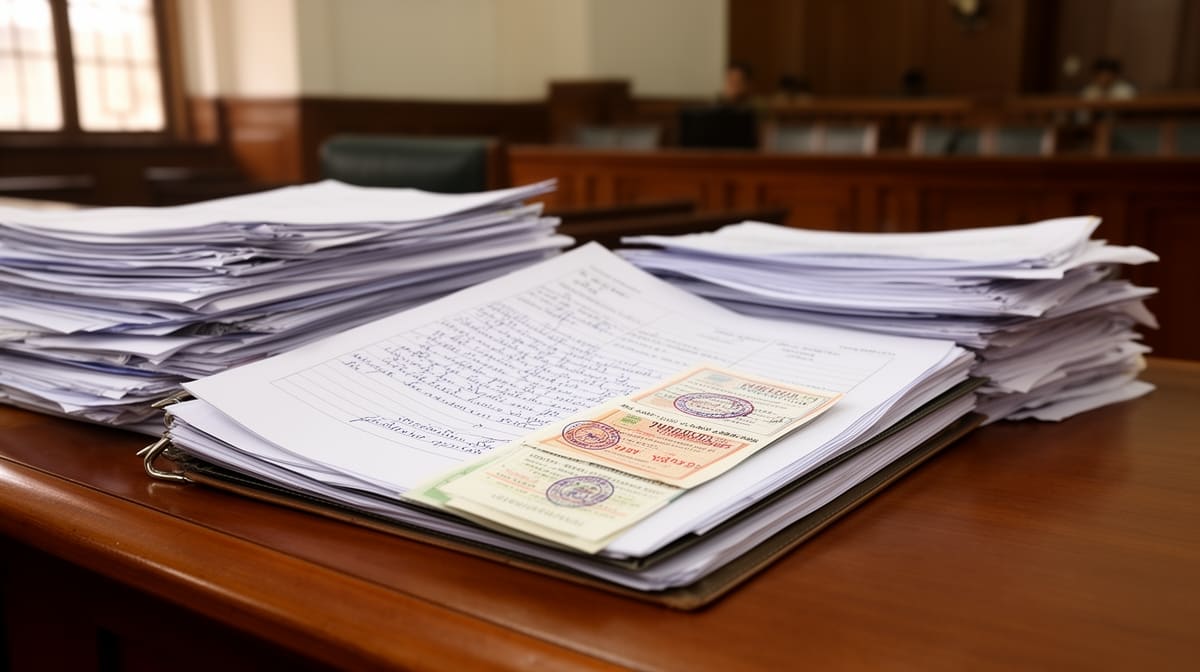
The Delhi High Court has reaffirmed that the mere production of a written arbitration agreement does not create a presumption of its execution. In a sharply reasoned judgment, the Court emphasized that the burden of proving authentic execution lies squarely on the party asserting its existence, and courts must not substitute their view for that of the arbitrator absent patent illegality.
Background & Facts
The Dispute
The petitioner, Galaxy Infra and Engineering Pvt. Ltd., claimed it provided consultancy services to the respondent, Pravin Electricals Pvt. Ltd., for securing a turnkey contract under the R-APDRP Scheme in Patna. The parties allegedly entered into a Consultancy Agreement (CA) dated 07.07.2014, which contained an arbitration clause. When payment for services was withheld, the petitioner invoked arbitration under Section 21 of the Arbitration and Conciliation Act, 1996.
Procedural History
- 2014: Alleged execution of Consultancy Agreement (CA) on 07.07.2014
- 2018: Petitioner issued notice under Section 21 seeking appointment of arbitrator
- 2020: Delhi High Court appointed arbitrator under Section 11(6)
- 2021: Supreme Court upheld appointment but set aside finding that arbitration agreement existed, directing arbitrator to determine existence of agreement as preliminary issue
- 2023: Arbitrator held CA was not executed; signatures of respondent’s representative were forged; no concluded agreement emerged from subsequent correspondence
- 2026: Petitioner filed Section 34 petition challenging award
Relief Sought
The petitioner sought to set aside the arbitral award on grounds that the arbitrator erred in rejecting the CA’s authenticity, misapplied the burden of proof, and improperly dismissed the alternative claim that a separate arbitration agreement arose from post-dated correspondence.
The Legal Issue
The central question was whether the burden of proving execution of an arbitration agreement shifts to the respondent once the agreement is produced, and whether an arbitration agreement can be inferred from post-execution correspondence when the original document is contested as forged.
Arguments Presented
For the Petitioner
The petitioner argued that production of the CA constituted prima facie proof of execution, shifting the burden to the respondent to prove forgery. It relied on cross-examination of Mr. M.G. Stephen (RW-1), claiming his responses amounted to admission of execution. It further contended that emails dated 15.07.2014, 22.07.2014, and 25.07.2014 evidenced a concluded agreement, and that the arbitrator violated the Supreme Court’s directive by conflating the two alternative pleas.
For the Respondent
The respondent countered that the petitioner failed to discharge its initial burden of proving execution. It highlighted that the CA was notarized in Faridabad by a notary whose license had expired, with no business nexus to the parties’ registered offices in Mumbai and Bihar. The respondent emphasized that the arbitrator’s findings on forgery were supported by documentary inconsistencies and lack of witness corroboration. It further argued that the alternative plea of a concluded agreement via correspondence was inconsistent with the primary claim and could not be entertained.
The Court's Analysis
The Court examined the arbitrator’s reasoning through the narrow lens of Section 34 of the Arbitration and Conciliation Act, which permits interference only on grounds of patent illegality, perversity, or contravention of public policy. It held that the arbitrator’s findings were neither irrational nor legally unsustainable.
"The facts of this case remind one of Alice in Wonderland... Large pieces of the jigsaw puzzle that forms the documentary evidence between the parties in this case remained unfilled."
The Court noted that the Supreme Court had explicitly declined to conclude the existence of an arbitration agreement, leaving it to the arbitrator to determine after full evidentiary scrutiny. The arbitrator meticulously analyzed the CA’s anomalies: the notary’s expired license, absence of negotiation in Faridabad, failure to examine witnesses or the notary, and the fact that a draft agreement was still being circulated eight days after the alleged execution date.
The Court rejected the petitioner’s reliance on prima facie proof as a legal shortcut. It held that the burden of proving execution never shifts until the claimant establishes a credible foundation. The arbitrator correctly applied the principles of Vidya Drolia v. Durga Trading Corporation and Ramesh Kumar Jain v. BALCO, emphasizing that courts cannot re-appreciate evidence under Section 34.
Regarding the alternative plea, the Court agreed that the arbitrator’s bifurcation of issues was prudent. Even if the second plea was inconsistent, the arbitrator’s decision on its merits was academic but not legally erroneous. The correspondence cited by the petitioner - particularly the email asking whether the "final consultancy agreement" was "in order" - demonstrated ongoing negotiation, not conclusion.
The Court also dismissed the argument that invoices raised against PCTS implied an agreement with the respondent. The invoices referenced PCTS, not the respondent, and the final invoice cited the disputed CA for a fee outside the petitioner’s scope of work.
The Verdict
The petitioner’s challenge failed. The Delhi High Court upheld the arbitral award, holding that the burden of proving execution of an arbitration agreement rests with the claimant, and post-execution correspondence cannot substitute for a validly executed agreement. The petition was dismissed.
What This Means For Similar Cases
Execution Cannot Be Presumed from Document Production
- Practitioners must now prepare comprehensive evidence chains for arbitration agreements: witness testimony, notary verification, communication trails, and proof of mutual assent
- Mere production of a signed document is insufficient; courts will scrutinize authenticity, jurisdictional relevance, and procedural compliance
- In cases involving forged signatures, the claimant must proactively establish execution before shifting burden
Post-Execution Conduct Does Not Create Arbitration Clauses
- Emails referencing "draft" agreements, pending approvals, or inquiries about terms indicate negotiation, not conclusion
- Parties cannot bootstrap an arbitration agreement from ambiguous correspondence if the original document is invalid
- Arbitrators may reject inconsistent pleas, but if they examine them on merits, courts will not interfere unless the reasoning is perverse
Section 34 Remains a Narrow Remedy
- Courts will not re-evaluate factual findings or evidentiary weight under Section 34
- Only patent illegality, perversity, or public policy violations justify setting aside an award
- Practitioners must focus Section 34 arguments on procedural defects or legal errors apparent on the face of the award, not on disputed facts