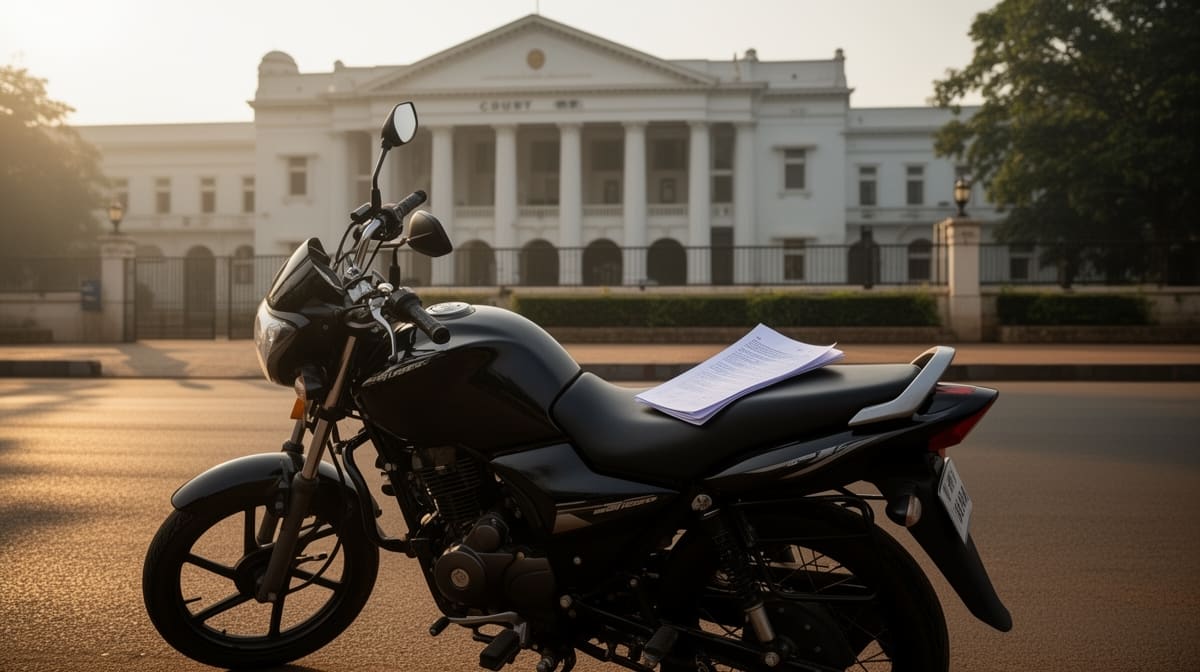
The Madras High Court has reaffirmed that an innocent owner of a vehicle seized under the NDPS Act cannot be denied interim custody merely on the basis of a circular, without a hearing or consideration of merits. This judgment reinforces the constitutional obligation to protect property rights and uphold procedural fairness even in stringent drug enforcement cases.
Background & Facts
The Dispute
The petitioner, Murugan, is the registered owner of a Bajaj KTM 200 Duke motorcycle bearing registration number TN-25-CK-5085. He purchased the vehicle with financial assistance from Bajaj Auto Credit Limited and uses it for daily wage employment. On an unspecified date prior to Crime No. 24 of 2025, the petitioner lent the vehicle to Naveenkumar, a relative of a friend residing in Avalurpettai, for a personal visit. Subsequently, the vehicle was seized by the Prohibition Enforcement Wing (PE Wing), Gingee, Villupuram District, in connection with Crime No. 24 of 2025 under Sections 8(c) and 20(b)(ii)(A) of the Narcotic Drugs and Psychotropic Substances Act, 1985 (NDPS Act). Naveenkumar was arrayed as Accused No. 2 in the case. The petitioner was never named as an accused, nor was he present at the time of seizure.
Key Facts
- The petitioner is a daily wage worker dependent on the motorcycle for livelihood
- The vehicle was purchased with financing from Bajaj Auto Credit Limited
- The petitioner had no knowledge of Naveenkumar’s intention to use the vehicle for transporting contraband
- The vehicle was parked at a location away from the petitioner’s residence at the time of seizure
- The petitioner claims the seizure is staged and that he possesses evidence to prove fabrication
- The petitioner filed an application for return of property before the Special Court for NDPS Cases, Villupuram
Procedural History
- Date of seizure: Prior to 06.11.2025 (exact date not specified in judgment)
- 06.11.2025: Special Court returned the petitioner’s application for return of property citing ROC.No.70917-A/2025/F1 dated 01.09.2025, without numbering, hearing, or adjudication on merits
- 16.03.2026: Criminal Original Petition filed under Section 528 of the Bharatiya Nagarik Suraksha Sanhita (BNSS) before the Madras High Court challenging the return order
The Parties' Positions
For the Petitioner
- The petitioner is not an accused and has no connection to the offence
- He was unaware of the contraband being transported in his vehicle
- The seizure is alleged to be fabricated
- He seeks an opportunity to prove his innocence and claim interim custody of the vehicle
- Relied on Sunderbhai Ambalal Desai v. State of Gujarat (2002) 10 SCC 283, Bishwajit Dey v. State of Assam (2025) 3 SCC 241, and Denash v. State of Tamil Nadu (2025 SCC Online SC 2276)
For the Respondent
- The vehicle was used in the commission of an offence under the NDPS Act
- The Special Court followed the Madras High Court’s ROC.No.70917-A/2025/F1 dated 01.09.2025, which allegedly bars interim release of vehicles in NDPS cases
- Argued that the petitioner, as owner, falls under the first contingency of Bishwajit Dey - where the contraband is recovered from the vehicle owned by the accused
- Contended that the vehicle is liable for confiscation under Section 63 of the NDPS Act
Relief Sought
The petitioner sought:
- Setting aside of the order dated 06.11.2025 returning the property application
- Direction to the Special Court to number, hear, and decide the petition on merits
- Grant of interim custody of the motorcycle subject to conditions
The Legal Issue
Can a Special Court under the NDPS Act summarily return an application for return of property without hearing the owner, merely on the basis of a High Court circular, when the owner is not an accused and claims no knowledge or connivance in the offence?
Arguments Presented
For the Petitioner
The petitioner’s counsel argued that the Special Court’s refusal to entertain the petition violated the binding precedents of the Supreme Court in Sunderbhai Ambalal Desai, Bishwajit Dey, and Denash. He emphasized that the four contingencies laid down in Bishwajit Dey clearly distinguish between owners who are accused and those who are innocent. Since the petitioner was not arrayed as an accused and had no knowledge of the contraband, he fell under the fourth contingency - where the vehicle was used by a third party without the owner’s knowledge or connivance. The petitioner further contended that the ROC issued on 01.09.2025 cannot override the Supreme Court’s interpretation of Sections 451 and 457 of the CrPC (now Sections 497 and 503 of BNSS), which empower Special Courts to grant interim custody. He cited Article 141 of the Constitution, asserting that the High Court’s circular cannot override binding Supreme Court rulings.
For the Respondent
The Additional Public Prosecutor conceded that the petitioner was not an accused but argued that the vehicle’s involvement in the offence justified non-release under the ROC. He contended that the ROC was issued to prevent misuse of interim custody provisions and that the Special Court was merely following a procedural directive. He relied on the Madurai Bench’s earlier decision in Denash (2024), which had denied interim custody, and argued that the vehicle’s connection to the offence was sufficient to warrant confiscation under Section 63 of the NDPS Act, irrespective of the owner’s innocence.
The Court's Analysis
The Court undertook a comprehensive review of the Supreme Court’s jurisprudence on the return of seized vehicles under the NDPS Act. It emphasized that the power to confiscate under Section 63 of the NDPS Act is a final adjudicatory power vested exclusively in the Special Court, and cannot be exercised by administrative bodies such as the Drug Disposal Committee. The Court quoted from Bishwajit Dey v. State of Assam (2025) 3 SCC 241:
"The legislative scheme thus contemplates that confiscation, being a measure resulting in deprivation of property, must conform to the basic tenets of natural justice and must be preceded with a prior hearing which would ensure that an innocent owner or a bona fide claimant, whose vehicle or container might have been misused without his knowledge or connivance, is not subjected to undue hardship and unjust deprivation of his property."
The Court further relied on Denash v. State of Tamil Nadu (2025 SCC Online SC 2276) and Tarun Kumar Majhi v. State of West Bengal (2025 SCC Online SC 2362), which clarified that the four contingencies are not rigid formulas but guiding principles to be applied contextually. The Court held that the Special Court’s action of returning the petition without numbering, without hearing, and without considering the petitioner’s claim of innocence was a direct violation of Article 141 of the Constitution and the principles of natural justice.
The Court rejected the Respondent’s reliance on the ROC dated 01.09.2025, stating that such circulars cannot override statutory rights or binding Supreme Court judgments. It observed:
"Any interpretation to the contrary would lead to anomalous and unjust consequences by depriving a bona fide owner of his property without judicial scrutiny or an opportunity of hearing, an outcome wholly inconsistent with the statutory scheme of the NDPS Act and contrary to the fundamental principles of natural justice."
The Court also noted that the petitioner’s claim of being a daily wage earner dependent on the vehicle for livelihood further strengthened the equitable grounds for interim custody.
The Verdict
The Madras High Court allowed the petition and set aside the order dated 06.11.2025 returning the property application. The Special Court is directed to receive the petitioner’s application, number it, hear both parties, and decide the matter on merits in accordance with law. The Court emphasized that if the petitioner establishes absence of knowledge or connivance, the vehicle must be released on interim custody subject to a bond and deposit of its assessed value, if confiscation is ultimately ordered. The Registry is directed to return the original petition to the petitioner’s counsel.
What This Means For Similar Cases
Interim Custody Cannot Be Denied by Circulars
- Practitioners must challenge any summary rejection of property return applications based on administrative circulars
- The Supreme Court’s four-contingency framework in Bishwajit Dey is binding and overrides internal court directives
- Special Courts must hear all claims of innocent ownership, regardless of the nature of the offence
Burden of Proof Is Not On the Owner at Preliminary Stage
- The owner need not prove innocence conclusively at the interim custody stage - only a prima facie case of non-involvement is required
- The burden to disprove innocence shifts to the prosecution only if the court proceeds to final confiscation
- Petitioners should submit proof of vehicle usage, financial ownership, and lack of access to the accused at the time of seizure
Procedural Compliance Is Non-Negotiable
- Applications for return of property must be numbered and heard - no summary return permitted
- Failure to hear the petitioner violates Article 141 and Article 21 of the Constitution
- Advocates should file writ petitions under Section 528 BNSS immediately if applications are summarily returned