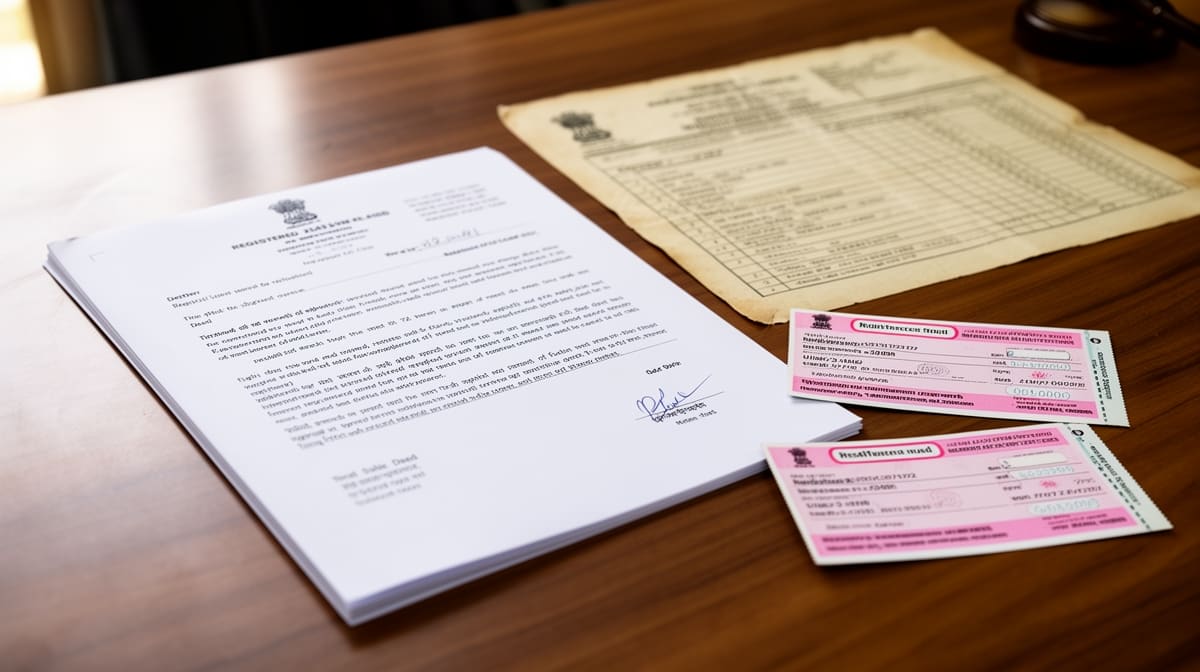
The Calcutta High Court has clarified that a bare assertion of thika tenancy, without specific factual pleadings, cannot automatically invalidate sale deeds or trigger vesting of property under the West Bengal Thika and Other Tenancies and Lands (Acquisition & Regulation) Act, 1981. This ruling reinforces the principle that procedural fairness in civil litigation demands precise pleading, not conclusory allegations.
Background & Facts
The Dispute
The dispute centers on competing claims of ownership over a parcel of land in Howrah, originally sold by a vendor to Banashree Saha (Appellant/Plaintiff) via a registered deed dated 15.06.1985. The Defendants, including Sunia Kurmi and others, claimed to be thika tenants under the Calcutta Thika Tenancy Act, 1949, and later under the West Bengal Thika and Other Tenancies and Lands (Acquisition & Regulation) Act, 1981. They alleged that the property had vested in the State upon the 1981 Act’s enforcement, rendering the sale deed void. The Appellant also filed a separate suit against the Calcutta Electric Supply Company (CESC) for restoration of electric connection, which was heard alongside the ownership suits.
Key Facts
- The Appellant purchased Schedule-A land on 15.06.1985 via registered sale deed (Ext.1)
- The Defendants occupied Schedule-B portion of the same land, claiming tenancy rights
- The Defendants deposited rent with the Thika Controller from 1982 onwards
- The Appellant filed Title Suit No. 225 of 1989 seeking possession and declaration of title
- The Defendants filed Title Suit No. 53 of 1993 claiming ownership and seeking injunction against the Appellant
- The Appellant filed Title Suit No. 52 of 1992 against CESC for restoration of electric supply
- All three suits were heard together by the Trial Court
Procedural History
- 15.06.1985: Registered sale deed executed between vendor and Appellant
- 1981: West Bengal Thika and Other Tenancies and Lands (Acquisition & Regulation) Act, 1981 came into force
- 1982: Defendants began depositing rent with Thika Controller
- 1989: Title Suit No. 225 of 1989 filed by Appellant
- 1992: Title Suit No. 52 of 1992 filed by Appellant against CESC
- 1993: Title Suit No. 53 of 1993 filed by Defendants
- 26.06.2002: Trial Court decreed Suits 225/1989 and 52/1992 in favor of Appellant; dismissed Suit 53/1993
- 16.02.2006: First Appellate Court (Additional District Judge, Howrah) set aside decrees in Suits 225/1989 and 52/1992, remanded for re-hearing on two new issues: (1) whether property is thika property; (2) validity of Ext.1 and Ext.2 deeds
- 22.07.2006: First Miscellaneous Appeals (FMA/661/2006 and FMA/663/2006) filed before Calcutta High Court
- 12.03.2026: Final hearing concluded
- 19.03.2026: Judgment delivered
The Parties' Positions
Appellant/Plaintiff (Banashree Saha): Contended that the Defendants never pleaded thika tenancy with specificity. The sale deed was registered, possession was delivered, and the Appellant had been in continuous possession since 1985. The 1981 Act’s vesting provisions were not triggered because the Defendants failed to establish the property met the statutory definition of a thika property.
Respondents/Defendants (Sunia Kurmi & Others): Argued that the property was a thika property under the 1981 Act, and therefore, the sale deeds were void ab initio. They relied on rent deposits with the Thika Controller as proof of tenancy.
Relief Sought
The Appellant sought: (1) setting aside the Appellate Court’s order of 16.02.2006; (2) restoration of the Trial Court’s decrees dated 26.06.2002; (3) dismissal of the Defendants’ suit (No. 53/1993) as unchallenged; and (4) direction to the First Appellate Court to decide the appeals on merit without further remand.
The Legal Issue
The central question was whether a bare, unsubstantiated assertion in pleadings that a property is a "thika property" is sufficient to invoke vesting under Section 5 of the West Bengal Thika and Other Tenancies and Lands (Acquisition & Regulation) Act, 1981, or whether specific factual pleadings detailing the nature of the structure, tenancy, and compliance with statutory definitions are mandatory.
Arguments Presented
For the Appellant
The Appellant’s counsel argued that the Defendants’ pleadings were conclusory and lacked the specificity required under Order VII Rule 7 of the CPC. The mere mention of "thika property" without identifying the nature of the structure, the relationship between landlord and tenant, the rent paid, or the existence of a pucca structure as defined under the 1981 Act, was legally insufficient. The Trial Court had already examined the applicability of the Act and found no vesting. The Appellate Court’s remand on vague grounds was an abuse of process.
For the Respondent
The Respondents’ counsel contended that the plea of thika tenancy was raised in the written statements of Suit No. 225/1989 and the plaint of Suit No. 52/1992, thereby triggering the need for formal issues on vesting under the 1981 Act. They relied on the fact that rent was paid to the Thika Controller as evidence of tenancy, and argued that the Appellate Court was justified in remanding to ensure all legal defenses were properly adjudicated.
The Court's Analysis
The Court examined the pleadings in both suits and found that while the word "thika property" was mentioned, there was no factual averment regarding the nature of the structure, the identity of the landlord, the terms of tenancy, or compliance with the definitions under Section 2 of the 1981 Act. The Court emphasized that Section 5 of the Act, which vests land in the State, applies only to properties meeting precise statutory criteria - including the existence of a "pucca structure" and a "thika tenant" as defined.
"Mere assertion that the property is a thika property, without pleading the essential ingredients of a thika tenancy under the 1981 Act, cannot be the basis for invalidating a registered sale deed or triggering vesting under Section 5."
The Court noted that the Trial Court had already considered the applicability of the 1981 Act and found no evidence of vesting. The Appellate Court’s decision to remand on the basis of two vague issues - without identifying any pleading deficiency - was legally unsustainable. The Court held that the Appellate Court had substituted its own view for that of the Trial Court, without applying the correct legal standard.
Regarding the deeds (Ext.1 and Ext.2), the Court observed that they were registered documents and their authenticity was not disputed. The only challenge was their validity under the 1981 Act, which required factual proof of vesting - proof that was entirely absent in the pleadings.
The Verdict
The Appellant succeeded. The Calcutta High Court set aside the order of the First Appellate Court dated 16.02.2006. The Trial Court’s decrees in Title Suit No. 225 of 1989 and Title Suit No. 52 of 1992 are restored. The First Appellate Court is directed to rehear the appeals on merit and dispose of them within six months from the date of receipt of the Trial Court record. The finding in Title Suit No. 53 of 1993, which was not challenged, remains undisturbed.
What This Means For Similar Cases
Pleadings Must Be Specific to Trigger Statutory Vesting
- Practitioners must now plead the exact statutory criteria under the 1981 Act (e.g., "pucca structure," "thika tenant," rent paid to Thika Controller) to invoke vesting - mere labels like "thika property" are insufficient
- Courts will not infer statutory compliance from vague assertions; failure to plead facts defeats the defense
- In property suits involving acquisition laws, the burden lies on the defendant to plead and prove compliance with the statute’s definitional requirements
Remand Is Not a Default Remedy for Unpleaded Defenses
- Appellate courts cannot remand cases merely because a defense was mentioned in pleadings - the defense must be legally tenable and factually pleaded
- If the Trial Court has already examined the issue and found no merit, remand for formal issue-framing is an abuse of process
- Courts must distinguish between a legally valid defense and a legally insufficient pleading
Registered Sale Deeds Are Presumed Valid Unless Statutory Vesting Is Proven
- A registered sale deed cannot be invalidated by a conclusory plea of statutory vesting
- The burden of proving vesting under the 1981 Act rests entirely on the party asserting it
- Absent proof of compliance with Section 5, the sale deed prevails over unverified claims of tenancy