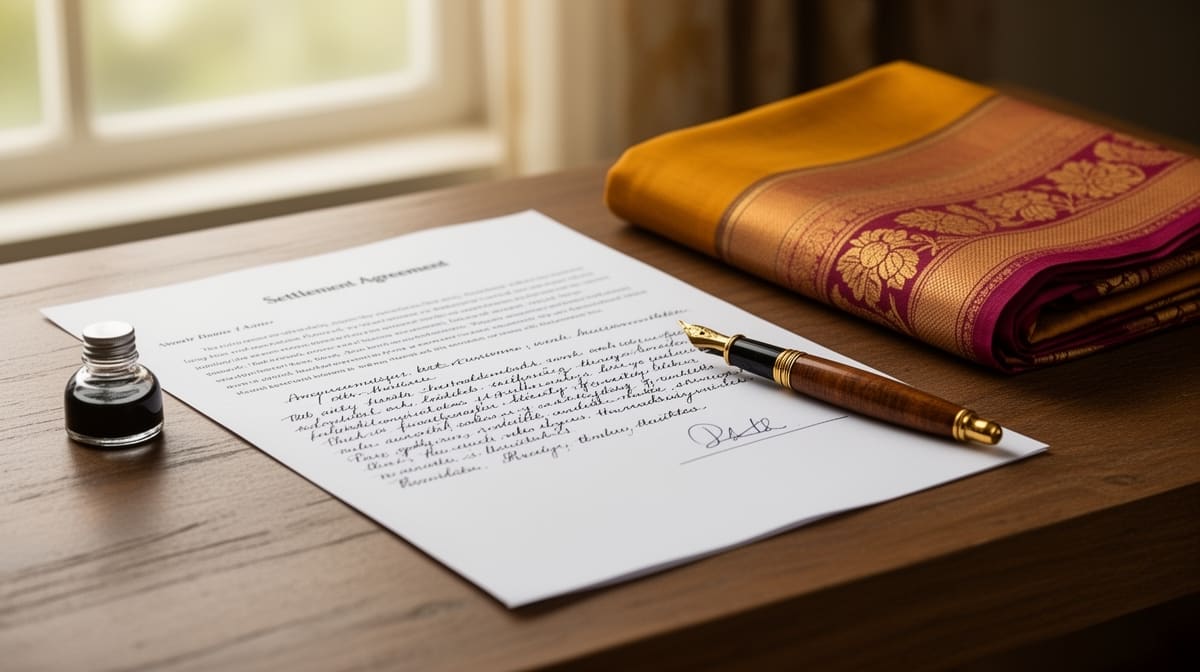
The Rajasthan High Court has reaffirmed that criminal proceedings arising from matrimonial disputes may be quashed upon genuine compromise between parties, even when the offence under Section 498-A IPC remains un-compounded. This ruling reinforces the principle that not all criminal cases - particularly those rooted in private, civil-like family conflicts - must proceed to trial when justice is better served by termination.
Background & Facts
The Dispute
The petitioner, Rajendra Singh, was named in FIR No. 33/2024 registered at Mahila Thana, Jodhpur, for alleged offences under Sections 498-A, 406, and 323 IPC, stemming from a marital dispute with his wife, the complainant. The allegations included cruelty, dowry demands, and physical assault. The police investigated and filed a charge-sheet, leading to the initiation of Criminal Regular Case No. 2240/2026 before the Metropolitan Magistrate.
Procedural History
- 2024: FIR registered at Mahila Thana, Jodhpur
- 2025: Petitioner and complainant entered into a written compromise agreement dated 19.12.2025
- 2026: Trial court acquitted petitioner on charges under Sections 406 and 323 IPC based on the compromise
- 2026: Petitioner filed Criminal Misc. Petition under Section 528 of BNSS seeking quashing of remaining proceedings under Section 498-A IPC
Relief Sought
The petitioner sought quashing of the entire criminal proceeding, including the FIR and all consequential proceedings, on the ground that the dispute had been fully and amicably resolved, and continuation of the case would cause undue hardship and injustice.
The Legal Issue
The central question was whether the High Court may exercise its inherent power under Section 528 of BNSS to quash criminal proceedings under Section 498-A IPC when the parties have reached a full and voluntary compromise, even though the offence is non-compoundable under Section 320 CrPC.
Arguments Presented
For the Petitioner
Counsel relied on Gian Singh v. State of Punjab & Anr. to argue that offences arising from matrimonial disputes have a predominantly civil flavour and are personal in nature. He submitted that the compromise was genuine, voluntary, and recorded before the trial court, which had already acquitted the petitioner on two charges. He contended that continuing the prosecution under Section 498-A would amount to abuse of process and inflict extreme prejudice.
For the Respondent
The Public Prosecutor opposed quashing, asserting that Section 498-A is a serious offence affecting women’s rights and societal dignity, and that non-compoundability under Section 320 CrPC bars any judicial termination. He argued that compromise cannot override the state’s interest in prosecuting crimes against women.
The Court's Analysis
The Court undertook a structured review of the Supreme Court’s ruling in Gian Singh v. State of Punjab, emphasizing that while Section 498-A IPC is non-compoundable, the High Court’s inherent jurisdiction under Section 528 of BNSS is not bound by the limitations of Section 320 CrPC. The Court observed that the nature of the offence must be assessed not merely by its statutory label but by its context and impact.
"The criminal cases having overwhelmingly and pre-dominatingly civil flavour stand on different footing for the purposes of quashing, particularly the offences arising from... matrimony relating to dowry, etc. or the family disputes where the wrong is basically private or personal in nature."
The Court noted that the trial court had already accepted the compromise and acquitted the petitioner on two charges, indicating the parties’ reconciliation was genuine. It further held that the remaining charge under Section 498-A, while serious, was part of a broader domestic dispute with no evidence of ongoing hostility or public harm. The Court concluded that continuing the prosecution would serve no public interest and would instead perpetuate injustice against the petitioner.
The Verdict
The petitioner succeeded. The Court quashed the entire criminal proceeding arising from FIR No. 33/2024, including the charge-sheet and trial, holding that the compromise in this matrimonial dispute justified termination under the High Court’s inherent jurisdiction to prevent abuse of process and secure ends of justice.
What This Means For Similar Cases
Compromise Can Override Non-Compoundability
- Practitioners may now file quashing petitions under Section 528 BNSS even for non-compoundable offences like Section 498-A if the dispute is purely matrimonial and compromise is documented and accepted by the trial court
- The burden shifts to the petitioner to demonstrate genuineness, voluntariness, and absence of coercion
- Trial court’s prior acceptance of compromise on related charges strengthens the petition
Civil Flavour Determines Quashing Eligibility
- Not all Section 498-A cases qualify; courts will examine whether the dispute arose from domestic friction, dowry demands, or property disputes - not from systemic abuse, harassment, or violence
- Cases involving physical brutality, repeated cruelty, or third-party involvement are unlikely to qualify
- Documentation such as compromise deeds, affidavits, and acquittals on related charges are critical evidence
Judicial Restraint Against Mechanical Prosecution
- Courts must avoid treating every Section 498-A complaint as inherently public in nature
- The state’s prosecutorial interest must yield when the victim consents to closure and no societal harm remains
- This decision discourages tactical prolongation of litigation by either party after reconciliation