The Allahabad High Court has granted bail to an accused who was not named in the First Information Report, reinforcing that absence from the initial complaint does not preclude release on bail where there is no prima facie evidence of direct participation. The order underscores the importance of proportionality in pre-trial detention, particularly in cases with prolonged pendency.
Background & Facts
The Dispute
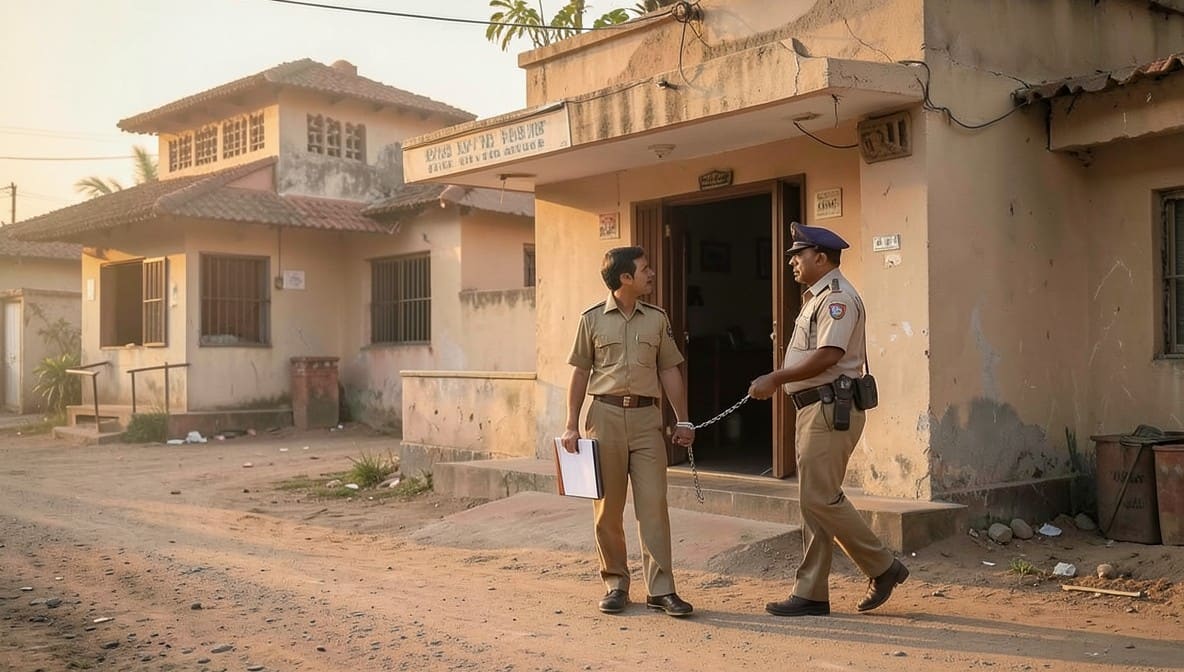
The applicant, Naseem Khan, is accused in Case Crime No. 50 of 2021, registered at Police Station Chandauli, District Chandauli, under Sections 3, 5A, 5B, and 8 of the U.P. Prevention of Cow Slaughter Act and Section 11 of the Prevention of Cruelty to Animals Act. The case pertains to the alleged transportation of live cows in contravention of state laws prohibiting cow slaughter and illegal transport.
Key Facts
- On the date of the incident, 24 live cows were recovered from a container.
- Two co-accused, Parvej and Meharban, were arrested at the scene from the same container.
- The applicant, Naseem Khan, is not mentioned in the First Information Report (FIR).
- His name emerged only during the course of investigation, without any specific allegation of direct involvement in the act of transportation or possession.
- The applicant has been in judicial custody since 31.03.2026.
- The applicant has a prior criminal record involving one case, which he has disclosed and explained in the memo of application.
- He has undertaken not to misuse liberty if granted bail.
Procedural History
- Date of Incident: Not specified in judgment, but inferred to precede FIR registration.
- FIR Registered: Crime No. 50 of 2021, Police Station Chandauli.
- Arrest of Co-accused: Parvej and Meharban arrested at the scene of recovery.
- Applicant’s Arrest: Date not specified, but custody commenced on 31.03.2026.
- Bail Application Filed: Criminal Misc. Bail Application No. 15934 of 2026 under Section 483 of Bharatiya Nagarik Suraksha Sanhita, 2023.
- Hearing Date: Before Justice Jitendra Kumar Sinha on an unspecified date prior to 18.05.2026.
- Order Date: 18.05.2026.
The Parties' Positions
For the Applicant
- Counsel Shri Mohammad Waseem submitted that the applicant was falsely implicated due to ulterior motives.
- Emphasized that the applicant’s name does not appear in the FIR, indicating no direct role in the alleged offence.
- Highlighted that the applicant has been in custody for over a year without trial commencement.
- Noted the heavy pendency of cases in the trial court, making early conclusion unlikely.
- Disclosed prior criminal history but assured non-misuse of liberty.
For the Respondent
- Shri B.P. Maurya, Additional Government Advocate, opposed the bail application without presenting specific counter-evidence or arguments challenging the applicant’s non-involvement.
- No submission was made regarding the strength of the prosecution’s case against the applicant.
Relief Sought
The applicant sought release on bail during the pendency of trial, with conditions to ensure cooperation with the judicial process.
The Legal Issue
The central question was whether an accused who is not named in the First Information Report and whose involvement arises only during investigation can be denied bail solely on the grounds of the nature of the offence, absent concrete evidence of direct participation.
Arguments Presented
For the Appellant/Petitioner
The applicant’s counsel relied on the principle that absence from the FIR is a significant factor indicating lack of direct involvement. He cited the doctrine of proportionality in pre-trial detention and the presumption of innocence under Section 1 of the Bharatiya Nagarik Suraksha Sanhita, 2023. He argued that prolonged incarceration without trial, especially in cases with no direct link to the accused, violates the right to personal liberty under Article 21 of the Constitution. He further emphasized that the applicant has no history of flight risk or witness tampering.
For the Respondent/State
The State did not contest the factual assertion that the applicant was not named in the FIR. No evidence was presented to establish a prima facie case of active participation by the applicant. The opposition was general and lacked specific legal or factual rebuttal.
The Court's Analysis
The Court examined the nature of the allegations and the stage of proceedings. It noted that the applicant was not present at the scene of recovery, was not named in the FIR, and no specific act of commission or conspiracy was attributed to him in the charge sheet or investigation report. The Court observed that the prosecution’s case, as reflected in the record, primarily targets the two co-accused who were physically present at the time of seizure.
"Applicant is not named in the first information report and his name has surfaced during investigation."
The Court emphasized that bail is the rule and jail the exception, particularly where the accused is not a flight risk and the trial is likely to be protracted. It held that the nature of the offence under the U.P. Cow Slaughter Act, while serious, does not automatically justify continued incarceration where the accused’s role is peripheral and uncorroborated by the initial complaint. The Court also took note of the applicant’s undertaking to comply with bail conditions and his disclosure of prior criminal history, which demonstrated transparency.
The Court further clarified that its decision was strictly limited to the bail stage and did not constitute any evaluation of the merits of the case. It reiterated that the trial court retains full discretion to assess evidence independently.
The Verdict
The applicant succeeded. The Court granted bail to Naseem Khan on furnishing a personal bond of Rs. 50,000 with two sureties each in the like amount. The applicant must comply with five conditions: (i) no intimidation or inducement of witnesses; (ii) no pressure on prosecution witnesses; (iii) personal appearance at key trial stages including opening of case, framing of charge, and recording of statement under Section 351 of B.N.S.S.; (iv) no request for adjournments when witnesses are present; and (v) presence before the trial court on all dates, personally or through counsel. Breach of any condition shall result in cancellation of bail. The Court clarified that this order does not prejudge the merits of the case.
What This Means For Similar Cases
Non-Inclusion in FIR Is a Material Factor for Bail
- Practitioners may now argue more forcefully that absence from the FIR, especially where the accused is not present at the scene, warrants bail even in serious statutory offences.
- Courts are expected to scrutinize the nature of involvement before denying bail on the basis of offence gravity alone.
- The burden shifts to the prosecution to demonstrate direct, active participation when the accused is not named in the initial complaint.
Procedural Fairness Over Punitive Detention
- Prolonged incarceration without trial, particularly in cases with delayed charge sheets or vague allegations, will be viewed as a violation of Article 21.
- Courts will increasingly consider the likelihood of trial conclusion when assessing the necessity of custody.
- Disclosure of prior criminal history, if accompanied by a candid undertaking, will not automatically disqualify an applicant from bail.
Conditions as Tools for Judicial Control
- The Court’s imposition of specific, enforceable conditions (e.g., no adjournments when witnesses are present) sets a precedent for tailored bail orders in complex cases.
- Such conditions reduce the risk of abuse while preserving liberty, offering a balanced alternative to blanket denial.
- Practitioners should draft undertakings with precision to meet judicial expectations and avoid technical breaches.