The Bombay High Court has reaffirmed that the filing of a charge-sheet after completion of investigation extinguishes the jurisdiction of the High Court to quash an FIR under Section 482 of the CrPC merely on grounds of suspicion or weak evidence. The judgment underscores that the trial court, not the High Court, is the proper forum to assess the credibility of evidence and determine whether a case prima facie exists.
Background & Facts
The Dispute
The dispute arises from a family conflict over the ownership and possession of Vishnu Kunj, an ancestral property in Mulund (East), Mumbai. The property is divided among four siblings, including the petitioner, Vijayshree Vijay Godbole (also known as Jayashree Pandit), and the respondent, Shrikant Eknath Pandit, her brother. The petitioner, aged 57, is a housewife who resides on the second floor of the property. The respondent, aged 60, is a businessman who manages the Swami Samarth Math and hall portion of the property. Tensions have persisted between the siblings over financial support, property usage, and alleged interference with security installations.
Key Facts
- The respondent installed eight CCTV cameras on the property for security purposes, including two on the terrace.
- On 17th May 2013, the respondent returned from Mumbai and noticed that the CCTV system displayed a "No video" message.
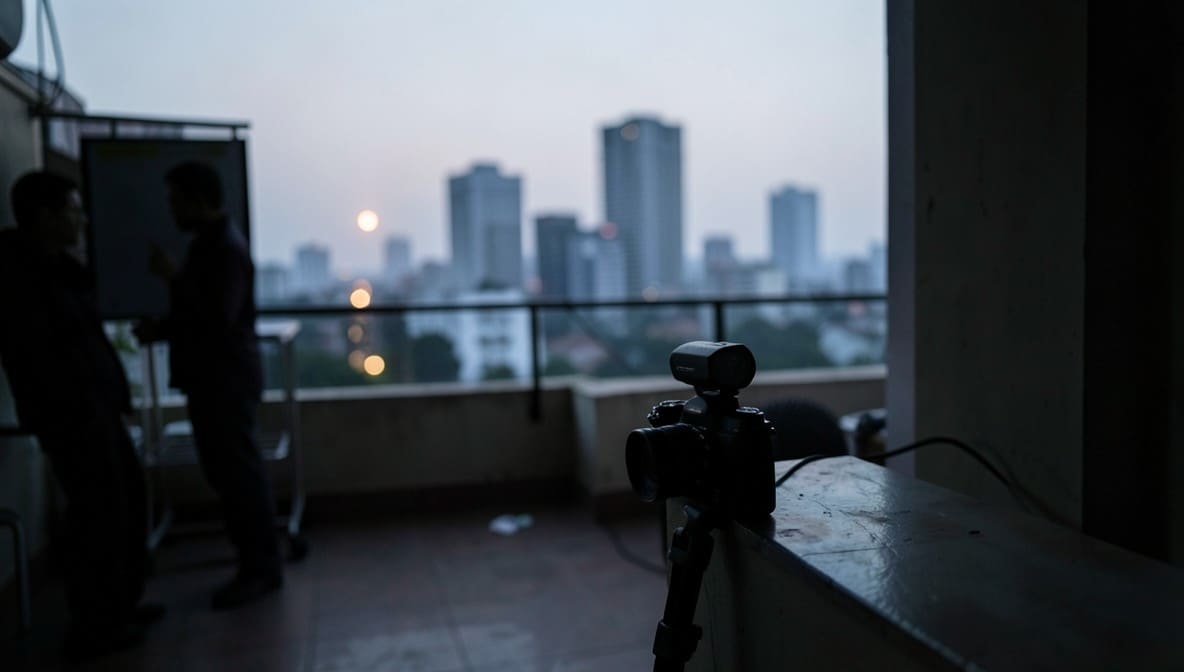
- Upon reviewing the recorded footage from 08:14 p.m. to 08:17 p.m. on 17th May 2013, the respondent observed two women on the terrace, appearing to remove or tamper with the cameras.
- Based on visual resemblance and prior disputes, the respondent suspected the two women to be his sister (Petitioner No.1) and his niece (Petitioner No.2).
- The respondent filed FIR No. 59/2013 on 18th May 2013 at Navghar Police Station under Sections 379 and 34 IPC, alleging theft of the CCTV cameras.
- The charge-sheet (No. 14/2013) was filed on the basis of statements from occupants of the building and the petitioner’s brothers, who identified the women in the footage as the petitioners.
- The petitioners have not cooperated in recovering the cameras or the chair visible in the footage.
- Multiple civil proceedings regarding property rights and possession are pending between the parties.
Procedural History
- 17.05.2013: Alleged incident of CCTV camera tampering.
- 18.05.2013: FIR No. 59/2013 registered at Navghar Police Station.
- 18.06.2016: Judicial Magistrate First Class, Mulund, took cognizance and issued process under Exh.1 in 430/PW/2016.
- 2013 - 2016: Investigation conducted by Navghar Police.
- 2016: Charge-sheet filed before the Judicial Magistrate First Class, Mulund.
- 2013: Writ Petition No. 4073 of 2013 filed before the Bombay High Court seeking quashing of FIR and charge-sheet.
- 14.01.2026: Judgment reserved.
- 10.04.2026: Judgment pronounced.
The Parties' Positions
For the Petitioners
The petitioners contend that the FIR was filed maliciously to harass them and facilitate illegal eviction from the ancestral property. They argue that the identification of the women in the CCTV footage is speculative, based on resemblance and not on conclusive evidence. They highlight that the brothers of the petitioner, who are also witnesses, have a vested interest in ousting her from the property. They further assert that the absence of specific details such as exact time, manner, or recovery of stolen items renders the FIR baseless.
For the Respondent No.1 (Shrikant Pandit)
The respondent maintains that the CCTV footage clearly shows two women tampering with the cameras, and their physical features match the petitioners. He asserts that the investigation was thorough and that the charge-sheet was filed only after corroborative statements from other occupants of the building.
Relief Sought
The petitioners seek quashing of:
- FIR No. 59/2013 dated 18.05.2013 under Sections 379 and 34 IPC,
- Charge-sheet No. 14/2013,
- Order dated 18.06.2016 by the Judicial Magistrate First Class, Mulund.
The Legal Issue
The central question was whether the High Court can quash an FIR and charge-sheet under Section 482 of the CrPC when the investigation is complete, the charge-sheet has been filed, and the allegations, though based on suspicion, are supported by witness statements identifying the accused.
Arguments Presented
For the Petitioner
The petitioners relied on the principle that Section 482 CrPC cannot be invoked to conduct a mini trial. They argued that the FIR was filed on suspicion alone, without corroboration, and that the identification of the petitioners from CCTV footage was unreliable. They cited pending civil disputes as evidence of mala fide intent and contended that the absence of specific details like date, time, and recovery of property rendered the FIR legally unsustainable.
For the Respondent
The respondent argued that the investigation was complete and the charge-sheet filed after examining all available evidence, including CCTV footage and witness statements. He submitted that the veracity of the evidence must be tested at trial, and that the High Court lacks jurisdiction to substitute its opinion for that of the trial court. He emphasized that the petitioners’ refusal to cooperate during investigation does not justify quashing.
The Court's Analysis
The Court examined the evolving jurisprudence on the scope of Section 482 CrPC, particularly the recent pronouncements of the Supreme Court in Central Bureau of Investigation v. Aryan Singh (2023) 18 SCC 399 and Iqbal alias Bala v. State of Uttar Pradesh (2023) 8 SCC 734.
"Although the allegations levelled in the FIR do not inspire any confidence more particularly in the absence of any specific date, time, etc. of the alleged offences, yet we are of the view that the appellants should prefer discharge application before the trial court under Section 227 of the Code of Criminal Procedure (CrPC)."
The Court held that once the investigation is complete and the charge-sheet is filed, the stage for quashing under Section 482 CrPC is closed unless the allegations are so absurd or inherently improbable that no reasonable person could believe them. The Court emphasized that the High Court is not a forum to evaluate the credibility of witnesses or weigh evidence. Such functions are exclusively reserved for the trial court.
The Court noted that the petitioners’ defence - that the identification is flawed and the FIR is mala fide - are matters of evidence that must be raised during trial. The fact that the petitioners did not cooperate during investigation does not absolve them of the burden to contest the case on merits before the trial court.
The Court further observed that the petitioners have a statutory remedy under Section 227 CrPC to seek discharge if the evidence is insufficient. The trial court, not the High Court, is the appropriate forum to determine whether a prima facie case exists.
The Verdict
The petition was dismissed. The High Court held that no case for quashing under Section 482 CrPC was made out. The petitioners are at liberty to file a discharge application under Section 227 CrPC before the trial court. The charge-sheet and proceedings shall continue as per law.
What This Means For Similar Cases
Discharge Application Is the Proper Remedy After Charge-Sheet Filing
- Practitioners must advise clients to file discharge applications under Section 227 CrPC after charge-sheet filing, not seek quashing under Section 482 CrPC.
- Quashing under Section 482 CrPC is now effectively barred once the charge-sheet is submitted, unless the allegations are legally non-existent or manifestly frivolous.
Suspicion Alone Cannot Justify Quashing
- FIRs based on suspicion, even if weak, cannot be quashed if corroborative statements exist and investigation is complete.
- Courts will not interfere with the evidentiary evaluation process at the pre-trial stage.
Civil Disputes Do Not Render Criminal Proceedings Mala Fide
- Pending civil litigation over property does not automatically make a criminal complaint malicious.
- The existence of family disputes must be proven as mala fide intent through concrete evidence, not mere assertion.
Evidence Evaluation Is a Trial Court Function
-
CCTV footage, witness identification, and circumstantial evidence must be tested through cross-examination at trial.
-
High Courts must resist the temptation to conduct mini-trials under the guise of inherent powers.
-
Practitioners should prepare discharge applications with focused arguments on evidentiary insufficiency, not general allegations of bias.
-
Defence counsel must ensure that all objections to identification, chain of custody, and reliability of CCTV footage are preserved for trial.
-
The judgment reinforces the principle that Section 482 CrPC is not a substitute for trial.