The Madhya Pradesh High Court has clarified that a victim of theft is entitled to interim custody of property seized from accused persons if there is prima facie evidence establishing their prior possession. This ruling reinforces the protective intent of Sections 451 and 457 of the CrPC, ensuring that seized assets do not remain in police custody indefinitely when ownership is reasonably established.
Background & Facts
The Dispute
The petitioner, Daulat Parwani, is a businessman operating M/s. Amba Traders in Bhopal, engaged in tour and travel services and railway e-ticketing. On 24.01.2023, while returning home after collecting cash from customers, he was ambushed by three masked individuals on motorcycles. One assailant struck him with a stick, causing him to fall and sustain injuries. The perpetrators then snatched his Activa motorcycle (MP-04-UJ-9754), which contained a cash bag with proceeds from daily transactions.
Key Facts
- The petitioner collected Rs. 8,78,350/- in cash on 24.01.2023 from various agents and customers, as evidenced by receipts and transaction records (Annexure P/10)
- The cash was stored in a bag placed in the dicky of his Activa motorcycle
- The incident occurred at approximately 09:15 PM near Kabristan Road, Bairagarh, Bhopal
- FIR No. 34/2023 was registered under Section 394 IPC on 25.01.2023
- Accused persons - Arif s/o Irshad, Mohd. Altaf s/o Mohd. Rafiq, Javed Uddin s/o Nasuruddin, Mohd. Laeek s/o Mohd. Ateek, Sameer alias Babla s/o Abdul, and Adnaan s/o Faruq - were arrested on 04.02.2023 and 05.02.2023
- Under Section 27 of the Evidence Act, the accused disclosed that they looted Rs. 8,30,000/- and used it to purchase:
- Three unregistered two-wheelers (Bajaj Pulsar 125 CC, Splendor, Activa moped)
- One OnePlus mobile phone
- Police seized:
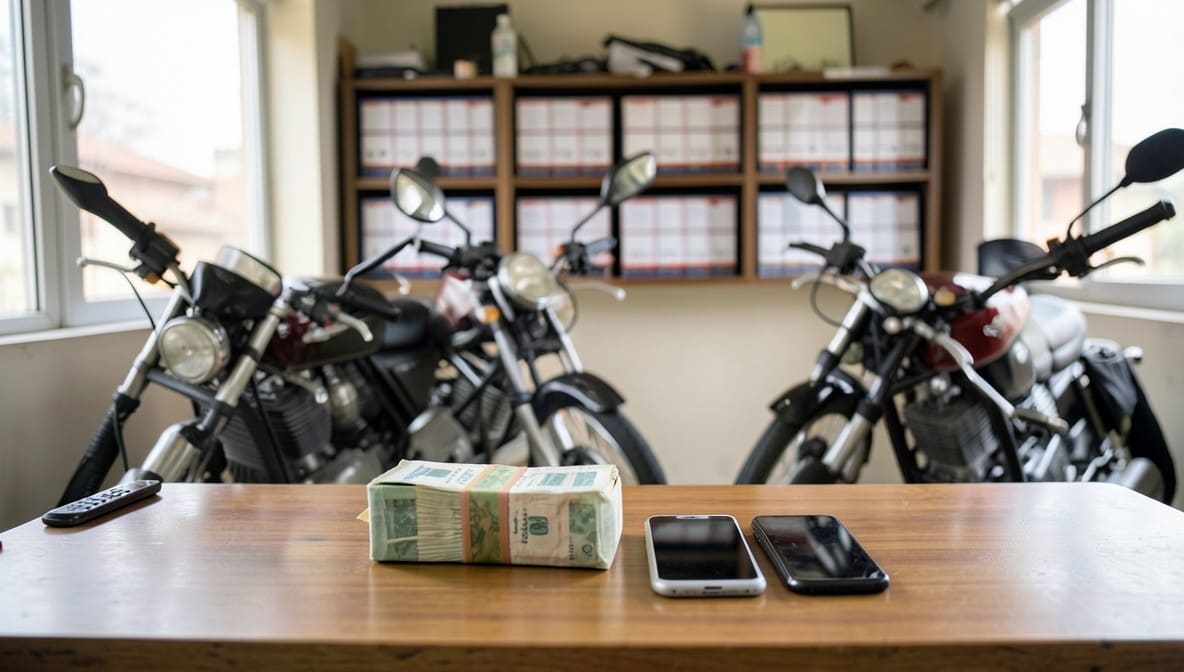
- Rs. 4,00,000/- in cash
- Three unregistered motorcycles/mopeds with engine and chassis numbers
- One OnePlus mobile phone with IMEI numbers 860859067714491 and 860859067714483
- Charge Sheet No. 01/2023 was filed on 01.05.2023 before the JMFC, Bhopal
Procedural History
- 24.01.2023: Incident of robbery and theft
- 25.01.2023: FIR registered at Police Station Bairagarh
- 04.02.2023 & 05.02.2023: Arrests of accused under Section 27 Evidence Act; disclosures recorded
- 01.05.2023: Charge sheet filed
- 09.02.2023: Application under Section 457 CrPC dismissed by JMFC, Bhopal
- 07.07.2023: Application under Section 451 CrPC dismissed by XVIIIth Additional Sessions Judge, Bhopal
- 20.07.2023: Petition under Section 482 CrPC filed before Madhya Pradesh High Court (MCRC-4936/2024)
- 2023: Concurrent petition MCRC-37461/2023 filed for similar relief
- 01.04.2026: Judgment delivered by Hon’ble Justice B.P. Sharma
Relief Sought
The petitioner sought interim custody (Supurdnama) of:
- Rs. 4,00,000/- in cash
- Three unregistered two-wheelers (with specified engine and chassis numbers)
- One OnePlus mobile phone (with specified IMEI numbers)
The Parties' Positions
For the Petitioner
- Relied on Annexure P/10 containing receipts and comparative statements proving possession of Rs. 8,78,350/- on the date of incident
- Argued that the seized property directly corresponds to the amount looted and was acquired by accused immediately after the offence
- Emphasized that Sections 451 and 457 CrPC are designed to prevent unnecessary detention of property and protect the victim’s interest
- Contended that the lower courts applied an overly technical standard requiring conclusive proof, contrary to the prima facie threshold
For the Respondent/State and Objector
- Argued that the petitioner failed to prove ownership of the exact amount looted
- Stated that the seized property could be used as evidence in trial and should remain in police custody
- Asserted that release without conclusive proof might prejudice the prosecution
The Legal Issue
The central question was whether a victim of theft is entitled to interim custody of property seized from accused persons under Section 451 of the CrPC, upon prima facie evidence of prior possession, even without conclusive proof of ownership.
Arguments Presented
For the Petitioner
The petitioner’s counsel relied on the settled principle that Sections 451 and 457 CrPC are remedial provisions meant to prevent prolonged detention of property by police. He cited State of U.P. v. Ramesh Kumar and Rajesh v. State of Haryana to argue that the court need not determine absolute title at the interim stage. He emphasized that the seizure memo, charge sheet, and Annexure P/10 collectively established a prima facie case of possession. The petitioner’s business records, consistent with the amount recovered, demonstrated a reasonable nexus between the looted sum and the seized assets.
For the Respondent/State
The State and objector contended that the petitioner had not produced bank statements, income tax records, or third-party verification to conclusively prove possession of Rs. 8,78,350/-. They argued that the receipts were self-serving and could be fabricated. They further asserted that releasing the property before trial might lead to tampering or destruction of evidence, especially since the vehicles were unregistered and the mobile phone was potentially linked to the crime.
The Court's Analysis
The Court observed that the object of Sections 451 and 457 CrPC is not to adjudicate title definitively but to ensure that property seized by police is not retained indefinitely without justification. The Court emphasized that at the interim stage, the standard is not proof beyond reasonable doubt but prima facie satisfaction.
"The Court is not required to conduct a detailed inquiry into the title or ownership of the seized property. It is well settled that the object of Sections 451 and 457 of Cr.P.C. is to ensure that the property seized by the police is not kept in custody for an unnecessarily long period and is handed over to the person prima facie entitled to its possession, subject to appropriate safeguards."
The Court noted that the petitioner’s receipts, corroborated by the accused’s disclosures under Section 27 of the Evidence Act and the seizure memo, formed a coherent chain establishing prima facie possession. The amount recovered (Rs. 4,00,000/-) was a substantial portion of the claimed Rs. 8,78,350/-, and the timing of the purchases (immediately after the robbery) further supported the petitioner’s version.
The Court rejected the lower courts’ reasoning that the petitioner failed to prove possession, calling it "overly technical" and inconsistent with the spirit of the CrPC. It held that requiring documentary proof equivalent to a civil suit for ownership would defeat the very purpose of interim relief under these provisions.
The Court also noted that keeping unregistered vehicles in police custody for prolonged periods would lead to deterioration, and the cash, if retained, would lose value. The petitioner’s undertaking to register the vehicles, maintain them, and not alienate them provided adequate safeguards.
The Verdict
The petitions were allowed. The impugned orders dated 07.07.2023 and 09.02.2023 were set aside. The Trial Court is directed to release:
- Rs. 4,00,000/- in cash
- Three unregistered two-wheelers (Bajaj Pulsar 125 CC, Splendor, Activa moped with specified engine and chassis numbers)
- One OnePlus mobile phone (IMEI: 860859067714491 and 860859067714483)
The release is subject to: (i) Furnishing surety of Rs. 8,00,000/- to the satisfaction of the Trial Court; (ii) Producing the property before the Court when directed; (iii) Not alienating, transferring, or creating third-party interest; (iv) Not altering parts, colour, or machinery except for necessary repairs; (v) Maintaining the property in good condition; (vi) Registering the vehicles with the RTO and insuring them within one month; (vii) Submitting proof of registration and insurance to the Trial Court.
What This Means For Similar Cases
Prima Facie Possession Suffices for Interim Release
- Practitioners may now rely on business records, transaction receipts, and accused disclosures under Section 27 to establish prima facie possession in theft cases
- The burden at the interim stage is not conclusive proof but reasonable satisfaction of ownership
- Courts must avoid requiring documentary evidence equivalent to civil litigation standards
Seized Property Should Not Be Held Indefinitely
- Unregistered vehicles and cash should not remain in police custody beyond necessity
- Courts must weigh the risk of deterioration or depreciation against the prosecution’s need for evidence
- Conditions like surety, non-alienation, and registration can mitigate risks without denying relief
Procedural Safeguards Are Key
- Courts must impose clear, enforceable conditions (surety, registration, maintenance) rather than outright denial
- Release under Supurdnama is not a final determination but a protective interim measure
- Failure to comply with conditions can lead to immediate re-seizure and contempt proceedings