Delhi High Court granted anticipatory bail to an accused in an NDPS case where the prosecution's case rested solely on 25 telephone calls to a co-accused, without any intercepted conversation or recovery of contraband. The Court held that such tenuous telephonic contact, absent substantive evidence, does not constitute reasonable grounds to deny liberty, emphasizing that gravity of offence alone cannot outweigh procedural safeguards under Section 438 CrPC.
Background & Facts
The Genesis
The present anticipatory bail application arises from FIR No. 690/2025 registered at PS Kashmere Gate for offences under Sections 20, 25 and 29 of the Narcotic Drugs and Psychotropic Substances Act, 1985 (NDPS Act). The FIR pertains to the alleged possession and distribution of ganja.
Key Facts
- On 08.10.2025, co-accused Ved Prakash was apprehended and 16.362 kg of ganja was recovered from his possession, leading to his arrest.
- Based on Ved Prakash’s disclosure statement, another co-accused, Ratan Rai, was apprehended on 11.10.2025 and 5.070 kg of ganja was recovered from him.
- On the disclosure statement of Ratan Rai, co-accused Karpai was apprehended and 86 pouches of ganja were recovered from her possession.
- Subsequently, a raid was conducted at the residence of the present accused/applicant, Rupesh Kumar, but he was not found at home.
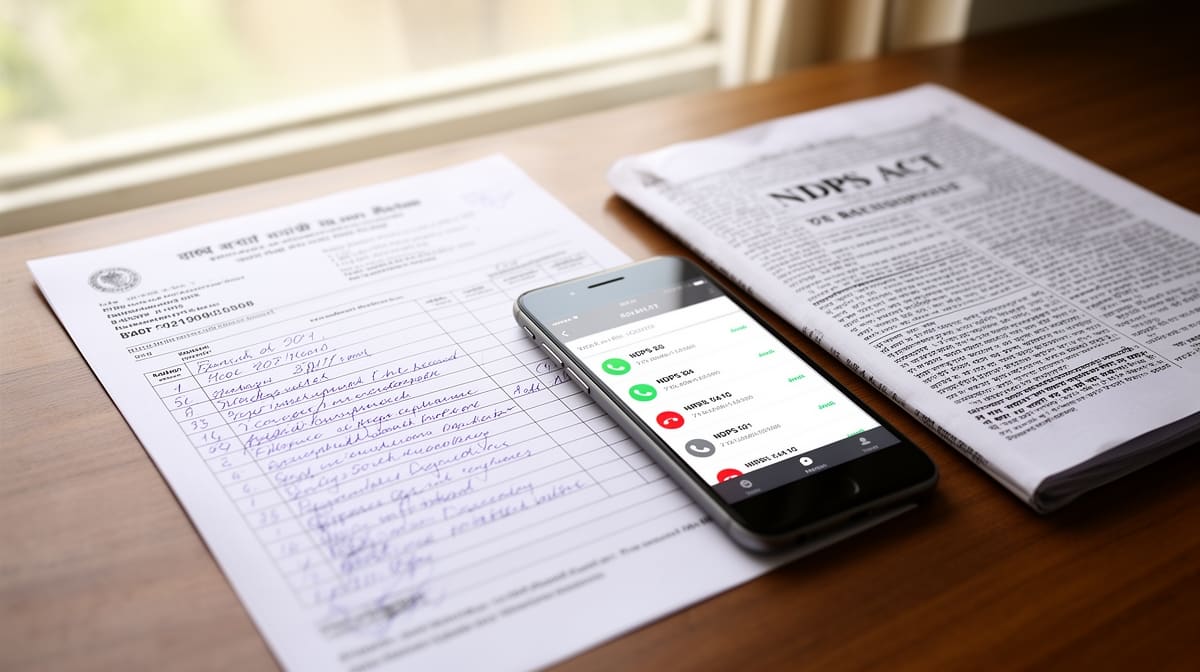
- The Investigating Officer (IO) ASI Shridhar found that, during the period from 16.06.2025 to 07.10.2025, the accused/applicant made 25 telephone calls to co-accused Ved Prakash.
- None of those calls was intercepted to ascertain their content, and the telephone number attributed to Ved Prakash is not registered in his name according to the Customer Application Form.
- On the last date of hearing (prior to judgment), the accused/applicant had been granted interim protection from arrest subject to joining the investigation, with no allegation of misuse of that liberty.
- During the hearing, the IO submitted that the accused/applicant was named as ‘Ram Prasad’ in Ved Prakash’s disclosure statement and, on being shown a photograph, Ved Prakash identified the accused/applicant as that person.
Procedural History
- The anticipatory bail application (BAIL APPLN. 2446/2026) was filed before the High Court of Delhi.
- Accompanying criminal miscellaneous application CRL.M.A. 18905/2026 was also filed.
- The matter was heard on 15.09.2026, and judgment was pronounced the same day.
The Parties' Positions
Petitioner (Accused/Applicant): Contended that the only link to the alleged offence is the telephonic contact, which is insufficient to establish involvement; no contraband was recovered from him; he did not misuse the interim protection granted; and the investigation suffers from material gaps, rendering the bail opposition untenable.
Respondent (State): Opposed bail on the ground that the 25 telephone calls indicate active participation in the conspiracy; the accused/applicant was identified by co-accused Ved Prakash; and granting bail would impede the investigation and risk tampering with evidence.
Relief Sought
The petitioner sought grant of anticipatory bail, direction for release on bail upon arrest with a personal bond and surety, and disposal of the accompanying CRL.M.A.
The Legal Issue
The central question was whether, under Section 438 of the Code of Criminal Procedure, 1973, anticipatory bail could be denied solely on the basis of telephonic contact with a co-accused where no contraband was recovered, no conversation was intercepted, and the investigating agency failed to substantiate the alleged involvement through any independent evidence.
Arguments Presented
For the Petitioner
The petitioner argued that the prosecution’s case rested entirely on 25 telephone calls made between 16.06.2025 and 07.10.2025, none of which were intercepted, leaving the content unknown. He emphasized that the number ascribed to Ved Prakash was not registered in his name, undermining the reliability of the call logs. No ganja or any incriminating material was recovered from his person, residence, or despite the raid. He further submitted that he had been granted interim protection from arrest and had not abused that liberty, indicating cooperation with the investigation. Relying on Arnesh Kumar v. State of Bihar, (2014) 8 SCC 273, he contended that liberty cannot be curtailed on mere suspicion and that the gravity of offence under the NDPS Act does not automatically negate the right to anticipatory bail. He urged the Court to scrutinize the investigative shortcomings and to apply the principle that bail is the rule and jail the exception.
For the Respondent
The State maintained that the repeated telephonic contact demonstrated a conscious association with the primary supplier, Ved Prakash, and thus established a prima facie role in the alleged ganja trafficking network. It pointed out that the accused/applicant was identified by Ved Prakash as ‘Ram Prasad’ and that this identification was corroborated when Ved Prakash recognized the applicant’s photograph. The State argued that granting anticipatory bail would enable the accused to influence witnesses, tamper with the call records, and obstruct the ongoing investigation, especially given the serious nature of NDPS offences which attract stringent punishment. It urged the Court to deny bail to preserve the integrity of the probe and to ensure the accused’s availability for trial.
The Court's Analysis
The Court began by noting that anticipatory bail under Section 438 CrPC is a safeguard against arbitrary arrest and that the power to grant bail must be exercised judiciously, balancing liberty with the interests of investigation. It reiterated the principle laid down in Arnesh Kumar v. State of Bihar that the gravity of the offence alone cannot be a ground to deny bail, and that the court must be satisfied that there are reasonable grounds for believing that the accused is guilty of the offence.
Applying this to the present case, the Court observed that the only material linking the accused to the alleged offence is the record of 25 telephone calls to Ved Prakash during the period 16.06.2025 - 07.10.2025. Crucially, none of these calls was intercepted, so their content remains unknown. Furthermore, the telephone number ascribed to Ved Prakash does not appear in his name in the Customer Application Form, casting doubt on the authenticity of the call logs. No contraband was recovered from the accused despite a raid on his residence, and he was not named by any of the co-accused in their initial disclosure statements; the identification as ‘Ram Prasad’ emerged only later and was based solely on a photograph shown to Ved Prakash.
The Court found these indicia to be tenuous and insufficient to constitute reasonable grounds for believing that the applicant had committed the offence. It emphasized that the investigating agency had not placed any reliance on scientific or documentary evidence, and that the case rested on a chain of hearsay that could easily be rebutted. The Court also noted that the accused had been granted interim protection from arrest and had not violated any condition, indicating a willingness to cooperate with the investigation.
In light of the above, the Court held that denying anticipatory bail would be an unjustified restriction on personal liberty, especially when the prosecution’s evidence does not meet the threshold of reasonable suspicion. It accordingly allowed the application, imposing the standard condition of a personal bond and surety to ensure the accused’s availability for trial.
The Verdict
The accused/applicant succeeded in his anticipatory bail application. The Court granted bail and directed that, in the event of his arrest, he shall be released on bail upon furnishing a personal bond of Rs. 25,000/- with one surety in the like amount to the satisfaction of the Investigating Officer/SHO. The accompanying CRL.M.A. 18905/2026 was also disposed of. No costs were awarded.
What This Means For Similar Cases
Telephonic Contact Alone Insufficient to Deny Bail
Courts must scrutinize the quality and reliability of telephonic evidence before using it as a basis to refuse anticipatory bail. Mere call logs, without interception or corroboration, do not establish reasonable grounds of guilt.
Investigative Gaps Must Be Addressed
The prosecution bears the burden to demonstrate a coherent link between the accused and the alleged offence. Gaps such as unverified subscriber details, lack of recovered contraband, and reliance on post-hoc identifications weaken the case and tilt the balance in favour of liberty.
Standard Bail Conditions Remain Applicable
Even when bail is granted on weak evidence, the imposition of a personal bond and surety - here Rs. 25,000 each - serves to ensure the accused’s presence during trial without unnecessarily restricting liberty.