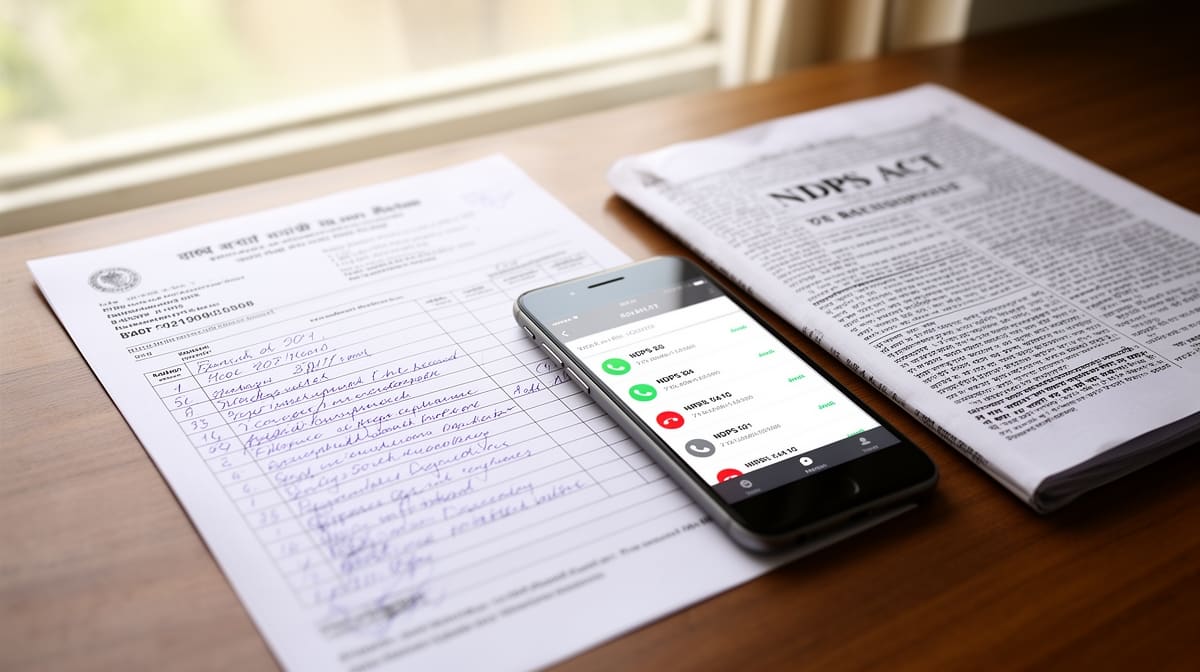
The Delhi High Court set aside the prosecution’s request to keep the accused in custody, granting regular bail on the ground that the material on record - chiefly co-accused statements and call-detail records - did not constitute substantive evidence of participation in the alleged drug cartel.
Background & Facts
The Dispute
The petitioner, Nafi Nazar, filed Bail Application No. 1043/2026 seeking regular bail in Crime No. VIII/77/DZU/2021 dated 17.12.2021 of the Narcotics Control Bureau (NCB), Delhi. The charges pertain to offences under Section 8, Section 21(c), Section 23 and Section 29 of the NDPS Act.
Key Facts
- 07.12.2021: NCB, acting on secret information, recovered a parcel from a DTDC office containing 480 g charas and 60 g methamphetamine. The parcel was allegedly dispatched by co-accused Harikrishan, from whose house a further 145 g methamphetamine was seized.
- 08.12.2021: Co-accused Paschal was arrested; from his residence 60 g cocaine and 55 g methamphetamine were recovered.
- The disclosure statements of the co-accused named Nafi Nazar as the person who had booked the parcel, leading NCB to label him the “kingpin” of an alleged drug cartel.
- 24.07.2025: Nafi Nazar was apprehended at Cochin Airport on the basis of a Letter of Custody (LoC) issued by the Bureau of Immigration and was placed in custody.
- The petitioner contends he has been in custody since that date without any legally admissible evidence linking him to the seized narcotics.
- The respondent, NCB, relies on:
- Disclosure statements of co-accused persons;
- Telephonic connectivity (call-detail records) between the petitioner and co-accused;
- Money-transaction records purportedly linking the petitioner to the drug trade.
- The petitioner argues that the money transactions relate to his legitimate spice-business and that no such transactions were made for the purchase of contraband.
- The court observed that call-detail records alone cannot establish complicity, especially when no interception was carried out to ascertain the content of the conversations.
- The amounts transacted were not substantial enough to infer payment for narcotics, and the use of banking channels for alleged illegal money raised further doubts.
Procedural History
- 07.12.2021 - NCB’s initial recovery of narcotics from DTDC office.
- 08.12.2021 - Arrest of co-accused Paschal and seizure of additional drugs.
- 17.12.2021 - Crime No. VIII/77/DZU/2021 dated; FIR lodged.
- 04.06.2022 - NCB’s complaint indicated that investigation into the petitioner remained open, with a supplementary complaint to be filed.
- 28.04.2022 - NCB wrote to its local unit in Kochi seeking verification of the petitioner’s antecedents and address; the local unit reported that the petitioner was not residing at the given address and no local FIR existed.
- 12.09.2023 - The petitioner’s passport was renewed.
- 10.07.2025 - Letter of Custody (LoC) issued against the petitioner; no attempt was made to summon him for investigation thereafter.
- 24.07.2025 - Petitioner apprehended at Cochin Airport and placed in custody.
- 2026 - Bail Application No. 1043/2026 filed (exact filing date not specified); the matter was transferred to the present bench.
- 12.08.2026 - Judgment delivered by Justice Girish Kathpalia.
Relief Sought
The petitioner sought regular bail, contending that the prosecution had failed to produce any material evidence directly linking him to the seized narcotics and that the charge sheet had not yet been framed.
The Legal Issue
Whether the presence of co-accused disclosure statements, call-detail records and modest money-transaction evidence suffices to justify the denial of bail for an accused charged under the NDPS Act when no narcotics have been recovered from him and the charge sheet remains unframed.
Arguments Presented
For the Appellant/Petitioner
- Asserted innocence and lack of any admissible evidence directly implicating him.
- Emphasised that the only incriminating material consists of co-accused statements, which are secondary and unreliable.
- Highlighted that call-detail records do not disclose the content of conversations and therefore cannot establish conspiracy.
- Stated that the money-transaction amounts were trivial and related to his legitimate spice-business.
- Pointed out procedural lapses: the LoC was issued without any prior summons, and the investigation remained open without a supplementary complaint.
For the Respondent/State
- Alleged that the petitioner was the mastermind (“kingpin”) of the drug cartel, based on co-accused statements.
- Submitted telephonic connectivity and money-transaction records as circumstantial evidence of involvement.
- Argued that the petitioner had absconded, necessitating the LoC and his subsequent arrest at the airport.
- Relied on the fact that the parcel recovered was booked on the petitioner’s directions, as per the co-accused disclosures.
The Court's Analysis
The Court began by scrutinising the nature and admissibility of the evidence placed before it. It noted that call-detail records (CDRs) merely establish that two numbers communicated; they do not reveal the substance of the conversation. In the absence of intercepted content, the Court held that CDRs cannot, on their own, substantiate a charge of conspiracy or participation in a drug-trafficking network.
"Merely because call detail records reflect telephone calls between two persons, complicity to the extent of incrimination cannot be inferred."
The Court further observed that the money-transaction evidence presented was neither substantial nor indicative of payment for contraband. The petitioner’s explanation that the transactions were linked to his spice-business was deemed plausible, especially given the lack of any forensic linkage between the funds and the seized narcotics.
Regarding the disclosure statements of the co-accused, the Court stressed that such statements are secondary evidence and must be corroborated by primary material, which was conspicuously absent. No narcotics, paraphernalia, or forensic evidence were recovered from the petitioner’s possession, nor was any direct testimony presented linking him to the recovered drugs.
The Court also considered procedural aspects. The investigation remained open as of 04.06.2022, with a supplementary complaint yet to be filed. Moreover, the petitioner’s passport renewal on 12.09.2023 and the lack of any summons prior to the issuance of the LoC on 10.07.2025 indicated procedural irregularities that weakened the prosecution’s case.
Finally, the Court reflected on the principle that bail should not be denied solely on the gravity of the alleged offence when the evidentiary foundation is weak. The fact that the charge sheet had not been framed further tilted the balance in favour of liberty.
The Verdict
The Court granted regular bail to Nafi Nazar. He was directed to furnish a personal bond of Rs.1,00,000 and one surety of an equal amount to the satisfaction of the trial court. The order was to be transmitted immediately to the Jail Superintendent, and the trial court was instructed to take an independent view of the evidence at the stage of trial.
What This Means For Similar Cases
Call-Detail Records Are Not Conclusive Proof
- Practitioners must corroborate CDRs with substantive evidence such as intercepted content, forensic links, or direct testimony before relying on them to oppose bail.
- Courts will scrutinise the relevance and probative value of telephonic data, especially where no interception has occurred.
Lack of Direct Material Weakens Prosecution
- Absence of seized narcotics or forensic evidence from the accused’s possession significantly favours bail.
- Secondary statements of co-accused must be supported by primary evidence; otherwise, they are insufficient to justify denial of liberty.
Procedural Lapses Can Tip the Balance
-
Failure to frame a charge sheet or to summon the accused before issuing a LoC may be viewed as a breach of due process.
-
Defence can highlight such lapses to argue for bail, emphasizing the presumption of innocence until proven otherwise.
-
Ensure that any monetary transactions alleged to be linked to illicit activity are substantiated with clear trails showing payment for contraband.
-
Promptly challenge the admissibility of evidence that is purely circumstantial or lacks forensic corroboration.