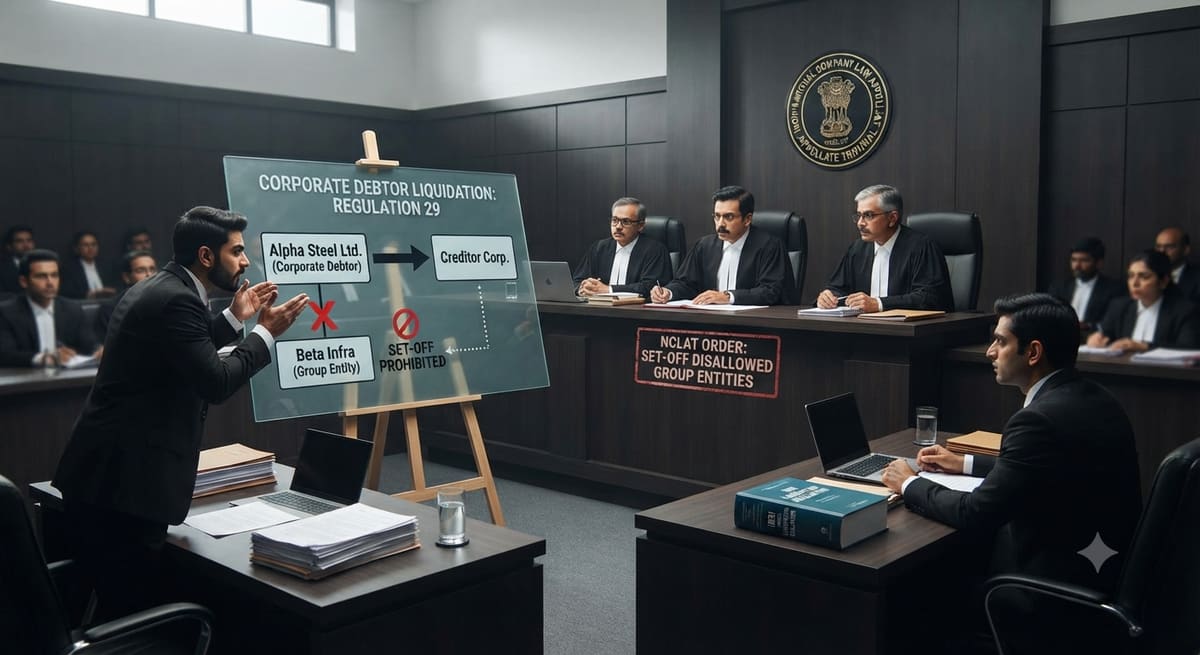
The National Company Law Appellate Tribunal has clarified that not all transfers to related parties during the insolvency look-back period qualify as preferential transactions under Section 43 of the Insolvency and Bankruptcy Code. Only those transfers that benefit a creditor, surety, or guarantor against an antecedent debt, and improve their position over other creditors, meet the statutory threshold. This judgment reinforces the need for precise application of the Anuj Jain test and rejects blanket assumptions of preferential intent.
Background & Facts
The Dispute
The dispute arose from the Resolution Professional’s application under Section 43 of the Insolvency and Bankruptcy Code, 2016, seeking to avoid two transfers made by the Corporate Debtor, M/s. KSS Ltd., to its sister concerns during the two-year look-back period preceding the commencement of its Corporate Insolvency Resolution Process (CIRP). The Adjudicating Authority, NCLT Mumbai, held both transfers as preferential and ordered the suspended directors to jointly and severally repay Rs. 47,92,646/- to the Corporate Debtor’s estate.
Key Facts
- Corporate Debtor: M/s. KSS Ltd., incorporated in Mumbai, engaged in cinema and entertainment infrastructure.
- CIRP Commencement Date: 24.01.2023, initiated by M/s. Micro Capitals Pvt. Ltd.
- Resolution Professional Appointed: Mr. Dharmendra Dhelariya on 24.01.2023.
- Transaction Audit Period: 24.01.2020 to 23.01.2023.
- Transaction Auditor Appointed: M/s. Arihant A. Jain & Associates on 10.03.2023; Final Report submitted on 03.08.2023.
- Alleged Preferential Transfers:
- Rs. 39,00,000/- transferred to M/s. K Sera Sera Miniplex Ltd. on 15.01.2022.
- Rs. 8,92,646/- transferred to M/s. K Sera Sera Digital Cinema Ltd. on 20.01.2022.
- Both transferee companies are wholly owned subsidiaries or sister concerns of the Corporate Debtor.
- M/s. K Sera Sera Digital Cinema Ltd. filed a financial claim of Rs. 3,08,58,210.63 in the CIRP, which was admitted by the Resolution Professional.
- No documents were produced by the appellants to substantiate the provision of goods or services by the transferees in exchange for the payments.
- The Corporate Debtor was incurring losses during FY 2021-22.
Procedural History
- 24.01.2023: CIRP initiated against M/s. KSS Ltd. by M/s. Micro Capitals Pvt. Ltd.
- 10.03.2023: Resolution Professional appointed M/s. Arihant A. Jain & Associates as Transaction Auditor.
- 03.08.2023: Final Transaction Audit Report submitted.
- 10.10.2023: Resolution Professional filed I.A. No. 4648 of 2023 under Section 43 before NCLT Mumbai.
- 01.08.2025: NCLT Mumbai allowed the application, directing repayment of Rs. 47,92,646/- by suspended directors.
- 11.05.2026: Appeal filed before NCLAT; judgment delivered.
The Parties' Positions
Appellants (Suspended Directors):
- Argued that the transactions were in the ordinary course of business.
- Contended that neither transferee company was a creditor of the Corporate Debtor at the time of transfer.
- Asserted that non-joinder of the transferee companies rendered the application legally defective.
- Relied on Anuj Jain v. Axis Bank and Section 43(3)(a) to claim exclusion.
- Cited internal ledgers and audit responses to show recurring inter-company adjustments.
Respondent No. 1 (Resolution Professional):
- Maintained that both transfers met the criteria under Section 43(2).
- Argued that M/s. K Sera Sera Digital Cinema Ltd. was an admitted creditor with a claim of over Rs. 3 crores.
- Stated that the Rs. 39 lakh transfer to M/s. K Sera Sera Miniplex Ltd. lacked any antecedent debt basis.
- Denied need for CoC approval to appoint auditor or file Section 43 application.
- Contended that the appellants failed to provide documentary proof of business justification.
Relief Sought
The Appellants sought:
- Setting aside of the NCLT order dated 01.08.2025.
- Dismissal of the Section 43 application in its entirety.
- Declaration that neither transfer constituted a preferential transaction.
- Costs of litigation.
The Legal Issue
The central question was whether a transfer by a corporate debtor to a related party, without any antecedent debt owed to the transferee, can be classified as a preferential transaction under Section 43(2)(a) of the Insolvency and Bankruptcy Code, and whether the ordinary course of business exception under Section 43(3)(a) applies where no underlying commercial transaction is substantiated.
Arguments Presented
For the Appellant
The Appellants relied on the Supreme Court’s decision in Anuj Jain v. Axis Bank to argue that Section 43 requires five cumulative conditions to be satisfied, including that the transfer must be for the benefit of a creditor, surety, or guarantor on account of an antecedent debt. They emphasized that M/s. K Sera Sera Miniplex Ltd. was not a creditor of the Corporate Debtor and that the Rs. 39 lakh transfer was a working capital advance, not a repayment of debt. For the Rs. 8.92 lakh transfer, they claimed it was part of a routine inter-company accounting adjustment to square off mutual debit-credit balances, consistent with industry practice. They cited the Guidance Note on Related Party Transactions by the Institute of Company Secretaries to support the notion that such adjustments are routine. They further argued that the non-joinder of the transferee companies violated the principles of natural justice and rendered the proceedings defective under Aliji Momonji & Co. v. Lalji Mavji.
For the Respondent
The Resolution Professional contended that M/s. K Sera Sera Digital Cinema Ltd. was an admitted financial creditor with a claim of over Rs. 3 crores, and the Rs. 8.92 lakh payment reduced the pool available to other creditors, thereby satisfying Section 43(2)(b). He argued that the transaction occurred during a period of financial distress, and the Corporate Debtor’s failure to pay external creditors first indicated preferential intent. He maintained that Section 25(2)(j) empowers the RP to independently file avoidance applications without CoC approval, and that joinder of transferees is not mandatory under the Code’s summary procedure. He relied on the Transaction Audit Report’s findings that the Corporate Debtor was incurring losses and should have prioritized external creditors.
The Court's Analysis
The NCLAT undertook a rigorous analysis of Section 43(2) and its exceptions under Section 43(3)(a), applying the five-pronged test from Anuj Jain v. Axis Bank. The Tribunal emphasized that the mere fact of transfer to a related party within the two-year look-back period is insufficient; the transfer must benefit a creditor, surety, or guarantor on account of an antecedent debt.
"Section 43(2)(a) requires a transfer to be made for the benefit of a creditor or a surety or a guarantor for or on account of an antecedent financial debt or operational debt or other liabilities owed by the corporate debtor. Without this essential ingredient, the transaction cannot be classified as preferential."
Regarding the Rs. 39 lakh transfer to M/s. K Sera Sera Miniplex Ltd., the Tribunal found no evidence that the transferee was a creditor of the Corporate Debtor. The explanation provided - that the amount was for working capital - did not establish an antecedent debt. The Tribunal held that advances made to subsidiaries for operational purposes, without any debt obligation, do not fall within the ambit of Section 43(2)(a). The absence of any claim filed by M/s. K Sera Sera Miniplex Ltd. in the CIRP further confirmed it was not a creditor.
In contrast, the Rs. 8.92 lakh transfer to M/s. K Sera Sera Digital Cinema Ltd. was found to satisfy all conditions. The Tribunal noted that this entity had filed and had its claim of Rs. 3.08 crores admitted by the RP, thereby establishing it as a creditor. The payment of Rs. 8.92 lakh during a period of financial distress, without any documentary proof of counter-performance, was deemed to have improved its position over other creditors. The Tribunal rejected the appellants’ claim that this was part of routine accounting adjustments, stating:
"Vague assertions of industry practice, unsupported by invoices, contracts, or ledger entries, cannot override the statutory requirement of antecedent debt under Section 43(2)(a)."
The Tribunal also dismissed the non-joinder argument, holding that the Code’s summary nature and the RP’s statutory duty under Section 25(2)(j) do not require impleading transferees. The focus remains on the Corporate Debtor’s financial records, not those of third parties.
Finally, the Tribunal examined the ordinary course of business exception under Section 43(3)(a). It held that for this exception to apply, there must be a demonstrable commercial exchange - goods or services rendered in return for payment. The absence of any such evidence rendered the exception inapplicable to the Rs. 8.92 lakh transfer.
The Verdict
The Appellants succeeded in part. The NCLAT set aside the NCLT order dated 01.08.2025 to the extent it held the Rs. 39,00,000/- transfer as preferential. The Tribunal held that only the Rs. 8,92,646/- transfer to M/s. K Sera Sera Digital Cinema Ltd. qualifies as a preferential transaction under Section 43 of the Code. The suspended directors (Appellants 1 - 3) and Respondents 2 - 4 are jointly and severally directed to repay Rs. 8,92,646/- to the Corporate Debtor’s estate within 30 days of the judgment, with interest at the rate determined by the NCLT Mumbai. All pending applications are closed. No costs are awarded.
What This Means For Similar Cases
Preferential Status Requires Creditor Status
- Practitioners must now prove that the transferee was a creditor at the time of transfer, not merely a related party.
- Transfers to subsidiaries for working capital, without any debt obligation, are not preferential under Section 43(2)(a).
- The mere existence of a future claim in CIRP does not retroactively convert a payment into repayment of antecedent debt.
Documentary Evidence Is Non-Negotiable
- Vague claims of "industry practice" or "accounting adjustments" are insufficient to invoke Section 43(3)(a).
- To claim ordinary course of business, parties must produce invoices, delivery challans, service agreements, or ledger entries evidencing reciprocal commercial activity.
- The burden of proof lies on the party asserting the exception.
Joinder of Transferees Not Mandatory
- Resolution Professionals need not implead transferee companies in Section 43 applications.
- The Code’s summary procedure permits adjudication based solely on the Corporate Debtor’s books.
- Challenges based on non-joinder will be dismissed unless procedural prejudice is demonstrably established.