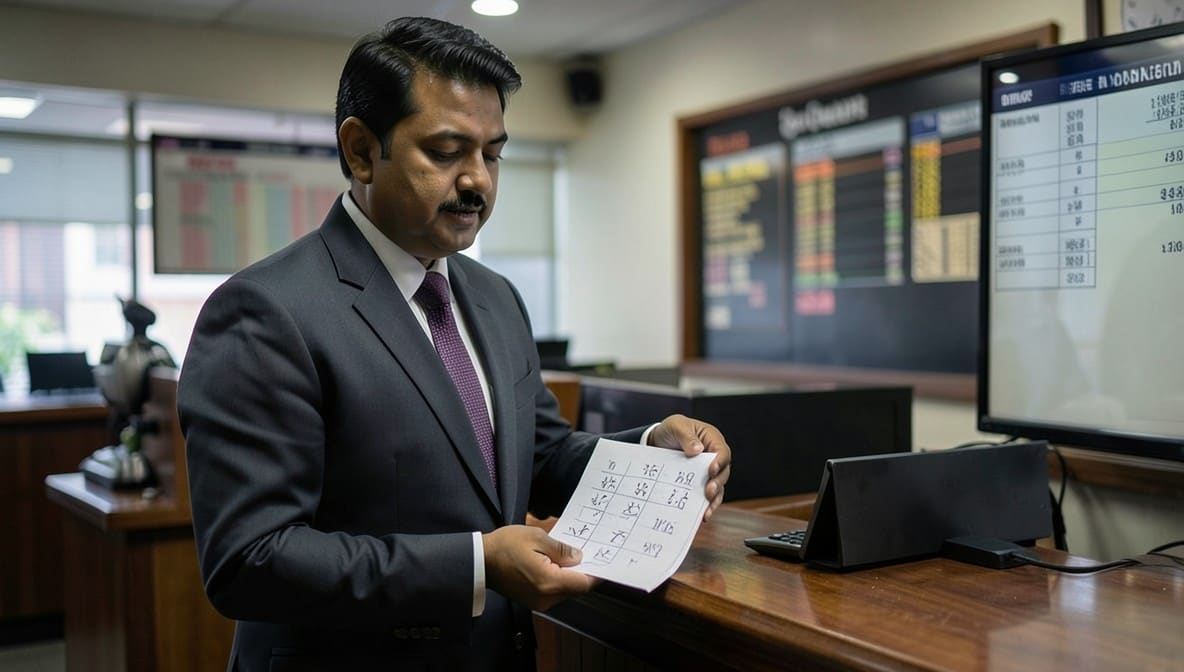
The Madhya Pradesh High Court has clarified that mere absence of a written agency agreement does not preclude framing of charges under Section 417 IPC where the accused held themselves out as agents and collected investments under that representation. This ruling reinforces the principle that criminal liability may arise from conduct and implied authority, not just formal documentation.
Background & Facts
The Dispute
The dispute arises from a financial fraud case involving alleged misrepresentation by individuals posing as agents of USK India Limited, a company registered under the Companies Act, 1956. The complainant, Dayaram Gawali, was induced to invest money in purported deposit schemes by Kesuram and Ganpat, who presented themselves as authorized agents of the company. Certificates of deposit were issued to Dayaram and his wife, Rambhabai, in exchange for payments made to Kesuram and Ganpat. Upon maturity, the promised returns were not paid, and the certificates were collected back by the accused without refund.
Key Facts
- USK India Limited had Corporate Identification Number U70101MP2009PLC022207
- Dayaram deposited funds based on representations made by Kesuram and Ganpat
- Certificates of deposit were issued to Dayaram and Rambhabai on 13.09.2023
- The certificates were later retrieved by the accused, but no maturity amount was returned
- Police seized the certificates and related pamphlets during investigation
- Ganpat produced an Agent Code No. 2923, which matched the code on the certificates
- Kesuram was found to have distributed pamphlets and collected money but no formal agency contract or agent code was recovered from him
- Statements of Dayaram, Rambhabai, and Nathulal s/o Shankarlal (recorded on 13.08.2024) all identified Kesuram as an agent of USK India Limited
Procedural History
- 15.06.2023: Crime No. 555/2023 registered at Police Station Raipuria, District Jhabua under Section 420 r/w 34 IPC
- 13.09.2023: Deposit certificates seized from complainant
- 25.07.2024: Final report submitted under Section 173 CrPC against Ganpat, Kesuram, Sannay, Pappu, with Umeshsingh and Shivramsingh declared absconding
- 07.08.2025: Trial Court (A.S.J. Petlawad) framed charges against Kesuram only under Section 417 IPC; against others under Section 420 r/w 34, 409 IPC and Section 6(1) of M.P. Nikshepakon ke Hiton Ka Sanrakshan Adhiniyam, 2000
- 15.08.2025: Criminal Revision No. 5497/2025 filed by Kesuram challenging framing of charge under Section 417 IPC
- 18.08.2025: Criminal Revision No. 4606/2025 filed by Dayaram seeking addition of charges under Section 420 r/w 34, 409 IPC and Section 6(1) against Kesuram
- 21.01.2026: Both revisions heard together by the High Court
- 24.03.2026: Judgment delivered
The Parties' Positions
For Kesuram (Petitioner in CRR No. 5497/2025)
- Argued that no agency agreement or agent code was recovered from him
- Contended that his involvement was based solely on statements of co-accused, which are inadmissible under Section 30 of the Indian Evidence Act
- Relied on State of Haryana v. Ch. Bhajan Lal, M.N. Ojha v. Alok Kumar Srivastava, and Neelu Chopra v. Bharti to argue that no prima facie case under Section 417 IPC was made out
- Asserted that the trial court erred in framing charges without concrete evidence linking him to the agency
For Dayaram (Petitioner in CRR No. 4606/2025)
- Argued that Kesuram and Ganpat acted in concert
- Pointed out that both collected money, distributed identical certificates, and used the same company name
- Contended that the trial court’s distinction between the two accused was legally untenable
- Relied on Section 186 of the Indian Contract Act, 1872, to assert that agency may be implied from conduct
Relief Sought
- Kesuram sought quashing of the charge under Section 417 IPC
- Dayaram sought addition of charges under Section 420 r/w 34, 409 IPC and Section 6(1) of the M.P. Nikshepakon ke Hiton Ka Sanrakshan Adhiniyam, 2000 against Kesuram
The Legal Issue
The central question was whether Section 417 of the IPC can be invoked against an accused who, though lacking a formal agency agreement, held himself out as an agent of a company, collected investments, and failed to return maturity amounts, where such conduct is corroborated by multiple complainants.
Arguments Presented
For the Appellant/Petitioner
Kesuram’s counsel contended that the absence of any seized document linking him to the agency - unlike Ganpat who produced an agent code - rendered the charge under Section 417 IPC unsustainable. He argued that the statements of co-accused cannot form the basis of a charge, citing State of Haryana v. Ch. Bhajan Lal and M.N. Ojha v. Alok Kumar Srivastava. He emphasized that at the stage of framing charges, the court must avoid a mini-trial and must not rely on speculative inferences.
For the Respondent/State
The State and Dayaram’s counsel countered that the law of agency under Section 186 of the Indian Contract Act, 1872 permits implied agency. They pointed to the consistent testimony of Dayaram, his wife, and Nathulal - all of whom identified Kesuram as the agent who solicited investments and collected money. They argued that the trial court’s distinction between Kesuram and Ganpat was artificial and ignored the totality of evidence, including distribution of identical pamphlets and certificates.
The Court's Analysis
The Court undertook a detailed review of the legal principles governing the framing of charges under Section 250 of the BNSS, 2023 (successor to Section 227 CrPC). It reaffirmed that the court at this stage must not conduct a mini-trial or weigh evidence for conviction, but must determine whether a prima facie case exists based on the record.
"The court cannot act merely as a post office or a mouthpiece of the prosecution but has to consider the broad probabilities of the case, the total effect of the evidence and the documents produced before the court, any basic infirmities, etc."
The Court noted that while no formal agency contract or agent code was recovered from Kesuram, the statements of three independent complainants - Dayaram, Rambhabai, and Nathulal - uniformly described him as the person who solicited investments and collected money on behalf of USK India Limited. The Court held that Section 186 of the Indian Contract Act, 1872 permits agency to be established by conduct, not merely by written agreement. The fact that Kesuram distributed identical pamphlets and collected certificates identical to those issued by Ganpat, who possessed an agent code, created a reasonable inference of common agency.
The trial court’s reliance on the absence of a physical agent code as decisive was found to be legally flawed. The Court observed that the prosecution need not prove every element beyond reasonable doubt at the charging stage; it need only establish a plausible basis for proceeding. The Court further held that the distinction drawn between Kesuram and Ganpat was arbitrary and inconsistent with the evidence.
The Verdict
The Court dismissed Criminal Revision No. 5497/2025 filed by Kesuram and allowed Criminal Revision No. 4606/2025 filed by Dayaram. The order of the trial court dated 07.08.2025 framing only Section 417 IPC against Kesuram was set aside. The trial court was directed to reconsider the framing of additional charges against Kesuram under Section 420 r/w 34, 409 IPC and Section 6(1) of the M.P. Nikshepakon ke Hiton Ka Sanrakshan Adhiniyam, 2000. The record was remitted back with a copy of this order for compliance.
What This Means For Similar Cases
Implied Agency Is Sufficient for Criminal Liability
- Practitioners must now argue that Section 417 IPC applies where conduct, not documents, establishes agency
- Absence of written contracts or agent IDs does not automatically defeat a charge of cheating by impersonation
- Consistent witness testimony identifying the accused as an agent can form the basis of a prima facie case
Trial Courts Must Avoid Artificial Distinctions
- Where multiple accused act in concert with identical modus operandi, charges must be framed uniformly unless clear evidence distinguishes roles
- Distinguishing accused based on minor evidentiary gaps (e.g., one had an agent code, another did not) without considering collective conduct is legally unsustainable
- Courts must evaluate the totality of evidence, not isolated fragments
Evidence at Charging Stage Is Not Subject to Mini-Trial
- The court at the framing stage must not demand proof beyond reasonable doubt
- Corroborative statements from multiple complainants, even if untested, suffice for prima facie satisfaction
- The burden at this stage is low: only whether the offence is "possible" based on the record