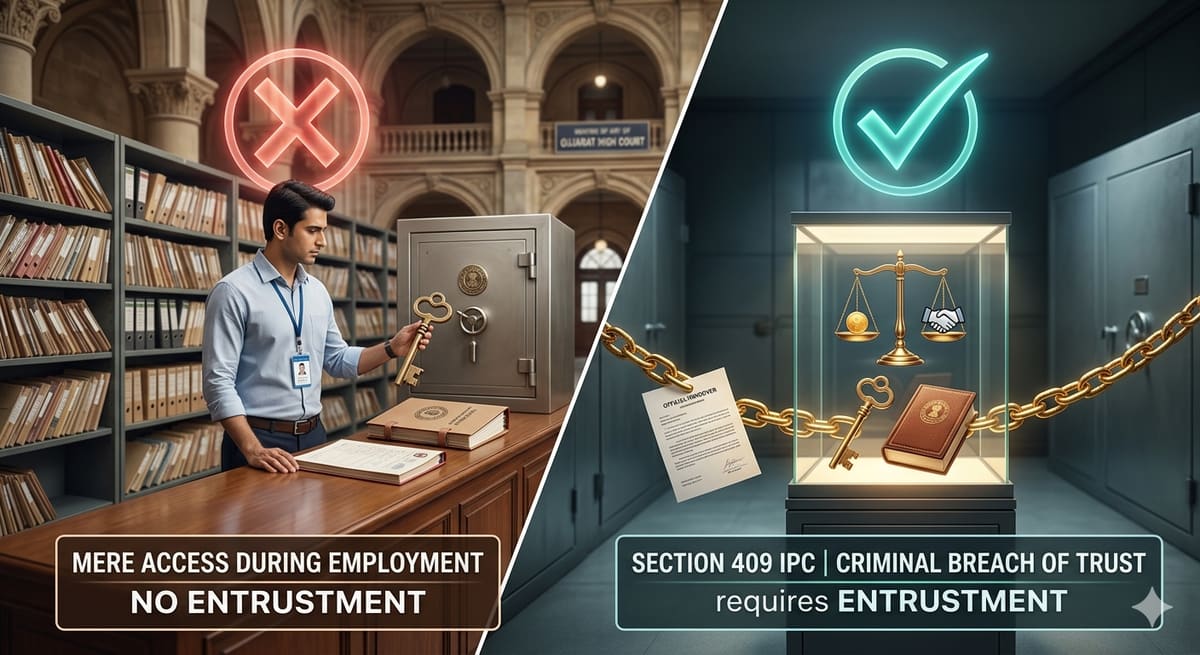
The Kerala High Court has affirmed that conviction under Section 409 IPC for criminal breach of trust by a public servant requires clear proof of entrustment of property and a dishonest intention to convert it to personal use, rejecting mere negligence or accounting irregularities as sufficient grounds. The judgment reinforces the necessity of proving both elements beyond reasonable doubt in cases involving misappropriation of public funds.
Background & Facts
The Dispute
The accused, A.P. Benoy, served as a cashier at the K.S.E.B. Section Office in Manimala, Kottayam, during the period from 1.3.2007 to 2.5.2007. He was accused of dishonestly misappropriating a total amount of Rs.1,74,979/- collected from consumers, which he failed to remit to the treasury. The prosecution alleged two distinct heads of misappropriation: a cash chest shortage of Rs.78,520/- and a "broken collection" of Rs.96,459/-, arising from unremitted electricity charges collected via official receipts.
Key Facts
- The accused was entrusted with collecting electricity charges from consumers across designated day codes (3A-1 to 25, 3B-1 to 25, 1A-13 to 25, 1B-13 to 25, LT-V, and division cash) as per Ext.P2(a) office order dated 01.03.2007.
- Other cashier PW15 was assigned different day codes (2A-1 to 25, 2B-1 to 25, 1A-1 to 12, 1B-1 to 12, LT-IV, and 10KW).
- On 02.05.2007, a cash chest inspection was conducted by PW2 (Assistant Engineer) in the presence of PW1, PW3, PW4, PW5, PW15, and PW16. The inspection revealed only Rs.9,305/- in the chest, despite a recorded collection of Rs.87,825/- for April 2007, resulting in a shortage of Rs.78,520/- (Ext.P5 mahazar).
- The accused prepared Ext.P14 SOP-10 on 30.04.2007, showing total collection of Rs.87,825/- as current charge.
- Ext.P1 and P1(a) cash remittance slips, dated 02.05.2007, were prepared by the accused to remit Rs.87,845/- and Rs.20/-, but these were not deposited.
- The prosecution identified 13 receipts (Exts.P11, P12, P18, P28 series, P30 series, P34, P34(a), P38, P40, P40(a), P42, P43, P44) totaling Rs.96,456/- issued by the accused for consumer payments, none of which were reflected in the Consumer Personal Ledgers (Exts.P6-P9) or remittance registers.
- Ext.P66 letter dated 16.10.2007, written by the accused to the Deputy Chief Engineer, admitted to a cash chest shortage of Rs.78,520/- and requested permission to remit Rs.1,52,228/- to clear audit objections.
- On 04.05.2007, the accused remitted Rs.78,520/- (Exts.D6 and D7), and on 14.11.2007, he remitted Rs.1,67,514/- (Ext.D5) as per Ext.P68 notice.
- Ext.P31 audit report by PW14 (Auditor) concluded that the accused used multiple receipt books simultaneously and failed to record collections in ledgers.
- Handwriting of the accused was confirmed on all disputed receipts (Exts.P11, P12, P18, P28, P30, P34, P34(a), P38, P40, P40(a), P42, P43, P44) by PW16 (Senior Assistant).
Procedural History
- 03.05.2007: Crime registered under Sections 13(1)(c), 13(1)(d) r/w 13(2) of the Prevention of Corruption Act, 1988, and Sections 406, 420, 477A IPC.
- 29.09.2018: Special Judge convicted the accused on all charges and sentenced him to 3 years rigorous imprisonment each for four offences, with concurrent sentences and fines of Rs.25,000/- each.
- 07.04.2026: Criminal Appeal No.1252 of 2018 heard before the Kerala High Court.
The Parties' Positions
For the Appellant/Petitioner
- Argued that the prosecution failed to produce individual consumer receipts proving collection of Rs.78,520/- and Rs.96,459/-.
- Contended that Ext.P66 was not a voluntary admission under Sections 17 or 21 of the Indian Evidence Act, as it was a request for time, not an acknowledgment of guilt.
- Asserted that Ext.P25 bank statement showed excess remittances, suggesting other cashiers’ collections were misattributed.
- Challenged the validity of prosecution sanction (Ext.P48), claiming it was granted without proper scrutiny.
- Argued that absence of proof of dishonest intention negated offences under Sections 409 and 477A IPC.
For the Respondent/State
- Maintained that Ext.P14 SOP-10, Ext.P5 mahazar, Ext.P31 audit report, and Ext.P66 letter collectively established misappropriation.
- Highlighted that the accused prepared remittance slips (Exts.P1, P1(a)) but did not deposit the amounts.
- Emphasized that the accused’s own handwriting on all disputed receipts and failure to record collections in ledgers proved intent.
- Stated that Ext.P66 constituted a clear admission under Section 17 of the Evidence Act, as it acknowledged liability and sought time to pay.
- Argued that the sanction (Ext.P48) was valid, as PW18 had reviewed records before granting it.
Relief Sought
The appellant sought quashing of the conviction and sentence, arguing that the prosecution failed to prove the essential ingredients of the offences beyond reasonable doubt. Alternatively, he sought reduction of sentence.
The Legal Issue
The central questions were: (1) Whether the prosecution proved that the accused, as a public servant, was entrusted with property and dishonestly converted it to his own use under Section 409 IPC; (2) Whether the accused willfully falsified accounts with intent to defraud under Section 477A IPC; and (3) Whether the accused’s conduct constituted criminal misconduct under Sections 13(1)(c) and 13(1)(d) read with 13(2) of the Prevention of Corruption Act, 1988.
Arguments Presented
For the Appellant/Petitioner
The appellant’s counsel relied on Sadhupati Nageswara Rao v. State of Andhra Pradesh to argue that mere failure to remit funds does not equate to criminal breach of trust without proof of dishonest intention. He contended that Ext.P66 was an administrative request, not a confession, and that the prosecution’s reliance on audit reports without direct evidence of collection violated the principle of proof beyond reasonable doubt. He further argued that Section 477A IPC requires proof of deceit and injury, which were absent since the accused later remitted the amounts.
For the Respondent/State
The Special Public Prosecutor cited Harman Singh v. Delhi Administration to assert that the accused’s preparation of false receipts, omission from ledgers, and subsequent remittance under audit pressure constituted deceit and intent to defraud. The prosecution emphasized that the accused’s own documents (Ext.P14, Ext.P66) and handwriting on all disputed receipts established a pattern of concealment. The remittance of Rs.78,520/- and Rs.1,67,514/- was not a correction but an admission of liability, satisfying the requirements of Sections 17 and 21 of the Evidence Act.
The Court's Analysis
The Court undertook a meticulous review of the evidence, distinguishing between administrative lapses and criminal conduct. It held that the accused, as a cashier entrusted with public funds, had a fiduciary duty to account for all collections. The Court found that the prosecution established entrustment through Ext.P2(a) work allocation and the accused’s role as cashier.
"The accused prepared Ext.P14 SOP-10 showing total collection of Rs.87,825/-, yet only Rs.9,305/- was found in the chest. The preparation of remittance slips (Exts.P1, P1(a)) without actual deposit, coupled with the omission of receipts from consumer ledgers, demonstrates a deliberate attempt to conceal misappropriation."
The Court rejected the argument that Ext.P66 was merely a request for time. It held that the letter, written after the crime was registered and after the audit revealed a liability, constituted a voluntary admission under Section 17 of the Indian Evidence Act. The subsequent remittance of Rs.78,520/- and Rs.1,67,514/- further corroborated the accused’s acknowledgment of liability.
Regarding Section 477A IPC, the Court clarified that intent to defraud requires both deceit and injury. The accused’s use of multiple receipt books, failure to record collections in ledgers, and falsification of records to conceal the shortage satisfied the elements of willful falsification with intent to defraud. The Court noted that the accused’s later payment did not negate the offence, as held in Harman Singh.
The Court also upheld the validity of prosecution sanction (Ext.P48), finding that PW18 had reviewed the records before granting it. The Court concluded that the Special Judge’s findings were based on cogent evidence and were not perverse.
The Verdict
The appeal was allowed in part. The conviction under Sections 13(1)(c) and 13(1)(d) read with 13(2) of the Prevention of Corruption Act, 1988, and Sections 409 and 477A of IPC was confirmed. However, the sentence was modified: the accused was sentenced to one year rigorous imprisonment for each offence, with a fine of Rs.50,000/- for each, and in default, three months rigorous imprisonment. The substantive sentences shall run concurrently, while default sentences shall run separately after the substantive term. The period of detention already undergone shall be set off against the substantive sentence. The accused is directed to surrender immediately to serve the sentence.
What This Means For Similar Cases
Entrustment Must Be Clearly Established
- Practitioners must demonstrate that the accused was formally entrusted with property or funds through official assignment, not merely by virtue of employment.
- Work allocation orders, job descriptions, and internal directives are critical evidence to establish entrustment under Section 409 IPC.
Admission Under Section 17 Requires Contextual Analysis
- Administrative letters requesting time to pay may constitute admissions if they acknowledge liability, even if phrased as requests.
- Courts will examine timing, content, and subsequent conduct (e.g., payment) to determine if a statement qualifies as an admission under Section 17 of the Evidence Act.
Falsification Under Section 477A IPC Does Not Require Permanent Loss
-
The offence is complete upon willful falsification with intent to defraud, regardless of whether the loss was later rectified.
-
Prosecution must prove deceit (false representation or concealment) and injury (actual or potential harm to employer’s property or interests).
-
Always cross-examine audit reports for gaps in data attribution.
-
Challenge the chain of custody and authenticity of receipts and ledgers.
-
Argue that remittance after detection negates dishonest intention only if done before discovery.