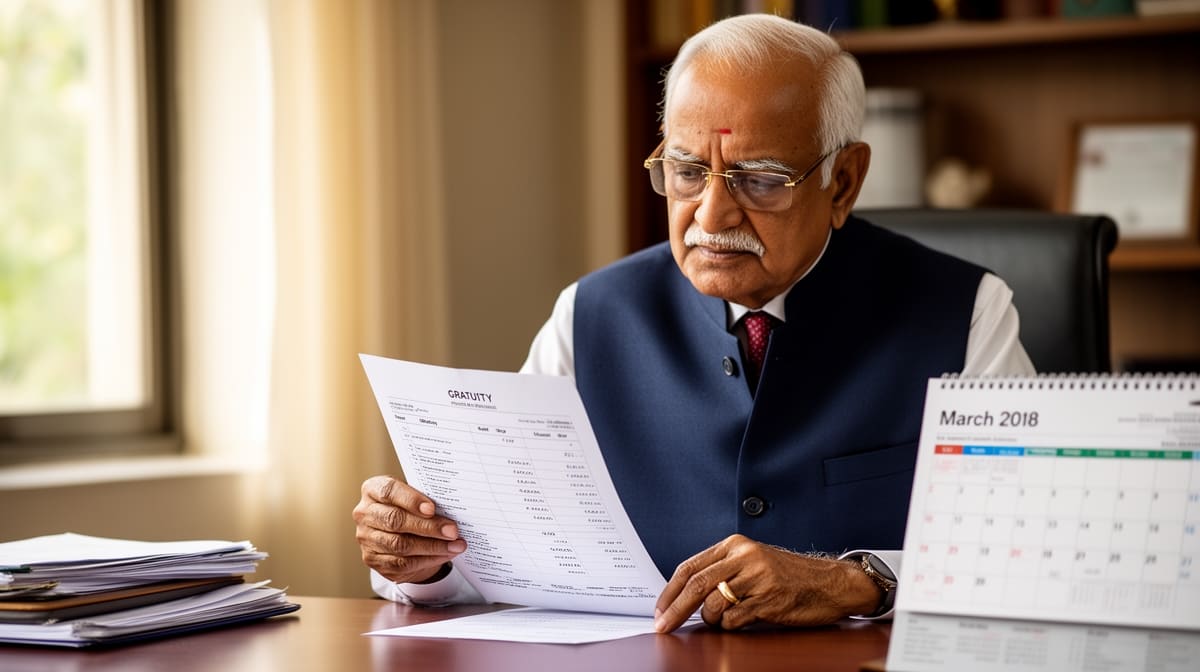
The Punjab and Haryana High Court has decisively affirmed that the enhanced gratuity ceiling of Rs.20 lakh under the amended Payment of Gratuity Act, 1972 applies retroactively to employees whose service terminated after the amendment’s effective date. This ruling resolves longstanding ambiguity over whether revised limits bind employers for past dues, establishing a clear obligation to recalculate and pay arrears with interest.
Background & Facts
The Dispute
The petitioners, former employees of Punjab Water Resources Management and Development Corporation Limited, were denied the enhanced gratuity benefit under the amended Payment of Gratuity Act, 1972, despite having completed qualifying service prior to their retirement or resignation. The respondents continued to calculate gratuity based on the pre-amendment ceiling of Rs.10 lakh, even though the amendment came into force on 29 March 2018.
Procedural History
- 29 March 2018: Amendment to the Payment of Gratuity Act, 1972 came into effect, raising the maximum gratuity limit from Rs.10 lakh to Rs.20 lakh.
- 2019: Yadbinder Pal Singh v. Punjab Water Resources Management and Development Corporation Ltd (CWP-1691-2019) was decided by a coordinate bench of the same High Court, holding that the enhanced ceiling applies to all eligible employees whose service ended after the amendment.
- 2025: Som Nath v. Punjab Water Resources Management and Development Corporation Limited (CWP-22009-2022) reaffirmed the same principle.
- 2025: Petitions under Articles 226 and 227 of the Constitution were filed seeking enforcement of the revised gratuity.
Relief Sought
The petitioners sought a writ of mandamus directing the respondents to recalculate their gratuity based on the Rs.20 lakh ceiling, pay the balance arrears, and grant interest at 9% per annum from the date the amount became due.
The Legal Issue
The central question was whether the enhanced gratuity ceiling of Rs.20 lakh under the amended Payment of Gratuity Act, 1972 applies retroactively to employees whose service terminated after 29 March 2018, even if their employment commenced before the amendment.
Arguments Presented
For the Petitioner
Learned counsel for the petitioners relied on two coordinate bench judgments of the same High Court - Yadbinder Pal Singh and Som Nath - which had already held that the amended ceiling is applicable to all eligible employees whose service ended after the amendment’s effective date. They argued that the amendment was clarificatory and not retrospective in the negative sense, and that denying the benefit violated the principle of equal treatment under Article 14 of the Constitution. They further contended that the respondents’ refusal was arbitrary and contrary to the legislative intent behind enhancing the ceiling to reflect inflation and cost of living.
For the Respondent
The respondents did not dispute the applicability of the earlier judgments. Their counsel conceded during hearing that the controversy was already settled by the coordinate benches and offered no substantive legal counter-argument. The state’s position effectively amounted to passive non-compliance rather than active legal resistance.
The Court's Analysis
The Court observed that the issue was no longer res integra and had been conclusively settled by two prior judgments delivered by coordinate benches of the same High Court. The Court emphasized that judicial consistency demands adherence to settled precedents within the same jurisdiction, particularly where the facts and legal questions are identical.
"In view of the above and without entering into any further detailed adjudication, this Court is of the considered opinion that the issue involved in the present writ petition(s) is no longer res integra and stands conclusively settled by the aforesaid judgments."
The Court noted that the amendment to the Payment of Gratuity Act was not merely a benefit enhancement but a statutory recognition of the increased economic value of employee service. The Court rejected any notion that the amendment could be applied prospectively only, as that would defeat the purpose of the legislative change and create arbitrary distinctions among similarly situated employees.
The Court also clarified that while the petitioners had sought interest at 9% per annum, the prevailing rate for such statutory arrears in public sector disputes is 6% per annum, which was accordingly applied from the date the gratuity became due until actual realization.
The Verdict
The petitioners won. The Court held that the revised gratuity ceiling of Rs.20 lakh under the amended Payment of Gratuity Act, 1972 applies to all employees whose service ended on or after 29 March 2018. The respondents were directed to recalculate the gratuity, pay the balance arrears within three months, and disburse interest at 6% per annum from the date the amount became due.
What This Means For Similar Cases
Retroactive Application of Statutory Benefits Is Presumed
- Employers cannot deny enhanced statutory benefits (e.g., gratuity, pension, leave encashment) merely because the employee’s service began before the amendment.
- The burden shifts to the employer to prove that the amendment was expressly made prospective; silence or administrative inertia does not override statutory intent.
Coordinate Bench Precedents Are Binding in Practice
- Even if not technically binding under stare decisis, judgments from coordinate benches on identical facts create a de facto obligation to follow them.
- Courts will summarily dispose of petitions where the issue has been conclusively settled by prior rulings, saving judicial time and ensuring uniformity.
Interest Rates on Statutory Arrears Are Fixed by Judicial Practice
- While petitioners may claim higher interest (e.g., 9%), courts in public sector cases routinely award 6% per annum as the standard rate for delayed statutory payments.
- Practitioners should plead interest as a matter of right, but must be prepared to accept the judicially recognized norm unless exceptional circumstances are shown.
Actionable Takeaways for Practitioners
- File writ petitions under Article 226 immediately upon denial of enhanced gratuity, citing Yadbinder Pal Singh and Som Nath.
- Ensure the petition includes a clear calculation of arrears based on the Rs.20 lakh ceiling.
- Seek interest at 6% per annum from the date the gratuity became payable, not from the date of filing.
- Do not waste court time re-litigating settled issues - cite the precedent and move for summary disposal.