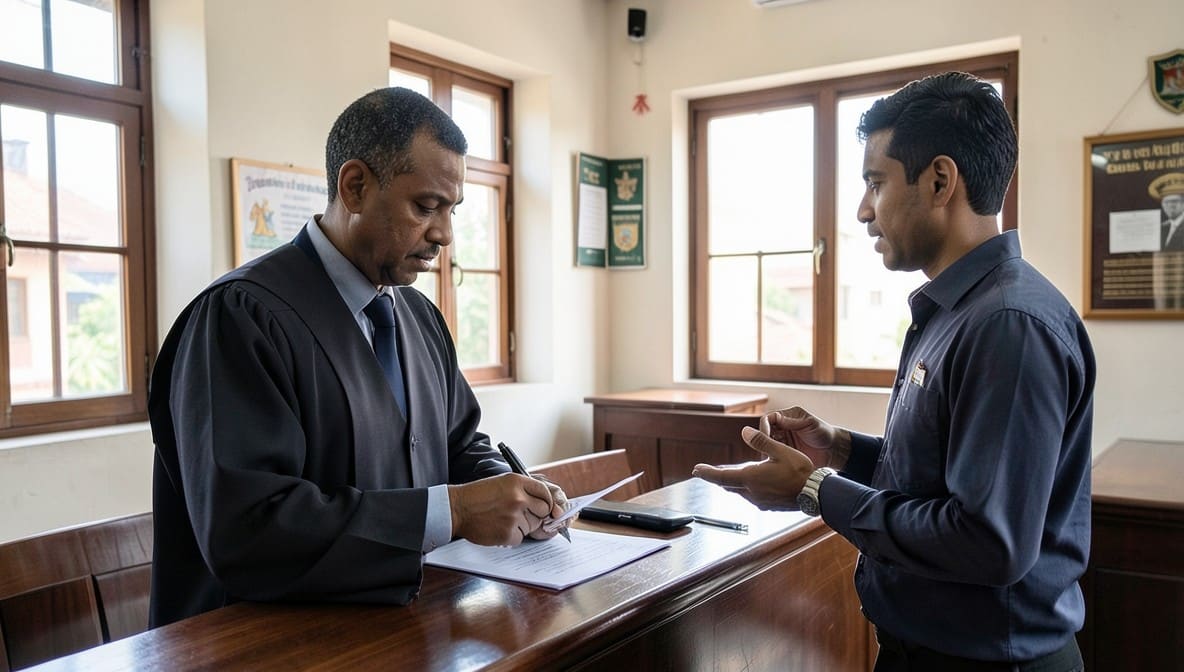
The Rajasthan High Court has granted suspension of sentence to two convicted public servants pending appeal, emphasizing that prolonged litigation and a hostile prosecution witness justify interim relief under principles of proportionality and fair trial. The order sets clear procedural conditions for their release, reinforcing that suspension is not a right but a discretionary remedy grounded in case-specific equity.
Background & Facts
The Dispute
The present applications for suspension of sentence were filed by Shyam Lal and Kanhaiyalal, both former employees of the Jodhpur Discom, who were convicted on 07.05.2026 by the Special Judge (Prevention of Corruption Act Cases), No.1, Jodhpur, in Criminal Original Case No.09/2021. Shyam Lal was convicted under Section 8 of the Prevention of Corruption Act, 1988 read with Section 120-B IPC, while Kanhaiyalal was convicted under Section 7 of the Prevention of Corruption Act, 1988 read with Section 120-B IPC. Both were sentenced to three years of simple imprisonment.
Key Facts
- The trial originated from an FIR lodged in 2021 alleging demand and acceptance of illegal gratification in connection with official duties.
- The complainant, who was the key witness, turned hostile during trial, severely undermining the prosecution’s case.
- The applicants have been in trial since 2021, with no final resolution despite the conviction being delivered on 07.05.2026.
- The sentence of three years’ simple imprisonment was imposed on both applicants.
- The applicants are not accused of violent or heinous crimes but of corruption-related offences involving public service.
Procedural History
- 2021: FIR registered and trial commenced.
- 07.05.2026: Special Judge convicted both applicants and sentenced them to three years’ simple imprisonment.
- 03.06.2026: Applications for suspension of sentence filed before the Rajasthan High Court.
- 03.06.2026: Hearing conducted by Justice Sanjeet Purohit.
The Parties' Positions
For the Petitioners
- Counsel argued that the conviction rests heavily on the testimony of a witness who has now turned hostile.
- The FIR was allegedly filed with ulterior motives, and the prosecution failed to establish guilt beyond reasonable doubt.
- The applicants have served no time in custody post-conviction, and the appeal process is expected to take considerable time.
- The sentence of three years, while statutory, is disproportionate given the absence of violence and the collapse of the prosecution’s primary evidence.
For the Respondent
- The Public Prosecutor opposed the suspension, arguing that corruption offences involving public servants are serious and warrant strict enforcement.
- No submission was made regarding the hostile nature of the witness or the delay in trial.
- The State maintained that suspension of sentence should not be granted merely on the ground of prolonged litigation.
Relief Sought
The applicants sought suspension of their three-year simple imprisonment sentences pending disposal of their criminal appeals, subject to conditions including execution of bonds and sureties, and regular appearance before the trial court.
The Legal Issue
The central question was whether the suspension of sentence under Section 389 CrPC is warranted when a convicted person faces a prolonged appeal, the prosecution’s key witness has turned hostile, and the sentence is not of a nature involving violence or public danger.
Arguments Presented
For the Appellant/Petitioner
Counsel relied on the principle that suspension of sentence is a discretionary remedy under Section 389 CrPC, to be granted when the appellate court is satisfied that the appeal is not frivolous and that the convict is likely to succeed on merits. They cited State of Rajasthan v. Ram Lal and Rajendra Prasad v. State of U.P. to argue that the collapse of the prosecution’s case due to a hostile witness creates a strong prima facie case for appeal. They emphasized that the applicants have no prior criminal record and that the sentence of three years, while mandatory, should not result in immediate incarceration when the appeal process is likely to take years.
For the Respondent/State
The Public Prosecutor contended that corruption offences under the Prevention of Corruption Act are grave and that suspension of sentence undermines deterrence. No specific precedent was cited to oppose the application, and no counter-evidence was presented to rebut the claim of a hostile witness or the delay in trial.
The Court's Analysis
The Court observed that while conviction under Section 7 and Section 8 of the Prevention of Corruption Act, 1988 is serious, the discretionary power under Section 389 CrPC must be exercised with a view to justice, not merely punishment. The Court noted that the complainant’s hostility significantly weakens the prosecution’s case, raising a legitimate ground for appeal. The Court further noted that the applicants have been under trial since 2021, and the appeal process is likely to be protracted.
"The fact that the complainant has turned hostile, coupled with the fact that the trial has spanned over five years and the appeal is likely to take considerable time, makes it inequitable to enforce immediate incarceration pending final adjudication."
The Court held that the applicants are not flight risks, have stable residences, and have no history of absconding. The Court also emphasized that the sentence of three years is not of a nature that requires immediate custodial enforcement, especially where the appeal raises substantial questions of law and fact.
The Court further directed that the trial court maintain a separate record of the applicants’ annual appearances to ensure compliance, and that failure to appear shall result in automatic cancellation of the suspension.
The Verdict
The applications for suspension of sentence were allowed. The three-year simple imprisonment sentences imposed on Shyam Lal and Kanhaiyalal are suspended pending disposal of their criminal appeals. Each applicant must execute two sureties of Rs.25,000 each and a personal bond of Rs.50,000, to be approved by the trial court. They must appear before the trial court every January until the appeal is decided, notify all authorities of any change in residence, and ensure sureties also report address changes. Failure to appear shall result in immediate cancellation of suspension by the High Court.
What This Means For Similar Cases
Hostile Witness Can Justify Suspension of Sentence
- Practitioners may now argue that the collapse of the prosecution’s primary witness, especially in corruption cases, constitutes a substantial ground for appeal under Section 389 CrPC.
- Courts are more likely to suspend sentences where the conviction hinges on a single witness who later retracts or turns hostile.
Protracted Trials Warrant Interim Relief
- When trials extend beyond five years and appeals are likely to be delayed, courts may view immediate incarceration as disproportionate.
- Suspension is not a reward but a procedural safeguard against undue hardship during prolonged litigation.
Annual Appearance as a Standard Condition
- Courts are increasingly imposing annual reporting conditions to ensure accountability without custodial detention.
- Practitioners should prepare clients for such conditions and ensure compliance mechanisms are in place.
Non-Violent Corruption Offences May Qualify for Suspension
- Convictions under Section 7 and 8 PCA involving no violence, no large-scale loss, and no prior record are more likely to qualify for suspension.
- The Court’s reasoning signals a shift toward proportionality in sentencing enforcement during appeals.
Documentation of Compliance Is Mandatory
- Trial courts must maintain separate files for suspended convicts, as directed.
- Practitioners must ensure copies of the suspension order are filed in the trial court and that all conditions are formally acknowledged in writing.