The Karnataka High Court has granted bail to an accused in a POCSO case after DNA evidence conclusively excluded him as the biological father of the victim’s child, significantly undermining the prosecution’s case under Sections 376(2)(n) and 376(3) of the IPC. While the Court declined to prejudge the POCSO allegations, it held that continued custody without substantial evidence on the gravest charges served no purpose.
Background & Facts
The Dispute
The petitioner, Srinivasa N., aged 24, is accused of sexually assaulting his minor cousin, the daughter of respondent No.2. The allegations stem from an incident allegedly occurring on 10.04.2011, when the victim was a child. The petitioner is the cousin of the victim and resides in the same village. The case was triggered when the victim, then aged approximately 16, reported to the police on 14.12.2024 that she had been subjected to repeated sexual abuse since 2011 and had recently become pregnant.
Key Facts
- The victim recorded her statement before a Woman Police Sub-Inspector on 14.12.2024
- On 13.12.2024, she experienced abdominal pain and was taken to Abhaya Hospital, Chikkaballapur, where a pregnancy test confirmed pregnancy
- Crime No.156/2024 was registered on 15.12.2024 at Sidlaghatta Town Police Station
- The investigation included collection of biological samples from the petitioner and the newborn
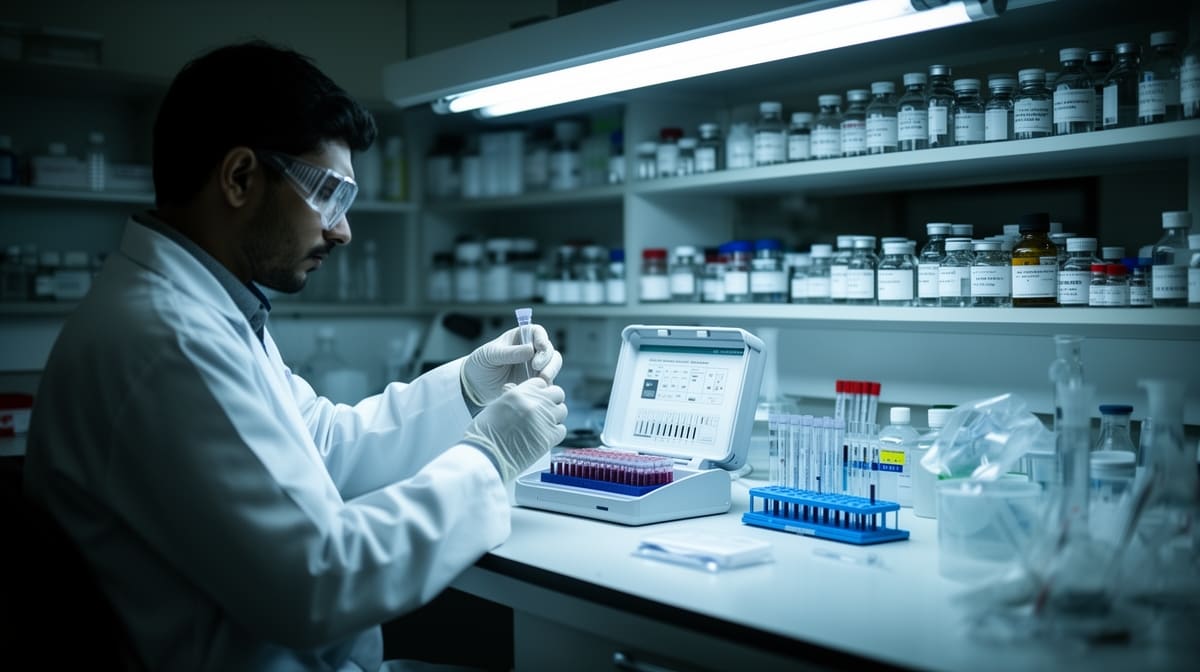
- A DNA profile report was conducted by the Forensic Science Laboratory, Karnataka
- The DNA report, dated 05.04.2026, conclusively showed no biological match between the petitioner and the child
- The charge sheet was filed on 18.02.2025, invoking:
- Sections 376(2)(n) and 376(3) of the IPC
- Sections 4(2), 5(l), 5(n), 5(J)(II), and 6 of the POCSO Act, 2012
- The petitioner was arrested and has been in custody since 20.02.2025
Procedural History
- 10.04.2011: Alleged first incident of sexual assault
- 13.12.2024: Victim undergoes pregnancy test at Abhaya Hospital
- 14.12.2024: Victim records statement before Woman PSI
- 15.12.2024: Crime No.156/2024 registered
- 18.02.2025: Charge sheet filed before Special Court (POCSO)
- 20.02.2025: Petitioner taken into custody
- 27.03.2025: Special Court rejects bail application
- 08.04.2026: Karnataka High Court directs submission of DNA report
- 05.04.2026: DNA report submitted to Court
- 29.05.2026: Criminal Petition heard and decided by Karnataka High Court
The Parties' Positions
Petitioner: Argues that the DNA report conclusively negates the core allegation under Sections 376(2)(n) and 376(3) IPC, which require proof of sexual intercourse resulting in pregnancy. He contends the POCSO charges are being misused to settle family disputes and that his continued custody is unjustified in light of the DNA evidence.
Respondent (State): Opposes bail, asserting that the gravity of offences under POCSO Act and IPC, particularly involving a minor, warrants continued custody regardless of DNA results. Argues that the POCSO charges relate to repeated sexual abuse over years, not solely the pregnancy.
Relief Sought
The petitioner seeks bail pending trial in Special Case No.25/2025, with conditions, arguing that his custody is no longer justified given the DNA evidence.
The Legal Issue
The central question was whether the conclusive exclusion of the petitioner as the biological father of the victim’s child, through DNA evidence, renders the charges under Sections 376(2)(n) and 376(3) of the IPC unsustainable at the bail stage, and whether this justifies release on bail despite the pendency of POCSO charges.
Arguments Presented
For the Petitioner
Counsel relied on the DNA report to argue that the prosecution’s case under Sections 376(2)(n) and 376(3) IPC - which require proof of sexual intercourse resulting in pregnancy - is rendered impossible. He cited State of Maharashtra v. Madhukar Narayan Mardikar to argue that bail must be granted where the prima facie case is weakened by objective evidence. He further contended that the invocation of POCSO is retaliatory, given the familial relationship and absence of prior complaints.
For the Respondent
The High Court Government Pleader argued that POCSO offences are non-bailable and grave, and that the DNA report only negates one aspect of the allegations. She emphasized that the charges include repeated sexual abuse over years, which do not depend on paternity. She relied on Kishore Singh v. State of Rajasthan to argue that gravity of offence and risk of tampering justify continued custody.
The Court's Analysis
The Court undertook a careful evaluation of the DNA report’s implications. It noted that Section 376(2)(n) of the IPC specifically criminalizes sexual intercourse by a person with a minor resulting in pregnancy. The Court held that the DNA report, being a scientific and objective piece of evidence, directly contradicts this essential ingredient of the offence.
"The DNA profile report conducted by the Investigating Agency discloses that the DNA profile of the baby delivered by the victim girl does not match with the DNA profile of the petitioner. Therefore, it is difficult to believe at this stage that the offence under Sections 376(2)(n), 376(3) of IPC was made out."
The Court further observed that while the POCSO charges remain unchallenged by the DNA report, they are not self-sustaining without corroboration. The Court emphasized that bail is not a determination of guilt but an assessment of custody necessity. Given that the petitioner had been in custody for over 15 months and the trial was underway, the Court found no compelling reason to continue detention when the most serious charge had been effectively negated.
The Court also rejected the argument that POCSO charges alone justified denial of bail, noting that the Act does not mandate automatic denial of bail irrespective of evidentiary developments. The Court applied the principle of proportionality and held that continued custody must be justified by the strength of the case, not merely the nature of the statute.
The Verdict
The petitioner succeeded. The Karnataka High Court allowed the bail petition and ordered the petitioner’s release in Special Case No.25/2025, subject to the following conditions: (i) execution of a personal bond of Rs.2,00,000 with a solvent surety; (ii) appearance before the trial court on all dates; (iii) no commission of similar offences or tampering with evidence or witnesses; and (iv) bail cancellation upon violation. The Court directed compliance within 48 hours.
What This Means For Similar Cases
DNA Evidence Can Undermine IPC Charges Even in POCSO Cases
- Practitioners must immediately request DNA testing in all POCSO cases involving pregnancy allegations
- A negative DNA match renders Section 376(2)(n) IPC unsustainable at the bail stage
- Courts cannot deny bail solely on the basis of POCSO charges when core IPC ingredients are disproven
Bail Is Not Automatic, But Must Be Proportionate
- The mere invocation of POCSO does not create a presumption against bail
- Courts must assess the evidentiary strength of each charge separately
- Continued custody without plausible grounds for the gravest charges violates Article 21
Family Disputes Must Not Be Weaponized Through POCSO
- Courts must scrutinize the timing and context of complaints in familial disputes
- Delayed reporting, absence of prior complaints, and motive for retaliation are relevant at bail stage
- POCSO cannot be used as a tool for extrajudicial punishment