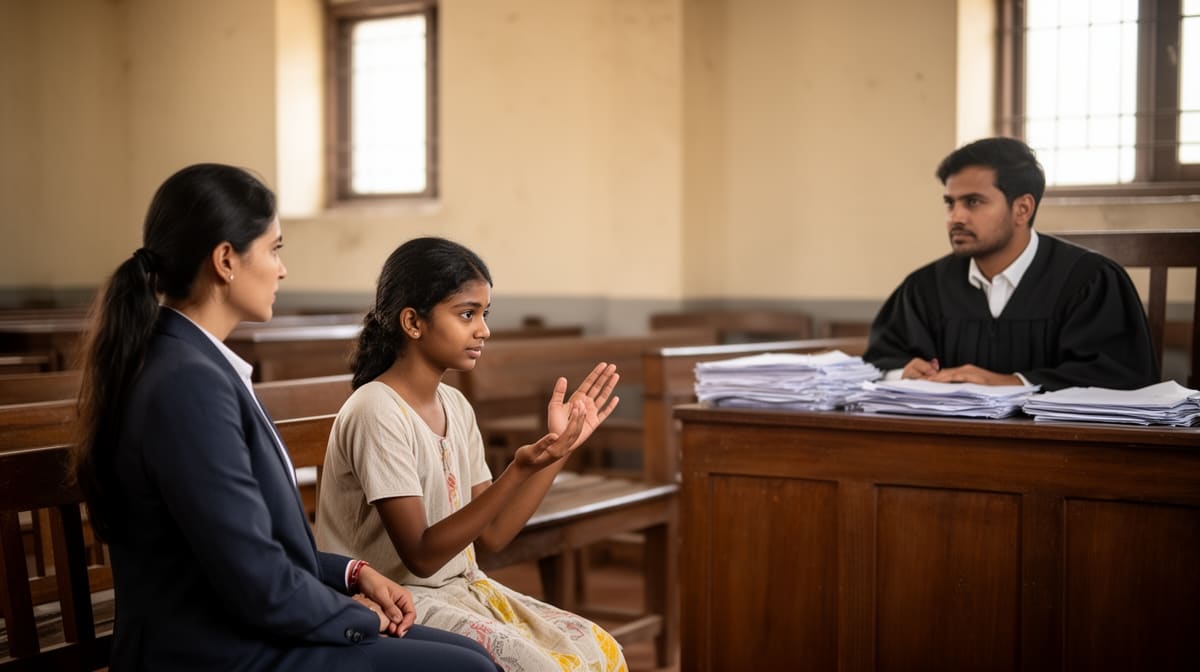
The Sikkim High Court has delivered a significant judgment in Rinzing Sherpa v. State of Sikkim, affirming the conviction and sentence under Section 376(2)(l) of the Indian Penal Code (IPC) for rape of a differently abled woman. The Court clarified that the testimony of a victim with intellectual disabilities, when corroborated by medical and forensic evidence, is sufficient to establish guilt, even if the victim cannot coherently name the aggressor. This ruling reinforces the legal principle that the testimony of disabled witnesses must be evaluated on its own merits, not dismissed due to communication barriers.
Background & Facts
The Dispute
The appellant, Rinzing Sherpa, was convicted by the Fast Track Court, South & West Sikkim, for raping a 25-year-old woman with 70% mental retardation and cerebral palsy under Section 376(2)(l) IPC. The victim’s niece (PW-5) witnessed the assault and reported it to the victim’s sister-in-law (PW-2), who lodged an FIR on 02.09.2022. The appellant, a 27-year-old carpenter/mason working at the victim’s house, was arrested and charged under Section 376(2)(l) IPC, which prescribes enhanced punishment for rape of a woman with intellectual or physical disabilities.
Key Facts
- The victim was certified as suffering from 70% mental retardation and cerebral palsy under the Persons with Disabilities (Equal Opportunities, Protection of Rights and Full Participation) Act, 1995 (Exhibit P1/PW1).
- On 02.09.2022, PW-5 witnessed the appellant sexually assaulting the victim at a playground near her grandfather’s house.
- The victim’s sister-in-law (PW-2) lodged an FIR (Exhibit P-2/PW-2) on the same day, alleging rape.
- The Investigating Officer (PW-12) filed a chargesheet under Section 376(2)(l) IPC on 06.03.2023.
- The victim’s medical examination (Exhibit P-12/PW-10) revealed fresh cuts on the inner labia, bleeding, torn hymen, and swollen labia majora with tenderness, confirming sexual assault.
- The Regional Forensic Science Laboratory (RFSL) Report (Exhibit P-18/PW-12) detected human blood on the victim’s vaginal swab and wash, corroborating the medical evidence.
- The appellant was medically examined on the same day, and defence marks were noted on his arm, which he attributed to an assault by PW-5’s brother.
Procedural History
- 02.09.2022: FIR lodged by PW-2 (Exhibit P-2).
- 03.09.2022: Victim and appellant medically examined.
- 06.03.2023: Charge framed under Section 376(2)(l) IPC.
- Trial Proceedings: Prosecution examined 12 witnesses, including the victim (PW-4), her niece (PW-5), mother (PW-1), sister-in-law (PW-2), Special Educator (PW-3), Medical Officer (PW-10), and Investigating Officer (PW-12).
- 21.02.2024: Trial Court convicted the appellant under Section 376(2)(l) IPC.
- 27.02.2024: Trial Court sentenced the appellant to 10 years of rigorous imprisonment and a fine of Rs. 25,000, with 1 year of simple imprisonment in default of payment. The Court also recommended compensation of Rs. 4,00,000 under the Sikkim Compensation to Victims Scheme, 2021.
- Crl. A. No. 9 of 2024: Appellant filed an appeal before the Sikkim High Court.
The Parties' Positions
For the Appellant
- The victim did not name the appellant in her deposition and alleged the assault occurred at home, not the playground.
- The medical evidence did not conclusively establish the appellant as the aggressor.
- The testimony of PW-5 was contradicted by her admission in cross-examination that she did not state to the police that she saw the appellant having sex with the victim.
- No injuries were found on the appellant during his medical examination.
- Relied on Raju & Others v. State of Madhya Pradesh (2008) 15 SCC 133 and Santosh Prasad alias Santosh Kumar v. State of Bihar (2020) 3 SCC 443 to argue that the victim’s testimony was unreliable and unsupported by corroborative evidence.
For the Respondent (State)
- The victim’s niece (PW-5) was an eyewitness and corroborated the prosecution’s case.
- The medical evidence (Exhibit P-12/PW-10) confirmed injuries consistent with rape.
- The RFSL Report (Exhibit P-18/PW-12) detected human blood on the victim’s vaginal swab and wash, corroborating the assault.
- The victim’s family members (PW-1, PW-2, PW-5, PW-7) identified the appellant as the perpetrator, as he was working at their house at the time of the incident.
- Relied on Mange v. State of Haryana (1979) 4 SCC 349 to argue that conviction can be based on the sole testimony of an eyewitness if it inspires confidence.
Relief Sought
The appellant sought acquittal, arguing that the prosecution failed to prove his guilt beyond reasonable doubt. The State sought dismissal of the appeal and confirmation of the conviction and sentence.
The Legal Issue
The central question was whether the testimony of a differently abled victim, who could not coherently name the aggressor but described the assault and identified the witness, inspires judicial confidence when corroborated by medical and forensic evidence. Additionally, the Court had to determine whether the silences or inconsistencies in the victim’s deposition could be used to discard the prosecution’s case.
Arguments Presented
For the Appellant
- The victim did not name the appellant and alleged the assault occurred at home, not the playground.
- The medical evidence did not conclusively establish the appellant as the aggressor.
- The testimony of PW-5 was unreliable as she admitted in cross-examination that she did not state to the police that she saw the appellant having sex with the victim.
- The Supreme Court judgments in Raju and Santosh Prasad held that the testimony of a prosecutrix, though believable, cannot be presumed to be the gospel truth, especially when material contradictions exist.
For the Respondent
- The victim’s niece (PW-5) was an eyewitness and her testimony was corroborated by the victim’s family members (PW-1, PW-2, PW-7).
- The medical evidence (Exhibit P-12/PW-10) confirmed injuries consistent with rape, including fresh cuts, bleeding, and a torn hymen.
- The RFSL Report (Exhibit P-18/PW-12) detected human blood on the victim’s vaginal swab and wash, corroborating the assault.
- The appellant’s presence at the scene was established by multiple witnesses, including PW-5, who saw him follow the victim to the playground.
- The Supreme Court in Mange v. State of Haryana held that conviction can be based on the sole testimony of an eyewitness if it inspires confidence.
The Court's Analysis
The High Court meticulously examined the evidentiary value of the victim’s testimony, the corroborative medical and forensic evidence, and the reliability of the eyewitness account to determine whether the conviction was sustainable.
Testimony of a Differently Abled Victim
The Court relied on Patan Jamal Vali v. State of A.P. (2021) 16 SCC 225, which held that the testimony of a disabled witness cannot be considered weak or inferior merely because they interact with the world differently. The Court emphasized that as long as the testimony meets the criteria for inspiring judicial confidence, it is entitled to full legal weight.
"The testimony of a prosecutrix with a disability, or of a disabled witness for that matter, cannot be considered weak or inferior only because such an individual interacts with the world in a different manner viz-a-vis their abled-bodied counterparts. As long as the testimony of such a witness otherwise meets the criteria for inspiring judicial confidence, it is entitled to full legal weight."
The victim, though unable to name the appellant, clearly deposed that she was sexually abused and identified PW-5 as the witness to the incident. The Court noted that the victim’s silences or inability to name the appellant should not be given undue weightage, as the medical and forensic evidence overwhelmingly corroborated the assault.
Medical and Forensic Evidence
The medical evidence (Exhibit P-12/PW-10) revealed fresh cuts on the inner labia, bleeding, a torn hymen, and swollen labia majora with tenderness, confirming sexual assault. Dr. Sonica Rai (PW-10) confirmed that the bleeding was not menstrual and was consistent with rape.
The RFSL Report (Exhibit P-18/PW-12) detected human blood on the victim’s vaginal swab and wash, further corroborating the assault. The Court held that the RFSL report was admissible under Section 293 Cr.P.C. as it was prepared by an expert and admitted without protest from the defence.
Corroboration by Eyewitness and Other Evidence
The victim’s niece (PW-5) deposed that she saw the appellant in a drunken state near her grandfather’s house, asking the victim to fetch alcohol. She followed them to the playground and witnessed the assault. Though PW-5 admitted in cross-examination that she did not state to the police that she saw the appellant having sex with the victim, the Court relied on other corroborative evidence to establish the appellant’s guilt.
The victim’s family members (PW-1, PW-2, PW-5, PW-7, PW-9) identified the appellant as the person working at their house at the time of the incident. PW-7, who heard PW-5’s shout, took the appellant to the police station from the scene of the crime. The appellant’s presence at the scene was further confirmed by the defence marks on his arm, which he attributed to an assault by PW-5’s brother.
Distinguishing Precedents
The Court distinguished the appellant’s reliance on Raju and Santosh Prasad, noting that in those cases, the testimony of the prosecutrix was either unreliable or unsupported by corroborative evidence. In the present case, the victim’s testimony, though silent on the appellant’s name, was corroborated by medical, forensic, and eyewitness evidence, which collectively established the appellant’s guilt beyond reasonable doubt.
The Verdict
The Sikkim High Court dismissed the appeal and upheld the conviction under Section 376(2)(l) IPC. The Court confirmed the sentence of 10 years of rigorous imprisonment and a fine of Rs. 25,000, with 1 year of simple imprisonment in default of payment. The Court also set off the period of detention undergone by the appellant from 03.09.2022 against the sentence under Section 428 Cr.P.C. Additionally, the Court upheld the recommendation for compensation of Rs. 4,00,000 to the victim under the Sikkim Compensation to Victims Scheme, 2021.
What This Means For Similar Cases
Testimony of Differently Abled Victims Must Be Evaluated on Its Own Merits
- Courts must avoid dismissing the testimony of disabled victims merely because they cannot communicate in a conventional manner. The focus should be on what the victim conveys, not how they convey it.
- Silences or inconsistencies in the victim’s deposition should not be given undue weight if the testimony is otherwise corroborated by medical, forensic, or eyewitness evidence.
- The burden of proof does not shift, but the Court must scrutinize evidence meticulously to ensure justice is not denied due to communication barriers.
Medical and Forensic Evidence Can Corroborate Even Incomplete Testimony
- Medical evidence (e.g., injuries consistent with rape) and forensic evidence (e.g., detection of human blood) can fill gaps in the victim’s testimony, especially in cases involving differently abled victims.
- Expert reports (e.g., RFSL reports) are admissible under Section 293 Cr.P.C. even if the expert is not examined, provided the defence does not object or seek cross-examination.
Eyewitness Testimony Must Be Scrutinized for Consistency
- Eyewitness testimony must be corroborated by other evidence if there are contradictions or admissions that weaken its reliability.
- Multiple witnesses identifying the accused and placing him at the scene of the crime strengthen the prosecution’s case, even if one witness’s testimony is partially inconsistent.
- Defence marks or injuries on the accused can corroborate the prosecution’s version if they align with the timeline of the incident.