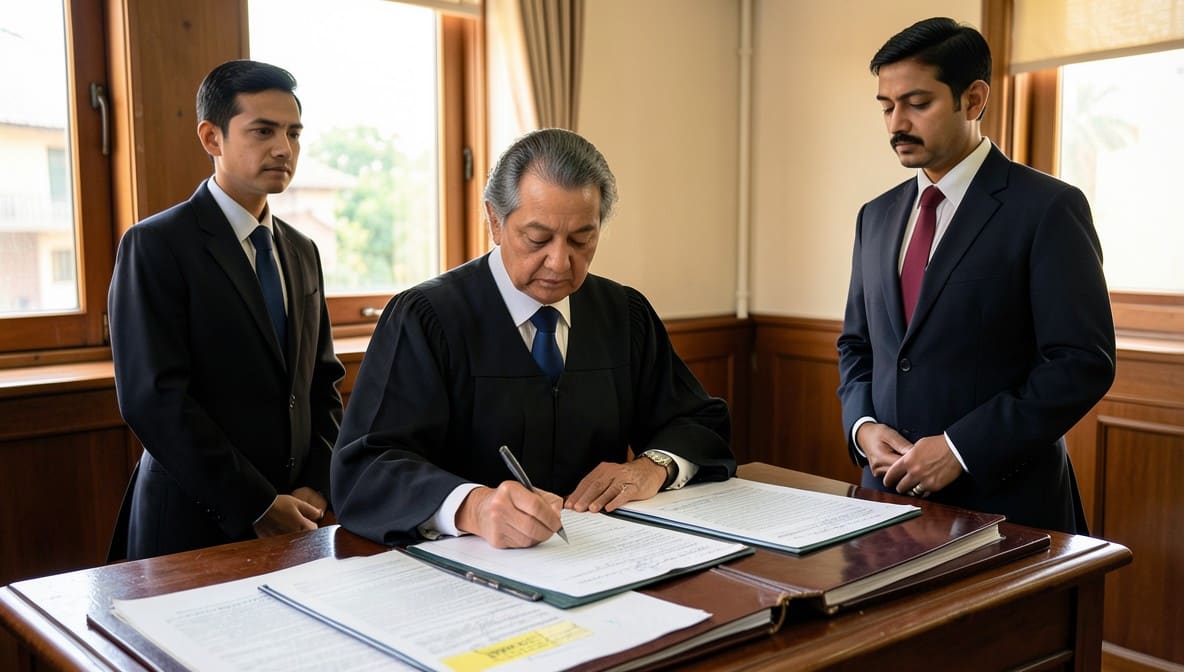
The Allahabad High Court has reaffirmed that in cases under the NDPS Act, the absence of direct recovery from an accused and the inadmissibility of a co-accused’s confessional statement must weigh heavily in favor of bail, particularly where no prior criminal record exists and trial delays are systemic. This order clarifies that Section 37 NDPS Act’s stringent bail conditions cannot be mechanically applied without evaluating evidentiary sufficiency.
Background & Facts
The Dispute
The applicant, Rakesh Vishwakarma, is accused in Crime No. 96 of 2026 under Sections 8, 21, 23, and 29 of the Narcotic Drugs and Psychotropic Substances (NDPS) Act, registered at Police Station Sadar Bazar, District Saharanpur. The case arises from an alleged drug trafficking operation involving the recovery of large quantities of controlled substances from two co-accused, but not from the applicant himself.
Key Facts
- The FIR alleges recovery of 1,900 ampules each of Diajapam injection, Brupenorphine injection, and Promethazine Hydrochloride from co-accused Rajendra Dharikar @ Ilu and Aditya Kumar Mishra
- No contraband was recovered from the personal possession or residence of the applicant
- The applicant’s name appears only in the confessional statement of co-accused Shankaranand Yadav
- The applicant is alleged to have transferred Rs. 1,20,000 to the bank account of the sister-in-law (bhabhi) of co-accused Bittu
- The applicant has no prior criminal record
- The applicant has been in judicial custody since 19.04.2026
Procedural History
- 19.04.2026: Applicant arrested and taken into custody
- Pending: Trial proceedings ongoing in the trial court
- 27.05.2026: Criminal Misc. Bail Application No. 17244 of 2026 filed under Section 483 of Bharatiya Nagarik Suraksha Sanhita, 2023
Relief Sought
The applicant seeks bail pending trial, arguing that the evidence against him is circumstantial, inadmissible, and insufficient to justify continued detention under Section 37 NDPS Act.
The Legal Issue
The central question was whether the mere mention of an accused in the inadmissible confessional statement of a co-accused, without any recovery from the accused or independent corroboration, satisfies the stringent conditions under Section 37 of the NDPS Act to deny bail.
Arguments Presented
For the Applicant
Learned counsel for the applicant argued that the confessional statement of co-accused Shankaranand Yadav is inadmissible against the applicant under the principle laid down in Toofan Singh v. State of Tamil Nadu, 2021 (4) SCC 1. He emphasized that no narcotic substance was recovered from the applicant’s possession, and the financial transaction alleged is not conclusive proof of involvement in trafficking. He further submitted that the applicant has no criminal antecedents and has been in custody for over a month with no prospect of early trial due to heavy pendency. He urged the court to apply the presumption of innocence and the proportionality principle in bail jurisprudence.
For the Respondent
The Additional Government Advocate contended that the transfer of Rs. 1,20,000 to the sister-in-law of a co-accused indicates financial involvement in the drug trade and thus satisfies the threshold under Section 37 NDPS Act. He argued that the nature of the offence - possession and trafficking of large quantities of scheduled substances - demands strict bail control, regardless of direct recovery from the applicant.
The Court's Analysis
The Court undertook a careful review of the evidentiary record and the legal framework under Section 37 of the NDPS Act, which mandates that bail shall not be granted unless the court is satisfied that there are reasonable grounds for believing the accused is not guilty and that he is not likely to commit any offence while on bail. The Court noted that the prosecution’s case against the applicant rests entirely on two pillars: the inadmissible confession of a co-accused and an unexplained bank transfer.
"Confessional statement of an accused is not admissible in evidence against co-accused."
The Court relied on Toofan Singh v. State of Tamil Nadu to reaffirm that confessions of one accused cannot be used to establish guilt against another. It further referenced Union of India v. Shiv Shanker Kesari to underscore that Section 37 must be interpreted strictly but not mechanically. The Court observed that while financial transactions may raise suspicion, they do not, by themselves, constitute proof of commission of a narcotic offence under Sections 8, 21, 23, or 29.
The Court also took judicial notice of the systemic delays in trial courts and the applicant’s prolonged detention without trial. It held that the absence of direct recovery, the inadmissibility of the primary incriminating evidence, and the lack of criminal history collectively negate the presumption of guilt required to deny bail under Section 37.
The Verdict
The bail application is allowed. The applicant, Rakesh Vishwakarma, shall be released on bail upon furnishing a personal bond of Rs. 50,000 with two sureties each in the like amount. The applicant must comply with five conditions: (i) no intimidation of witnesses or tampering with evidence; (ii) no pressure on prosecution witnesses; (iii) personal appearance at key trial stages (opening of case, framing of charge, statement recording under Section 351 B.N.S.S.); (iv) no adjournment requests when witnesses are present; and (v) presence before the trial court on all dates, personally or through counsel. Breach of any condition shall lead to immediate cancellation of bail. The Court explicitly clarified that this order expresses no opinion on the merits of the case.
What This Means For Similar Cases
Confessions Cannot Substitute Evidence
- Practitioners must challenge the use of co-accused confessions as substantive evidence against any accused in NDPS cases
- Courts must reject bail denials based solely on inadmissible statements under Toofan Singh
- The burden remains on the prosecution to establish independent, admissible evidence linking the accused to the offence
Financial Transactions Require Contextual Corroboration
- Bank transfers to relatives of co-accused are not ipso facto proof of drug trafficking
- Absence of recovery, possession, or direct involvement must be weighed against speculative financial links
- Defence counsel should demand specific nexus between the transaction and the alleged offence
Procedural Delay as a Bail Factor
- Prolonged pre-trial detention due to court backlogs is a legitimate consideration under Section 37
- Courts must balance the right to speedy trial with the rigour of NDPS bail conditions
- Applications for bail should explicitly cite trial delays as a mitigating factor