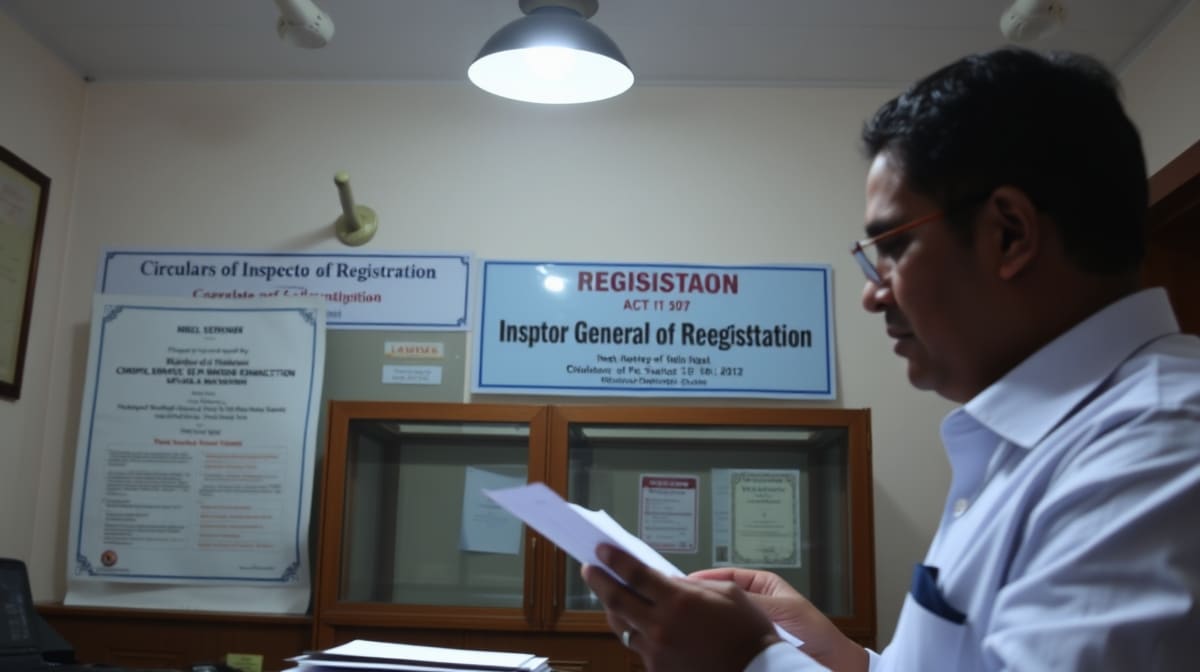
In a significant ruling under the recently amended Registration Act, the Madras High Court clarified that a Non-Traceable Certificate issued by the police can substitute the original parent document for registering a sale deed. This judgment provides relief to property owners who lose critical documents, ensuring that registration proceedings are not stalled indefinitely due to misplaced paperwork.
Background & Facts
The Dispute
The petitioner, Devendiran, sought registration of a sale deed before the Sub-Registrar, No.III-Joint Registrar Office, West Salem, Salem District. The respondent refused registration on 13.02.2026 via refusal check slip RFL/No.3/Joint Sub Registrar West Salem/22/2026, citing the absence of the original parent document as required under the third proviso to Section 34-C of the Registration Act, inserted in January 2026.
Key Facts
- The petitioner claimed the original parent document was lost or misplaced
- A police complaint was filed seeking a Non-Traceable Certificate, but the certificate was yet to be issued at the time of the refusal
- The third proviso to Section 34-C mandates production of either the original parent document or a Non-Traceable Certificate for registration
- The petitioner argued that the refusal was unjustified, relying on the judgment in 2023 1 CWC 533
Procedural History
- 13.02.2026: Respondent issued refusal check slip denying registration
- Date of filing: Writ Petition W.P.No.13109 of 2026 under Article 226 of the Constitution
- 08.04.2026: Madras High Court disposed of the writ petition with directions
Relief Sought
The petitioner prayed for:
- Quashing of the refusal check slip dated 13.02.2026
- A Writ of Certiorarified Mandamus directing the respondent to register the sale deed
- Reliance on the precedent in 2023 1 CWC 533 to support the claim
The Legal Issue
The central question was whether the third proviso to Section 34-C of the Registration Act permits registration of a sale deed on production of a Non-Traceable Certificate in lieu of the original parent document, and whether the respondent’s refusal was arbitrary in light of the petitioner’s undertaking to obtain such a certificate.
Arguments Presented
For the Petitioner
- Contended that the refusal to register the sale deed was unjust and arbitrary, as the petitioner had already filed a police complaint for the lost document
- Argued that the third proviso to Section 34-C explicitly allows for a Non-Traceable Certificate as an alternative to the original parent document
- Submitted that the petitioner was willing to obtain the Non-Traceable Certificate and should not be penalized for procedural delays
For the Respondent
- The Special Government Pleader argued that the third proviso to Section 34-C mandates production of either the original parent document or the Non-Traceable Certificate
- Without the Non-Traceable Certificate, the respondent could not proceed with registration, as the law required strict compliance
The Court's Analysis
The Court examined the third proviso to Section 34-C of the Registration Act, which was inserted in January 2026. The provision states that for registration of a sale deed, the original parent document must be produced, or in the alternative, a Non-Traceable Certificate issued by the police.
The Court observed that the petitioner had already filed a police complaint and was willing to obtain the Non-Traceable Certificate. The respondent’s refusal to register the sale deed without the certificate was held to be procedurally rigid, especially since the petitioner had undertaken to comply with the requirement.
"In view of the undertaking given by the petitioner, this Court directs the respondent to register the sale deed presented by the petitioner for registration on production of the Non-Traceable Certificate in respect of the parent document, which has been lost/mis-placed by the petitioner."
The Court further clarified that the registration should proceed if the sale deed is otherwise in order and upon payment of requisite stamp duty and registration fees.
The Verdict
The Madras High Court disposed of the writ petition with the following directions:
- The respondent must register the sale deed upon production of the Non-Traceable Certificate for the lost parent document
- Registration must be completed within two (2) weeks from the date of re-presentation of the sale deed and production of the certificate
- The sale deed must be otherwise in order and the petitioner must pay the requisite stamp duty and registration fees
- The writ petition was disposed of with no costs
What This Means For Similar Cases
Non-Traceable Certificate as a Valid Substitute
- The judgment establishes that a Non-Traceable Certificate is a valid substitute for the original parent document under Section 34-C of the Registration Act
- Property owners who lose documents can now proceed with registration by obtaining this certificate, avoiding indefinite delays
Procedural Flexibility in Registration Matters
- The Court emphasized procedural flexibility, holding that registration authorities cannot rigidly insist on the original document if the petitioner undertakes to produce the Non-Traceable Certificate
- This ruling sets a precedent for similar cases where document loss or misplacement occurs, ensuring that registration proceedings are not unduly stalled
Compliance Timelines and Undertakings
- The Court imposed a strict timeline of two (2) weeks for registration upon production of the certificate
- Practitioners should note that undertakings to comply with procedural requirements can influence judicial directions, particularly in cases involving lost or misplaced documents