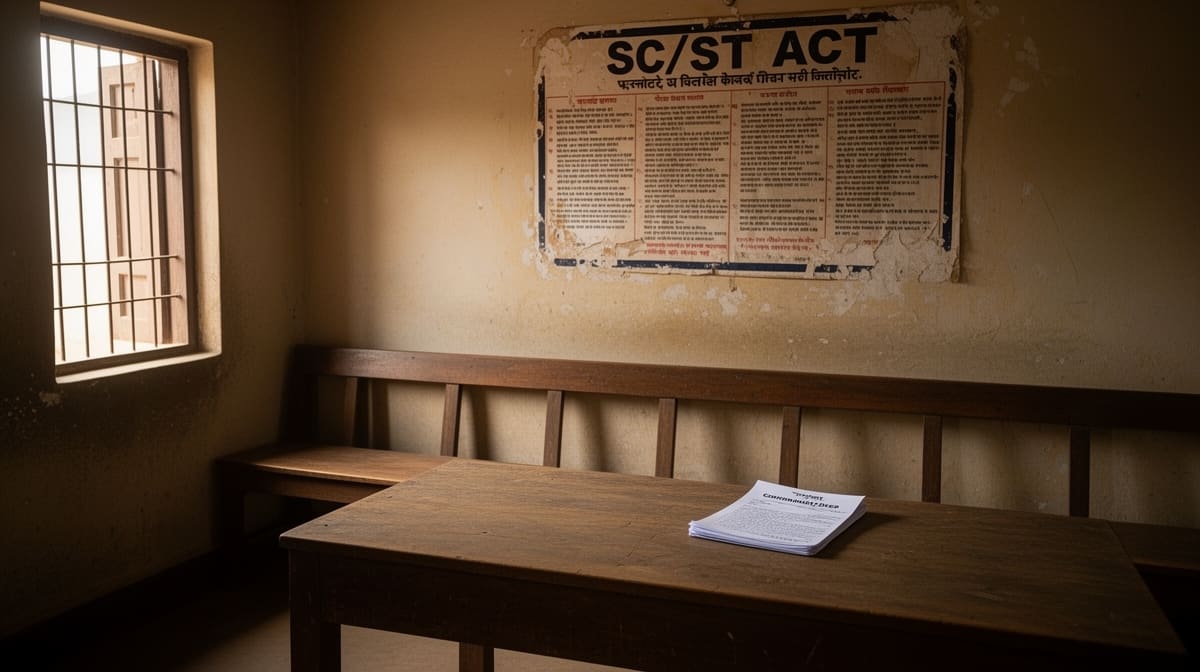
The Punjab and Haryana High Court has reaffirmed that offences under the Scheduled Castes and Scheduled Tribes (Prevention of Atrocities) Act, particularly those involving caste-based humiliation and criminal intimidation, cannot be extinguished by private compromise, even where parties have settled financially. This ruling underscores the public nature of such crimes and the judiciary’s duty to uphold social justice over private settlement.
Background & Facts
The Dispute
The petitioners are accused of inducing the complainant, a member of a Scheduled Caste, to part with ₹2,05,000 on the false pretext of securing a government job. When the complainant demanded repayment, he was allegedly subjected to caste-based derogatory remarks in public, threatened with a pistol, and denied return of his documents. These allegations formed the basis of FIR No.54 dated 12.07.2025 registered under Section 420 (cheating), Section 506 (criminal intimidation), Section 120-B (criminal conspiracy) of the IPC, and Section 3(1)(R) of the Scheduled Castes and Scheduled Tribes (Prevention of Atrocities) Act.
Procedural History
- 12.07.2025: FIR registered at Police Station Maloud, Ludhiana
- 20.07.2025: Compromise deed executed between petitioners and complainant, with payment of the disputed amount
- 20.02.2026: Petition filed under Section 528 of the Bhartiya Nagarik Suraksha Sanhita, 2023 seeking quashing of FIR on grounds of compromise
- 05.03.2026: Court directed parties to appear before the Trial Court to record statements on genuineness of compromise
Relief Sought
The petitioners sought quashing of the FIR and all consequential proceedings, arguing that the dispute was purely personal and financial, and that the complainant had no grievance left after receiving full restitution.
The Legal Issue
The central question was whether Section 528 of the Bhartiya Nagarik Suraksha Sanhita, 2023 permits quashing of an FIR involving Section 3(1)(R) of the SC/ST Act and criminal intimidation with a weapon, solely on the basis of a compromise between the parties, even where the allegations disclose serious social harm.
Arguments Presented
For the Petitioner
Counsel relied on Kulwinder Singh v. State of Punjab and K. Ramkrishnan v. State of Bihar to argue that the High Court’s inherent powers under Section 528 BNSS allow quashing of non-compoundable offences where a genuine compromise exists. It was contended that the dispute was purely financial, the amount had been repaid, and the complainant had filed an affidavit affirming the compromise was voluntary and without coercion. Counsel emphasized that continued proceedings would amount to abuse of process.
For the Respondent/State
The Additional Advocate General contended that Section 3(1)(R) of the SC/ST Act is not a private wrong but a crime against the dignity of a Scheduled Caste community. The allegations of caste-based insult and threat with a firearm constitute aggravated offences with societal ramifications. The State argued that compromise cannot override the statutory mandate of the SC/ST Act, and that the Court must preserve the integrity of public prosecution in such cases.
The Court's Analysis
The Court began by acknowledging the broad scope of Section 528 BNSS, which preserves the High Court’s inherent jurisdiction to quash proceedings to prevent abuse of process or secure justice. However, it emphasized that such power must be exercised with utmost circumspection, particularly at the investigation stage, where the Court must not usurp the statutory role of the police.
"The offence under Section 3(1)(R) of the SC/ST Act is not an offence against an individual alone but is an offence against the dignity of a member of a Scheduled Caste or Scheduled Tribe and has a direct bearing on social justice. Such an offence cannot be treated as a matter of private settlement between two parties."
The Court held that the allegations - cheating of a vulnerable individual, use of caste-based slurs in public, and criminal intimidation with a firearm - collectively disclose moral turpitude, systemic discrimination, and threat to public order. These are not mere civil disputes amenable to private resolution.
The Court further noted that in cases involving members of vulnerable communities, the possibility of coercion or undue influence in securing a compromise cannot be ignored, especially when parties reside in the same locality. The compromise, even if voluntary on its face, does not erase the public interest in prosecuting crimes that undermine constitutional values of equality and dignity.
The Court distinguished this case from ordinary financial frauds, emphasizing that the SC/ST Act is a special enactment designed to combat entrenched social oppression. Permitting quashing on compromise would defeat its very object.
The Verdict
The petition was dismissed. The Court held that compromise cannot extinguish criminal liability under Section 3(1)(R) of the SC/ST Act where allegations involve caste-based humiliation and weapon-based intimidation. The FIR shall proceed, and the Trial Court must continue the investigation and trial without being influenced by the compromise.
What This Means For Similar Cases
Caste-Based Crimes Are Non-Compoundable by Nature
- Practitioners must advise clients that Section 3(1)(R) offences cannot be settled privately, even if restitution is made
- Compromise affidavits, while admissible, do not constitute a legal bar to prosecution
- Courts will treat such offences as public wrongs, irrespective of victim’s willingness to withdraw
Weapon Threats Elevate Offences Beyond Civil Disputes
- Use of a firearm or any weapon during commission of an offence under IPC or SC/ST Act automatically triggers heightened scrutiny
- Even if the weapon is not discharged, the threat alone constitutes criminal intimidation under Section 506 IPC and aggravates the social impact
- Such conduct disqualifies the case from quashing under inherent jurisdiction
Judicial Restraint in Early-Stage Quashing
- Courts will not examine truth of allegations at investigation stage
- Quashing under Section 528 BNSS is permissible only where allegations are frivolous or legally unsustainable
- Where prima facie cognizable offences are disclosed, investigation must proceed
- Petitioners must exhaust remedies at trial stage rather than seek premature quashing