The Allahabad High Court's judgment in Chandra Bhan v. State of U.P. underscores the critical evidentiary burden in dowry death cases. The Court acquitted the appellant after finding that the prosecution failed to establish a 'proximate and live link' between alleged dowry demands and the deceased's death, despite a dying declaration implicating the accused. The judgment clarifies the strict interpretation of 'soon before death' under Section 304-B IPC and highlights procedural lapses in framing charges under Section 302 IPC in homicidal dowry cases.
Background & Facts
The Dispute
The case arose from the death of Munni Devi, who was married to the appellant, Chandra Bhan, approximately 8-9 months before her death. The prosecution alleged that Munni Devi was harassed and ultimately killed by her husband and in-laws for failing to meet a dowry demand of either a Scooter or Rs. 10,000 in cash. The First Information Report (FIR) was lodged by the deceased's father, Mahesh Chandra (PW-1), on 01.03.1988 at 5:45 am, alleging offences under Section 302 IPC and Section 3/4 of the Dowry Prohibition Act.
Key Facts
- Marriage: Munni Devi was married to Chandra Bhan about 8-9 months before her death.
- Dowry Demand: The deceased allegedly informed her parents in October 1987 that her in-laws were demanding a Scooter or Rs. 10,000 in cash and harassing her for non-fulfillment.
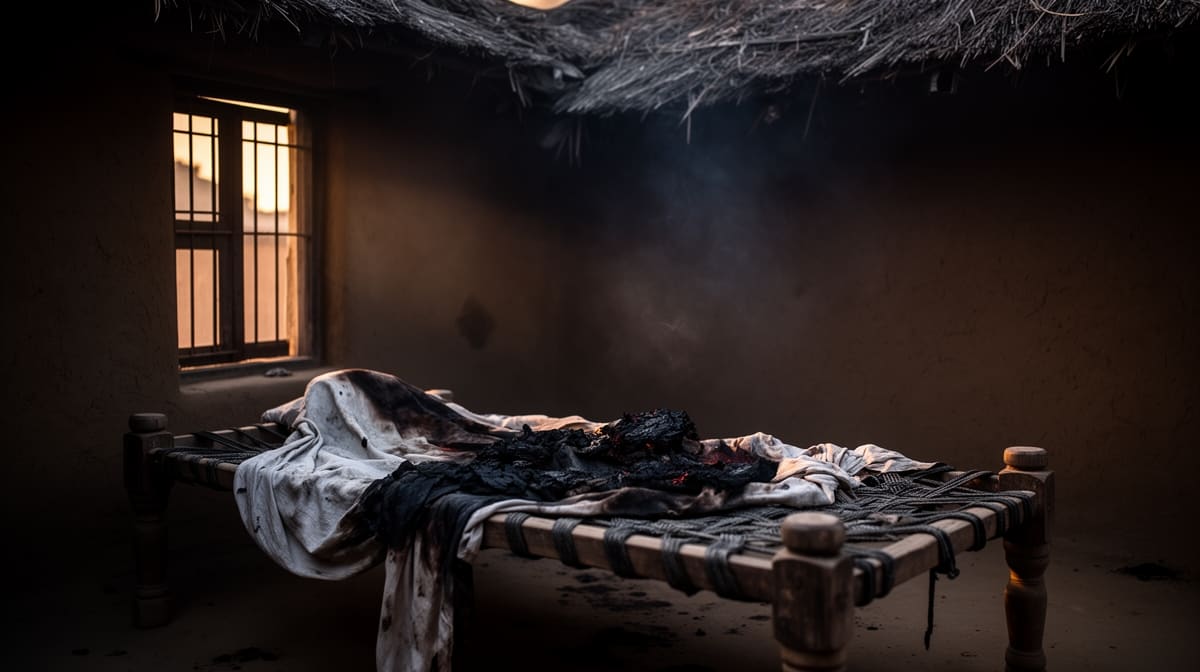
- Incident: On 29.02.1988, Munni Devi was burnt to death. The prosecution alleged that kerosene oil was poured on her by Chandra Bhan, his brother-in-law Jairam, and sister-in-law Sunita.
- Dying Declaration: Munni Devi, while in a critical condition, stated in her dying declaration (recorded on 29.02.1988) that Chandra Bhan, Jairam, and Sunita poured kerosene oil on her and set her ablaze at around 6:00 pm.
- Medical Evidence: Dr. P.K. Srivastava (PW-7) examined Munni Devi at 6:45 pm on 29.02.1988 and noted 90% burn injuries. Chandra Bhan was also examined and found to have 15% burn injuries.
Procedural History
- 29.02.1988: FIR lodged (Case Crime No. 101/1988) under Section 302 IPC and Section 3/4 Dowry Prohibition Act.
- 01.03.1988: Post-mortem conducted; Munni Devi declared dead at 5:10 am.
- 01.02.1989: Charges framed under Sections 498-A and 304-B IPC.
- 04.10.1989: Trial Court convicted Chandra Bhan and Jairam under Sections 304-B and 498-A IPC, sentencing them to life imprisonment and three years rigorous imprisonment, respectively.
- 16.10.2025: Appeal abated against Jairam (appellant no. 2) due to his death.
- 13.07.2026: Present judgment passed by the Allahabad High Court.
The Parties' Positions
- Appellant (Chandra Bhan): Denied all allegations, claiming he tried to save his wife and sustained burn injuries in the process. Argued that the prosecution failed to prove dowry demand or cruelty 'soon before death'.
- Respondent (State): Contended that the trial court's judgment was sound and that the prosecution had established cruelty and dowry demand beyond reasonable doubt.
Relief Sought
The appellant sought acquittal on all charges, arguing that the prosecution failed to prove the essential ingredients of Sections 304-B and 498-A IPC.
The Legal Issue
The central questions before the Court were:
- Whether the prosecution proved beyond reasonable doubt that the deceased was subjected to cruelty or harassment in connection with dowry demand as contemplated under Sections 498-A and 304-B IPC.
- Whether the prosecution proved its case against the appellant beyond reasonable doubt.
- Whether the appellant could be convicted under Section 302 IPC in the absence of a specific charge.
Arguments Presented
For the Appellant
- The prosecution failed to prove any specific instance of cruelty or harassment linked to dowry demand.
- The alleged demand of a Scooter or Rs. 10,000 was not corroborated by any documentary evidence (e.g., letters, complaints).
- The deceased's letter (Ext. Ka-1) and the testimony of PW-2 (mother of the deceased) suggested that the deceased was distressed due to her husband's illicit relationship with his sister-in-law, not dowry harassment.
- The prosecution did not establish a proximate and live link between the alleged dowry demand and the deceased's death, as required under Section 304-B IPC.
- No charge was framed under Section 302 IPC, and the appellant could not be convicted for a graver offence without trial.
For the Respondent
- The trial court had correctly appreciated the evidence and convicted the appellant based on the dying declaration and testimonies of PW-1 and PW-2.
- The deceased's dying declaration clearly implicated the appellant and co-accused in her murder.
- The prosecution had established cruelty and harassment for dowry demand, satisfying the ingredients of Sections 304-B and 498-A IPC.
The Court's Analysis
The Court conducted a meticulous examination of the evidence and legal principles:
1. Failure to Prove Cruelty or Harassment for Dowry Demand
The Court relied on the Supreme Court's decision in Karan Singh v. State of Haryana (2025 SCC OnLine 214) to emphasize the essential ingredients of Section 304-B IPC:
"The following are the essential ingredients of Section 304-B IPC: a) The death of a woman must have been caused by any burns or bodily injury, or must have occurred otherwise than under normal circumstances; b) The death must have been caused within seven years of her marriage; c) Soon before her death, she must have been subjected to cruelty or harassment by the husband or any relative of her husband; and d) Cruelty or harassment must be for, or in connection with, any demand for dowry."
The Court observed that the prosecution's case rested on general and vague allegations of dowry demand and harassment. PW-1 and PW-2 testified that the deceased informed them of the demand in October 1987, but:
- There was no specific instance of cruelty or harassment attributed to the appellant.
- The deceased's letter (Ext. Ka-1) made no mention of dowry demand but highlighted her distress over her husband's relationship with his sister-in-law.
- The alleged demand was not made 'soon before death', as the last complaint was in October 1987, while the death occurred on 01.03.1988.
The Court cited Satbir Singh v. State of Haryana ((2021) 6 SCC 1) to explain the phrase 'soon before death':
"The phrase 'soon before' as appearing in Section 304-B IPC cannot be construed to mean 'immediately before'. The prosecution must establish existence of 'proximate and live link' between the dowry death and cruelty or harassment for dowry demand by the husband or his relatives."
The Court concluded that the prosecution failed to prove this proximate and live link, as there was no evidence of harassment between October 1987 and 29.02.1988.
2. Dying Declaration and Conduct of the Appellant
The Court scrutinized the dying declaration (Ext. Ka-7), which stated:
"My sister-in-law (Jethani), Sunita, and brother-in-law (Jeth), Jairam, and Chandra Bhan poured five liters of kerosene oil on me and burnt me yesterday evening at around 6 pm. Chandra Bhan resides with his sister-in-law (Bhabhi) for 3 days and at his house for 1 day. My sister-in-law (Jethani) is a widow."
However, the Court noted:
- The dying declaration did not mention dowry demand or harassment for dowry.
- The deceased's letter (Ext. Ka-1) and PW-2's testimony suggested the deceased was distressed over her husband's illicit relationship with his sister-in-law.
- The appellant sustained burn injuries while allegedly trying to save the deceased, and took her to the hospital.
- The appellant did not flee and was present in the hospital when PW-1 arrived.
The Court held that the dying declaration was not free from doubt, especially in light of the appellant's conduct and injuries.
3. Absence of Charge Under Section 302 IPC
The Court observed that the trial court failed to frame a charge under Section 302 IPC, despite the dying declaration clearly indicating homicide. The Court relied on Shamnsaheb M. Multtani v. State of Karnataka ((2001) 2 SCC 577) to hold:
"Section 304-B IPC is vastly different from the formation of the offence of murder under Section 302 IPC and hence the former cannot be regarded as minor offence vis-à-vis the latter."
Since Section 302 IPC is a graver offence than Section 304-B IPC, the appellant could not be convicted under Section 302 IPC without a specific charge. The Court declined to remand the case for retrial due to the lapse of time (incident occurred in 1988).
4. Criticism of Investigation and Trial Court
The Court criticized the investigating officer for failing to submit a charge-sheet under Section 302 IPC despite the dying declaration indicating homicide. It also criticized the trial court for not framing an appropriate charge:
"It clearly reflects not only lack of knowledge on the part of Investigating Officer but also is indicative of his failure to perform statutory duties regarding fair investigation. Moreover, the then Presiding Officer of the learned trial Court was also required to be more careful while framing charges."
The Court directed that copies of the judgment be circulated among judicial officers to ensure proper framing of charges in dowry death cases.
The Verdict
The Court allowed the appeal and acquitted the surviving appellant, Chandra Bhan, of all charges. The impugned judgment dated 04.10.1989 was set aside, and the appellant was discharged from his bail bonds subject to compliance with Section 437-A CrPC.
What This Means For Similar Cases
1. Cruelty Must Be Proved 'Soon Before Death'
- The phrase 'soon before death' under Section 304-B IPC requires a proximate and live link between the cruelty/harassment and the death.
- General allegations of dowry demand or harassment are insufficient; the prosecution must prove specific instances of cruelty.
- The harassment must be contemporaneous with the death (e.g., within days or weeks, not months prior).
2. Dying Declaration Alone Is Not Conclusive
- A dying declaration must be corroborated by other evidence, especially when it is vague or inconsistent with other testimonies.
- The Court will scrutinize the circumstances under which the dying declaration was recorded (e.g., fitness of the victim, presence of accused).
- Conduct of the accused (e.g., sustaining injuries, taking the victim to hospital) can cast doubt on the veracity of the dying declaration.
3. Proper Framing of Charges Is Critical
- In dowry death cases where the dying declaration suggests homicide, the trial court must frame a charge under Section 302 IPC alongside Section 304-B IPC.
- Failure to frame appropriate charges can lead to acquittal, even if the evidence suggests a graver offence.
- Investigating officers must carefully analyze dying declarations and other evidence to ensure correct charges are filed.
4. Dowry Demand Must Be Corroborated
- Oral testimonies of relatives must be specific (e.g., dates, places, instances of cruelty).
- Documentary evidence (e.g., letters, complaints, legal notices) is crucial to corroborate allegations of dowry demand.
- Vague allegations without specific instances of cruelty or harassment will not satisfy the ingredients of Sections 304-B/498-A IPC.