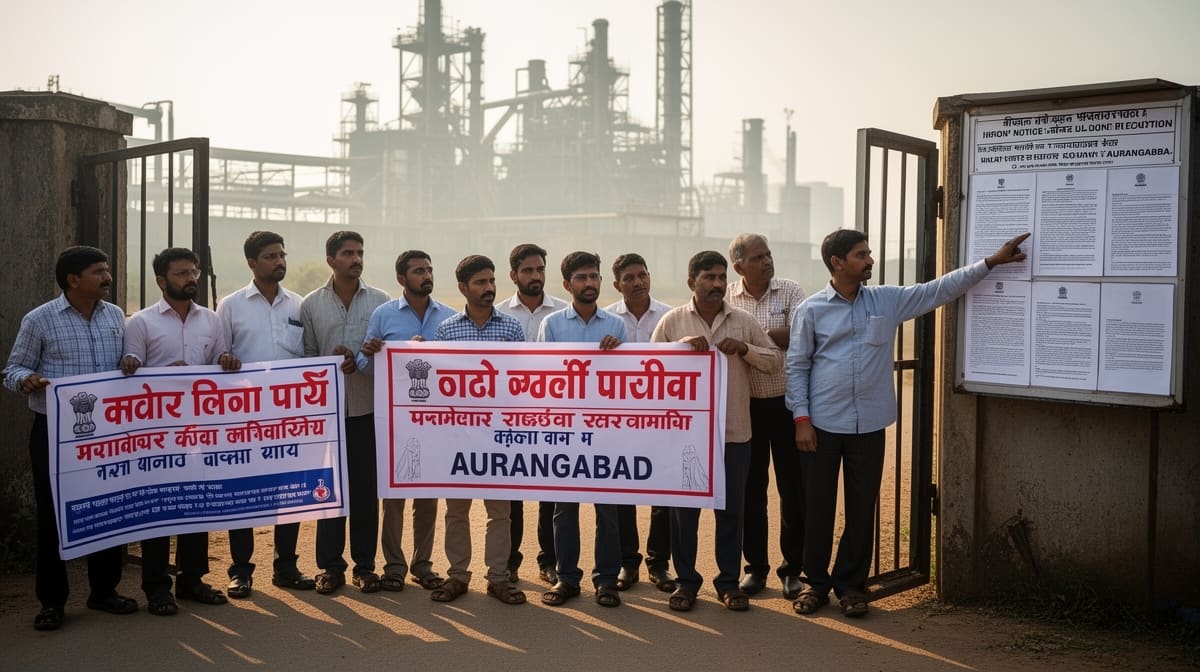
The Bombay High Court has clarified that a workman is not required to wait for a formal reference from the Deputy Commissioner of Labour to initiate proceedings under Section 2A(2) of the Industrial Disputes Act, 1947. The Court quashed a Labour Court order that dismissed a dispute on procedural grounds, reaffirming that the statutory scheme permits direct access to adjudication when pre-conditions are met.
Background & Facts
The Dispute
The petitioner, Vikas Shivaji Bhosale, was employed by Valmont Structure Pvt. Ltd. as a workman. He alleged that he was wrongfully discharged from service on 15.12.2021 without due process or valid reason. He contended that his termination violated principles of natural justice and was not in accordance with the terms of his employment.
Key Facts
- The petitioner submitted a written application for conciliation before the Conciliation Officer on 20.12.2021.
- No conciliation report was issued within the statutory period of 45 days.
- On 05.02.2022, the petitioner filed Reference (IDA) No. 1 of 2022 directly before the Labour Court, Pune, without any formal reference from the Deputy Commissioner of Labour.
- The Labour Court, on 28.04.2025, dismissed the reference on the ground that it was not routed through the Deputy Commissioner of Labour’s office.
- The Labour Court did not examine whether the petitioner had complied with Section 2A(2), nor did it consider the merits of the discharge claim.
- The petitioner was not given any opportunity to present evidence or argue the legality of his termination.
Procedural History
- 20.12.2021: Petitioner filed application for conciliation before the Conciliation Officer.
- 05.02.2022: Petitioner filed Reference (IDA) No. 1 of 2022 directly before the Labour Court, Pune.
- 28.04.2025: Labour Court dismissed the reference, holding that proceedings must originate through the Deputy Commissioner of Labour.
- 15.05.2025: Petitioner filed Writ Petition No. 15589 of 2025 before the Bombay High Court.
- 17.04.2026: Judgment delivered by the Bombay High Court.
Relief Sought
The petitioner sought quashing of the Labour Court’s order dated 28.04.2025, and a direction to the Labour Court to adjudicate the dispute on its merits, including determination of whether the termination was lawful, and if not, to award reinstatement with back wages and other consequential reliefs.
The Legal Issue
The central question was whether a workman must obtain a formal reference from the Deputy Commissioner of Labour to invoke the jurisdiction of the Labour Court under Section 2A(2) of the Industrial Disputes Act, 1947, or whether direct filing after expiry of 45 days from the conciliation application suffices.
Arguments Presented
For the Petitioner
The petitioner’s counsel argued that Section 2A(2) contains a non obstante clause that expressly permits a workman to approach the Labour Court directly after 45 days from the date of filing the conciliation application. Reliance was placed on the legislative intent to remove procedural barriers for individual workmen, citing Workmen of Meenakshi Mills v. Management of Meenakshi Mills and National Textile Workers’ Union v. P.R. Ramakrishnan. The petitioner had fulfilled all statutory pre-conditions and the Labour Court’s refusal to examine the merits was a denial of substantive justice.
For the Respondent
The respondent contended that the Labour Court was justified in rejecting the reference because the proceedings were not formally transmitted by the Deputy Commissioner of Labour, as per established administrative protocol. It was argued that direct filing created chaos in the system and that the Labour Court was entitled to insist on procedural regularity to maintain order.
The Court's Analysis
The Court examined the language and legislative history of Section 2A(2), which states: "Notwithstanding anything contained in Section 10, any workman who is aggrieved by an order of discharge, dismissal or termination may directly approach the Labour Court or Tribunal after the expiry of forty-five days from the date of making an application for conciliation."
"The non obstante clause is not a mere formality - it is the very foundation of the provision. It overrides any other procedural requirement, including the need for a formal reference by the appropriate Government."
The Court held that the Labour Court’s reliance on the absence of a referral from the Deputy Commissioner was legally untenable. The provision was enacted to ensure that individual workmen, who often lack resources and legal representation, are not delayed or denied justice due to bureaucratic inertia. The Court emphasized that the source of the filing is irrelevant if the statutory conditions under Section 2A(2) are satisfied.
The Court further noted that the Labour Court’s refusal to examine the merits of the dispute amounted to abdication of its statutory duty. The Court observed that the Labour Court’s role under Section 2A(2) is identical to that under Section 10 - it must adjudicate the dispute on facts and law, frame issues, and give both parties a full opportunity to be heard.
The Verdict
The writ petition was allowed. The Labour Court’s order dated 28.04.2025 was quashed and set aside. The matter was remanded to the Labour Court, Pune, to be treated as a reference under Section 10 of the Industrial Disputes Act, 1947. The parties were directed to appear before the Labour Court on 04.05.2026 at 11.00 a.m. The Labour Court was directed to decide the reference within one year from the date of appearance, after granting full opportunity of hearing to both parties.
What This Means For Similar Cases
Direct Access Is a Statutory Right, Not a Privilege
- Practitioners representing workmen may now file directly before the Labour Court after 45 days from conciliation application, without waiting for or relying on a formal reference.
- Any dismissal on grounds of "improper routing" or "lack of referral" is legally unsustainable under Section 2A(2).
Labour Courts Must Adjudicate on Merits
- Labour Courts cannot refuse to hear disputes on procedural technicalities when the statutory pre-condition is met.
- Failure to examine the facts of discharge, dismissal, or termination constitutes a violation of natural justice and statutory duty.
Procedural Compliance Must Not Override Substantive Justice
- The legislative intent behind Section 2A(2) is to provide a swift, accessible remedy to individual workmen.
- Courts must interpret this provision liberally, not restrictively, to ensure access to justice for vulnerable litigants.