The Allahabad High Court has reaffirmed the narrow scope of rectification under Section 254(2) of the Income Tax Act, holding that only errors patent on the face of the record - not those requiring argument or interpretation - can be corrected. This judgment reinforces procedural discipline in tax litigation and limits the use of review applications as a backdoor to reargue merits.
Background & Facts
The Dispute
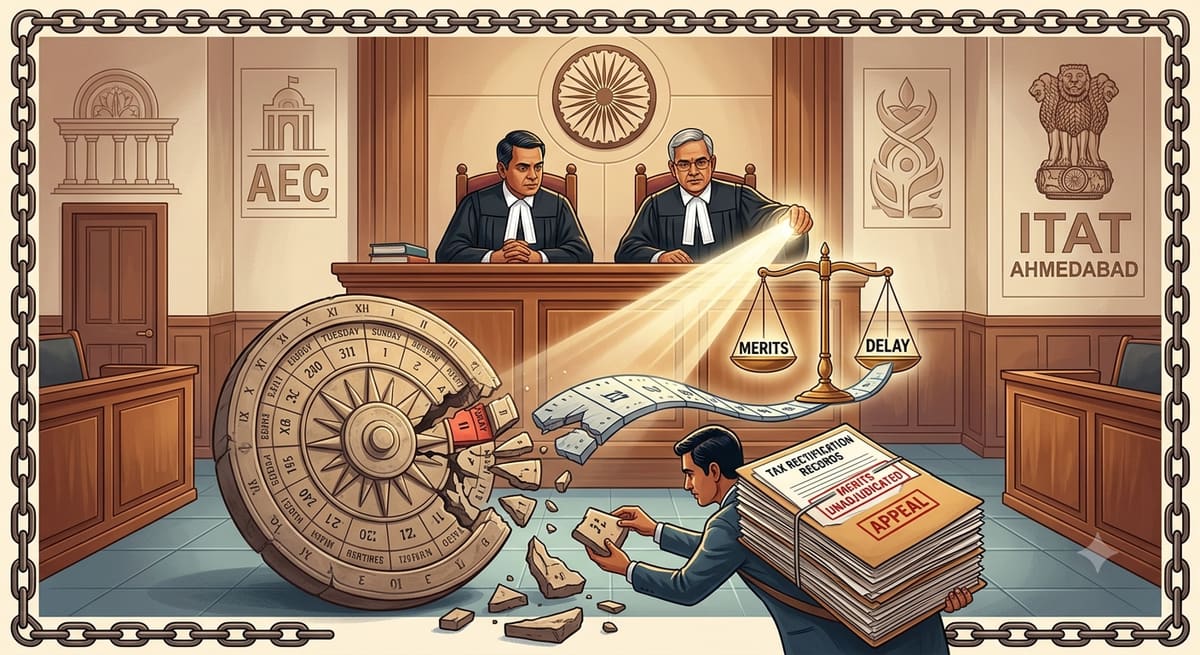
The appellant, Abusaad Ahmad, filed Income Tax Appeals before the Income Tax Appellate Tribunal (ITAT) under Section 253(1)(a) of the Income Tax Act, 1961, challenging orders of the Commissioner of Income Tax (Appeals). The appeals were filed 867 days after the statutory deadline prescribed under Section 253(3). The appellant sought condonation of delay, claiming that the order of the Commissioner (Appeals) was received by his driver, who inadvertently kept it in the garage and failed to inform him. The delay was only discovered during the assessment of a subsequent financial year.
Key Facts
- The appellant received the order of the Commissioner (Appeals) on 15.04.2016
- The statutory period for filing appeal expired on 15.07.2016
- The appeals were filed on 15.01.2018 - 867 days late
- The appellant filed applications for condonation of delay, supported by an affidavit from his driver
- The driver’s affidavit stated he received the order but did not hand it over due to negligence
- No independent evidence (e.g., email, receipt, witness testimony) was produced to corroborate the driver’s affidavit
- The Tribunal dismissed the appeals on limitation grounds on 03.07.2024
- The appellant filed review applications under Section 254(2) on 15.08.2024, alleging the Tribunal failed to consider the driver’s affidavit and misapplied Mehta Parikh & Co. v. CIT
- The Tribunal dismissed the review applications on 30.10.2025, holding no mistake apparent on record
- The appellant filed two appeals under Section 260A before the High Court on 20.11.2025
Procedural History
- 15.04.2016: Order of Commissioner (Appeals) received by appellant’s driver
- 15.07.2016: Deadline for filing appeal under Section 253(3)
- 15.01.2018: Appeals filed before ITAT (ITA Nos. 365 & 366/LKW/2018)
- 15.01.2018: Applications for condonation of delay filed with appeals
- 03.07.2024: ITAT dismissed appeals on ground of limitation; held delay unexplained and affidavit uncorroborated
- 15.08.2024: Review applications (Misc. Apps. 16 & 17/LKW/2024) filed under Section 254(2)
- 30.10.2025: ITAT dismissed review applications, finding no mistake apparent on record
- 20.11.2025: Appeals filed before Allahabad High Court under Section 260A (ITA Nos. 11 & 12 of 2026)
- 23.04.2026: Arguments heard at admission stage
- 06.05.2026: Judgment delivered
The Parties' Positions
For the Appellant
- Argued that the Tribunal’s failure to consider the driver’s affidavit constituted a mistake apparent on record
- Contended that the Tribunal should have summoned or cross-examined the driver under Section 131 read with Section 255(6)
- Relied on Mehta Parikh & Co. v. CIT (1956) 2 SCC 100 to assert that affidavits must be accepted unless rebutted by cross-examination
- Claimed that non-application of precedent and procedural lapse amounted to a rectifiable error
For the Respondent
- Argued that the appeals under Section 260A were improperly filed against the review order, not the main order
- Stated that the appellant was attempting to reargue merits under the guise of rectification
- Maintained that the Tribunal’s rejection of the affidavit was a factual assessment, not an apparent error
- Emphasized that Section 254(2) does not permit re-litigation of debatable legal or factual issues
Relief Sought
The appellant sought: (1) setting aside of the Tribunal’s order dated 30.10.2025; (2) remand of the review applications for reconsideration; (3) condonation of the 867-day delay; and (4) restoration of the appeals for adjudication on merits.
The Legal Issue
The central question was whether the Tribunal’s failure to consider the driver’s affidavit and its non-application of Mehta Parikh & Co. constituted a mistake apparent on the record under Section 254(2) of the Income Tax Act, warranting rectification.
Arguments Presented
For the Appellant
The appellant’s counsel contended that the Tribunal’s dismissal of the review applications was legally flawed because it ignored a sworn affidavit that, under Mehta Parikh & Co., could not be rejected without cross-examination. He argued that the Tribunal’s failure to apply this binding precedent and its refusal to summon the deponent amounted to a procedural error apparent on the record. He further asserted that the Tribunal’s non-exercise of powers under Section 131 r/w Section 255(6) - which permit discovery and inspection - constituted a jurisdictional oversight, rendering the order defective and rectifiable.
For the Respondent
The respondent’s counsel countered that Section 254(2) permits rectification only for patent, self-evident errors - not for disagreements over factual appreciation or legal interpretation. He emphasized that the Tribunal had thoroughly examined the delay condonation application and found the explanation implausible due to lack of corroboration. The affidavit’s rejection was not a mistake but a reasoned conclusion. He also noted that the appellant had not challenged the main order dismissing the appeals on limitation, making the present appeals an impermissible attempt to circumvent the limitation bar.
The Court's Analysis
The Court undertook a detailed examination of Section 254(2), emphasizing that the term "mistake apparent on the record" is not synonymous with any error. The Court held that for a mistake to be rectifiable, it must be patent, obvious, and incapable of debate. The Court cited Master Construction Co. v. State of Orissa and Satyanarayan Laxminarayan Hegde v. Mallikarjun Bhavanappa Tirumale to affirm that errors requiring elaborate argument or legal interpretation fall outside the scope of rectification.
"An error which is apparent on the face of the record should be one which is not an error which depends for its discovery on elaborate arguments on questions of fact or law."
The Court observed that the Tribunal’s rejection of the driver’s affidavit was not a mechanical oversight but a reasoned determination based on the absence of corroboration. The failure to summon the driver was not a jurisdictional error but a discretionary procedural choice, which does not constitute an apparent mistake. The Court further held that the applicability of Mehta Parikh & Co. was a debatable point of law, dependent on factual context, and thus not a mistake apparent on record.
The Court also relied on Ras Bihari Bansal v. CIT to reinforce that failure to consider an argument, even if erroneous, is an error of judgment - not a rectifiable mistake. The Court concluded that the appellant was attempting to use Section 254(2) as a substitute for an appeal, which is impermissible.
Additionally, the Court noted that under Section 260A, the High Court’s jurisdiction is limited to substantial questions of law. Since the Tribunal’s findings were based on cogent evidence and no perversity or legal error was demonstrated, no substantial question of law arose.
The Verdict
The appeals were dismissed. The High Court upheld the Tribunal’s order dated 30.10.2025 dismissing the review applications under Section 254(2). The Court held that the delay of 867 days was not condoned, the driver’s affidavit was rightly not accepted without corroboration, and no mistake apparent on record existed. There shall be no order as to costs.
What This Means For Similar Cases
Rectification Is Not a Second Appeal
- Practitioners must understand that Section 254(2) is not a vehicle to reargue merits or challenge factual findings
- Any attempt to use review applications to circumvent limitation bars will be rejected
- Appeals against review orders under Section 260A are maintainable only if a substantial question of law is framed and established
Affidavits Alone Are Insufficient for Delay Condonation
- Sworn affidavits from employees or agents, without independent corroboration, are unlikely to satisfy the "sufficient cause" standard under Section 253(3)
- Tribunals are entitled to reject such affidavits if they appear self-serving or unverified
- Practitioners must proactively secure documentary evidence (e.g., postal receipts, email trails, third-party attestations) to support delay condonation claims
Precedents Cannot Be Applied by Implication
- Courts will not treat a precedent as binding on facts it does not directly address
- The applicability of Mehta Parikh & Co. or similar rulings must be argued contextually - not assumed
- A failure to cite or apply a precedent is not a mistake apparent on record unless the precedent is directly on point and ignored