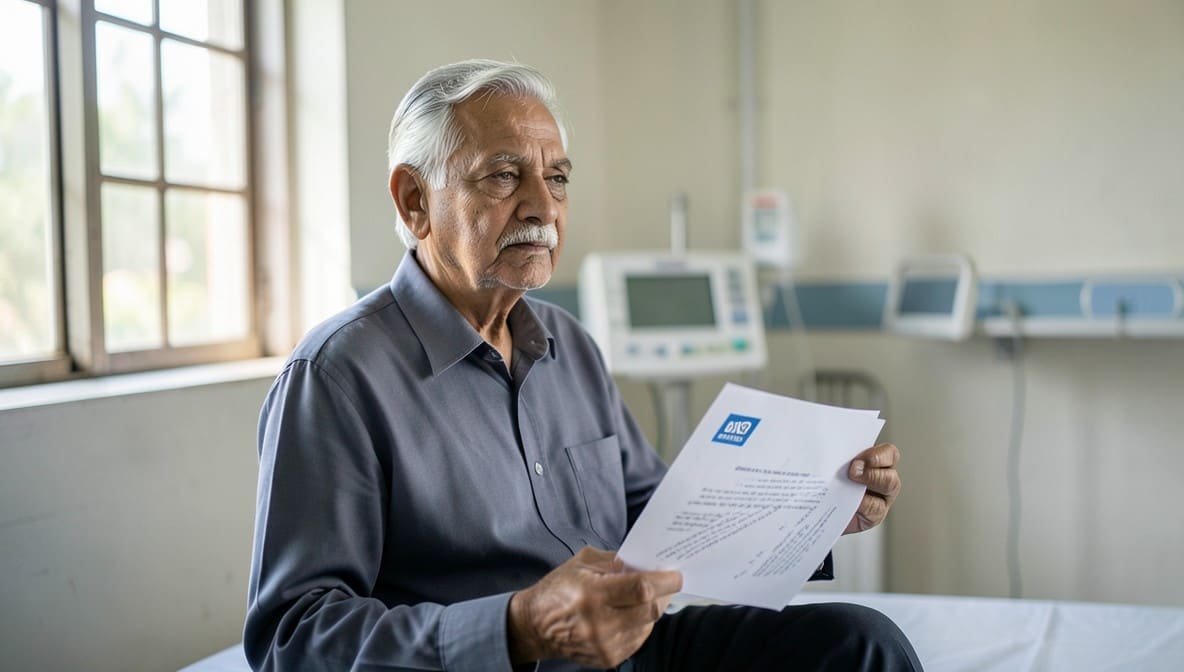
The Income Tax Appellate Tribunal, Ahmedabad, has reaffirmed that procedural technicalities must not override substantive justice, particularly when taxpayers are incapacitated by severe medical conditions. In a series of consolidated appeals spanning four assessment years, the Tribunal set aside orders passed ex parte due to non-appearance and restored the matters for fresh adjudication, emphasizing that the right to be heard is fundamental even in tax proceedings.
Background & Facts
The Dispute
The appellant, Hajimohmadsafi Abdulrehman Shaikh, an individual engaged in real estate development, faced substantial additions to his income across Assessment Years (A.Y.) 2012-13 to 2015-16. The Assessing Officer (AO) made aggregate additions of over Rs. 1.42 crore on grounds of alleged bogus purchases, unexplained credits under Section 68, and unverified liabilities. Penalty proceedings under Section 271(1)(c) were also initiated. The appellant failed to respond to notices during assessment and appellate stages, leading to adverse orders being passed ex parte by the Commissioner of Income Tax (Appeals) [CIT(A)].
Key Facts
- The appellant is a senior citizen aged approximately 63 years during the relevant period.
- He suffered from multiple life-threatening medical conditions between 2016 and 2022, including:
- Chronic spinal ailments requiring multiple surgeries
- A heart attack requiring angioplasty and stent placement
- Severe COVID-19 infection with lung damage requiring ventilator support
- Prolonged hospitalizations and continuous medical treatment
- He was entirely dependent on his Chartered Accountant for tax compliance, who failed to inform him of appellate orders or file appeals within time.
- The appellant only became aware of the missed appeals upon receiving a recovery notice dated 24.09.2025.
- He immediately engaged a new Chartered Accountant and filed appeals with applications for condonation of delay.
- Medical certificates and affidavits from treating physicians and his CA were submitted to substantiate his incapacity.
- The delays in filing appeals were substantial:
- A.Y. 2013-14 (penalty appeal): 2074 days
- A.Y. 2014-15: 460 days
- A.Y. 2015-16: 461 days
- A.Y. 2012-13: Appeal filed within time but dismissed on non-prosecution grounds
Procedural History
- 31.03.2015: Assessment completed under Section 143(3) for A.Y. 2012-13 with additions.
- 2016 - 2022: Appellant incapacitated due to medical conditions.
- 2017 - 2020: CIT(A) passed orders dismissing appeals for non-response and non-prosecution.
- 17.09.2025 & 11.06.2024: CIT(A) orders issued for A.Y. 2012-13, 2014-15, and 2015-16.
- 30.01.2020: CIT(A) order issued for A.Y. 2013-14.
- 24.09.2025: Recovery notice received by appellant, triggering awareness of missed appeals.
- 26.03.2026: Hearing before ITAT Ahmedabad.
- 27.03.2026: Judgment pronounced.
The Parties' Positions
For the Appellant
- Argued that non-appearance before lower authorities was due to genuine medical incapacity, not negligence.
- Submitted medical records, affidavits, and CA’s affidavit to prove inability to manage affairs.
- Relied on Collector, Land Acquisition v. Mst. Katiji and Sangram Singh v. Election Tribunal to argue for liberal condonation of delay.
- Requested restoration of appeals for adjudication on merits.
- Contended that penalty proceedings were premature and based on quantum additions still under dispute.
For the Respondent
- Relied on the CIT(A)’s findings that the appellant failed to respond to notices and did not prosecute the appeals.
- Argued that the delays were excessive and could not be condoned without proof of due diligence.
- Maintained that the additions and penalties were justified based on available evidence.
Relief Sought
The appellant sought:
- Condonation of delay in filing appeals for all four assessment years.
- Setting aside of ex parte orders passed by CIT(A).
- Restoration of appeals to the file of the Assessing Officer or CIT(A) for de novo adjudication.
- Cancellation of penalty orders under Section 271(1)(c) pending adjudication of quantum issues.
- Waiver of costs or, at minimum, reduction in penalty.
The Legal Issue
Can a taxpayer’s prolonged medical incapacity, supported by credible evidence, constitute sufficient cause to condone significant delays in filing tax appeals, and does such hardship justify restoring the matter for adjudication on merits despite prior non-prosecution?
Arguments Presented
For the Appellant
The appellant’s counsel relied on Collector, Land Acquisition v. Mst. Katiji & Others (1987) 167 ITR 471 (SC), which mandates a liberal approach to condonation of delay where substantial justice is at stake. The counsel emphasized that the appellant’s medical conditions - spinal surgeries, cardiac arrest, and severe COVID-19 - rendered him physically and mentally incapable of managing legal affairs. The failure of the Chartered Accountant to act was cited as a valid ground under Concord of India Insurance Co. Ltd. v. Nirmala Devi (1979) 118 ITR 507 (SC). The counsel argued that the appellant acted promptly upon discovering the lapse, demonstrating no mala fide intent. The quantum appeals were pending, and penalties could not be sustained independently.
For the Respondent
The Department relied on the CIT(A)’s findings that the appellant had been given multiple opportunities to file submissions and failed to do so. It contended that the delays - ranging from 460 to over 2000 days - were excessive and that the appellant’s reliance on his CA did not absolve him of responsibility. The Department argued that the principle of res judicata and finality of tax proceedings should prevail over equitable considerations.
The Court's Analysis
The Tribunal examined the nature of the delay, the genuineness of the cause, and the principles of natural justice under the Income Tax Act. It noted that while the delays were substantial, the length alone is not decisive. The Tribunal emphasized that procedural laws exist to serve justice, not defeat it, citing Sangram Singh v. Election Tribunal (AIR 1955 SC 425).
"The Hon'ble Supreme Court in Collector, Land Acquisition v. Mst. Katiji & Others has held that substantial justice should prevail over technical considerations and a liberal approach should be adopted where sufficient cause is shown."
The Tribunal accepted the medical affidavits as credible and corroborated by the timeline of hospitalizations and surgeries. It held that the appellant’s dependence on his CA, coupled with the CA’s failure to act, was not attributable to the appellant’s negligence. The Tribunal distinguished this from cases of mere indifference or procrastination.
Regarding the ex parte dismissal of the A.Y. 2012-13 appeal, the Tribunal held that the appellant’s medical condition constituted reasonable cause for non-appearance, and denying a hearing would amount to a miscarriage of justice. The Tribunal further observed that the penalty proceedings under Section 271(1)(c) were premature, as they were based on quantum additions still under dispute.
The Tribunal concluded that the interests of justice required restoration of all appeals for fresh adjudication, with the Assessing Officer and CIT(A) providing a fair opportunity to the appellant to substantiate his claims.
The Verdict
The appellant succeeded on all fronts. The Tribunal:
- Condoned the delay of 2074 days for A.Y. 2013-14 (penalty appeal), 460 days for A.Y. 2014-15, and 461 days for A.Y. 2015-16.
- Set aside the ex parte orders of the CIT(A) for all four assessment years.
- Restored the appeals to the file of the Assessing Officer (for A.Y. 2012-13, 2014-15, 2015-16) and CIT(A) (for A.Y. 2013-14 penalty) for de novo adjudication.
- Directed the appellant to deposit costs of Rs. 10,000 for A.Y. 2012-13 and Rs. 5,000 each for A.Y. 2013-14, 2014-15, and 2015-16 with the Prime Minister’s Relief Fund.
- Ordered that the appellant shall not seek unnecessary adjournments and must diligently participate in the fresh proceedings.
- Held that penalty proceedings under Section 271(1)(c) shall be adjudicated only after final determination of quantum additions.
What This Means For Similar Cases
Medical Hardship Can Justify Condonation of Delay
- Practitioners must now proactively submit detailed medical records, hospital discharge summaries, and affidavits from treating physicians when seeking condonation of delay.
- A mere assertion of illness is insufficient; corroboration through official medical documentation is critical.
- Delays exceeding 1000 days are not automatically fatal if the cause is medically verifiable and non-negligent.
Restoration Over Dismissal Is the New Norm in Tax Appeals
- Tribunals are increasingly prioritizing adjudication on merits over technical dismissal, especially where the taxpayer is vulnerable.
- Ex parte orders based on non-appearance will be set aside if the appellant demonstrates a credible, non-negligent reason for default.
- The burden shifts to the Department to prove mala fide intent or gross negligence, not merely non-compliance.
Penalty Proceedings Must Await Final Quantum Determination
- Penalty under Section 271(1)(c) cannot be imposed independently when the underlying addition is under appeal.
- Practitioners should immediately challenge penalty orders if quantum appeals are pending, citing ITAT Ahmedabad as binding precedent.
- The Tribunal’s directive to defer penalty adjudication until quantum issues are resolved sets a clear procedural safeguard.